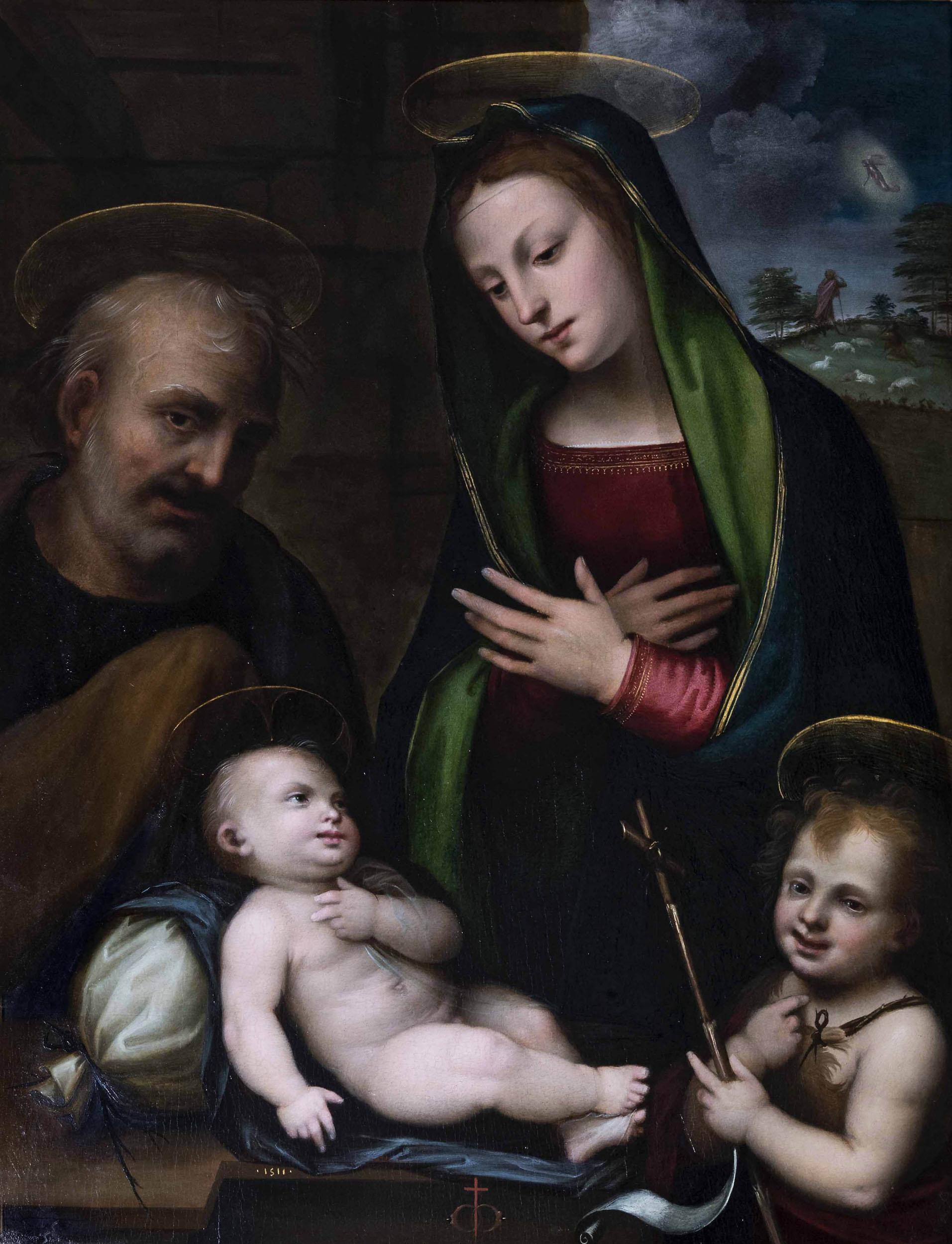
Sacra Famiglia con san Giovannino
1511
Mariotto Albertinelli
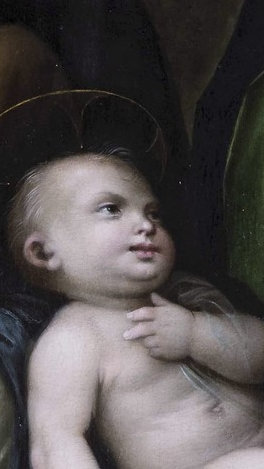
This face appears in a Holy Family painting by Albertinelli which is surprisingly dark. Within this darkness, though, the tender expression on the face Mary stands out, highlighting her devout and caring nature. This strange baby Jesus clearly has not had enough vitamin D in the last few days, as he more resembles a newly-born vampire than the son of god. The depiction does make the viewer wonder about the nature of God whether God appreciates garlic and silver bullets.
Mariotto Albertinelli (1474–1515) was a Florentine painter closely linked to Fra Bartolomeo, sharing with him a commitment to clear drawing, balanced composition, and the serene, harmonious idiom that defined the mature Quattrocento on the eve of the High Renaissance; trained within the same milieu and often collaborating with Bartolomeo, he developed a style marked by calm, idealized figures, luminous color, and carefully ordered spatial structures, visible in works such as the *Visitation*—one of his most celebrated paintings for its poised geometry and gentle emotional clarity. Although his temperament and career were more irregular than his partner’s, Albertinelli’s best works embody the polished, devotional elegance of late fifteenth‑century Florence and contribute to the transition toward the more monumental, unified language that would soon dominate the city’s artistic production.
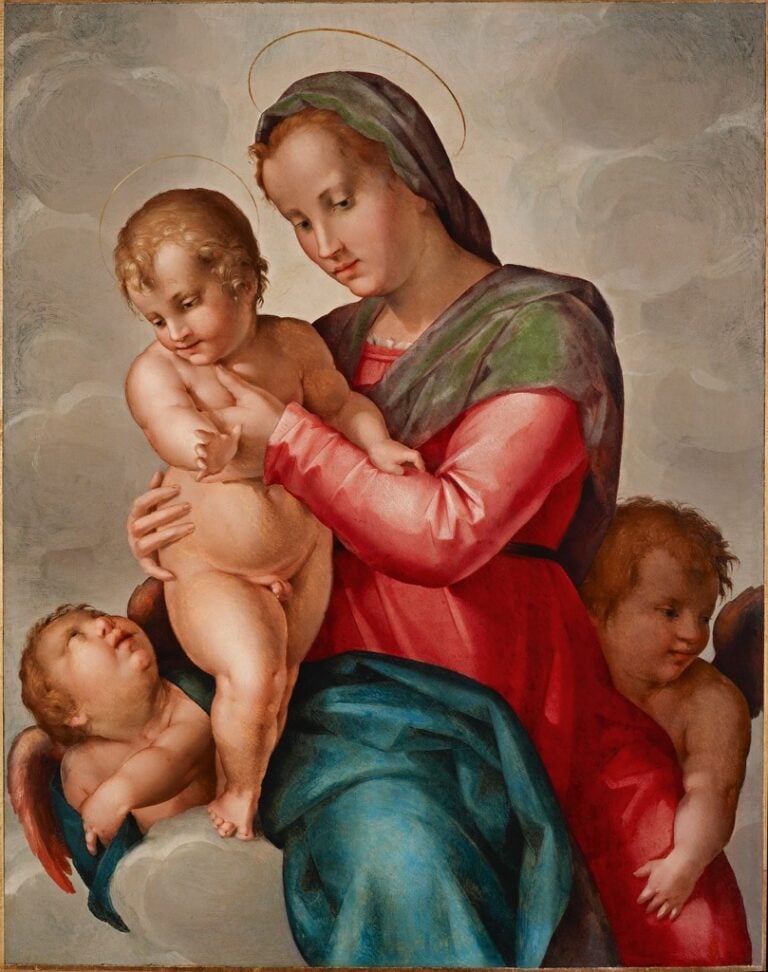
Madonna and Child with Two Angels
c. 1530
Pier Francesco di Jacopo Foschi
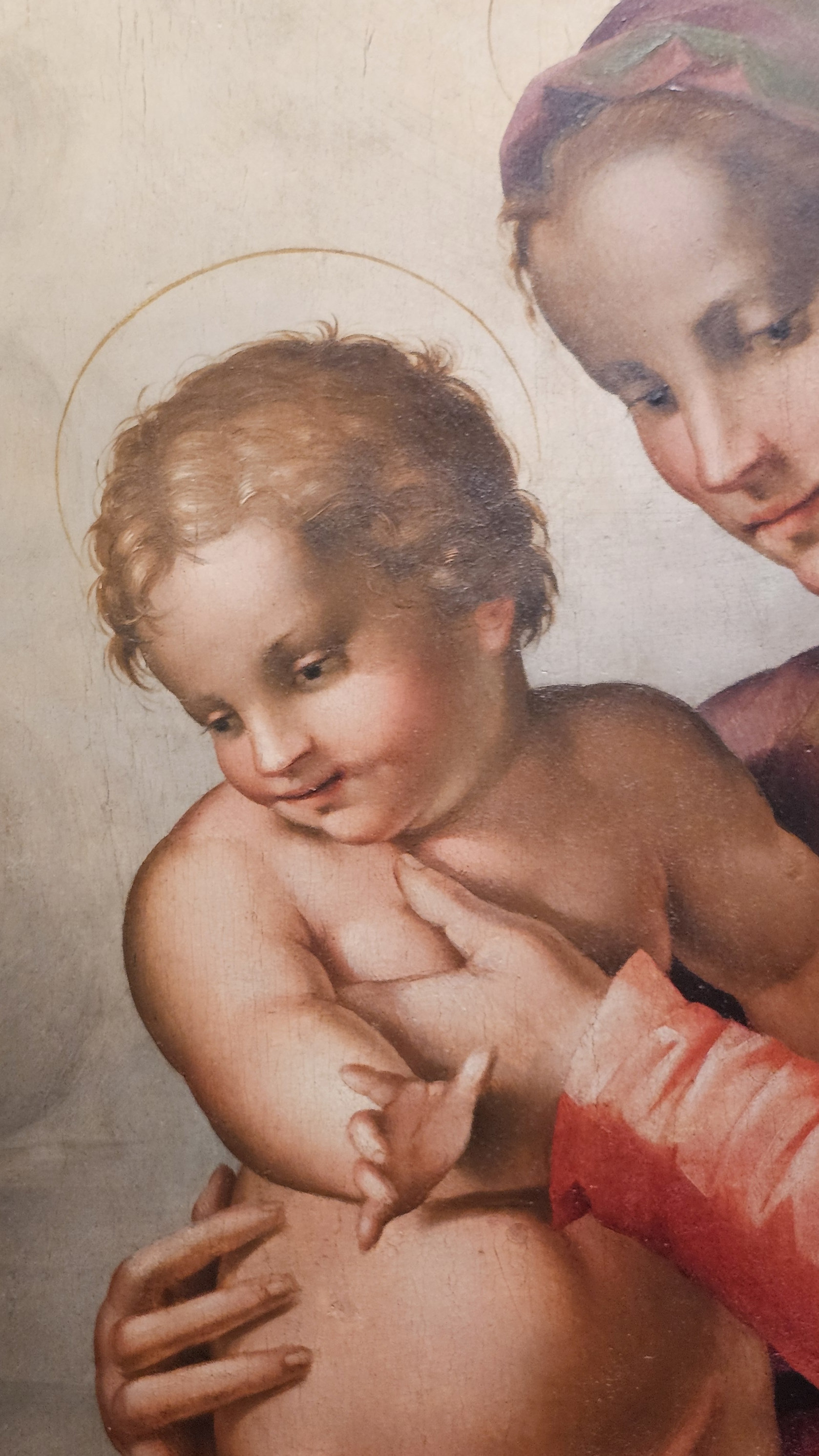
This face appears in an oil on wood composition by Pier Francesco Foschi. However, it is very clearly based on previous work by Andrea del Sarto. Especially the strange baby Jesus face stands out, which was esentially copied from 'Child with the Young St. John the Baptist, hanging in Vienna. In the modelling of the figures, we can also see a clear influence of Botticelli's elegance and grace. Still one wonders, whether or not the facial expression of this strange baby Jesusm really shows grace. Mary seems unimpressed, but Jesus has something in mind. Oh ... just you wait!
Pier Francesco di Jacopo Foschi (c. 1502–1567) was a Florentine painter shaped by the refined, courtly elegance of mid‑sixteenth‑century Mannerism, producing portraits, altarpieces, and domestic devotional works marked by clear contours, polished surfaces, and a poised, almost ceremonious figural presence; trained in the orbit of Andrea del Sarto and active among Florence’s patrician families, he developed a style that balances gentle idealization with meticulous attention to costume, gesture, and decorative detail, making his portraits—often distinguished by their calm symmetry and subtle psychological reserve—particularly representative of the city’s cultivated visual culture under Cosimo I de’ Medici.
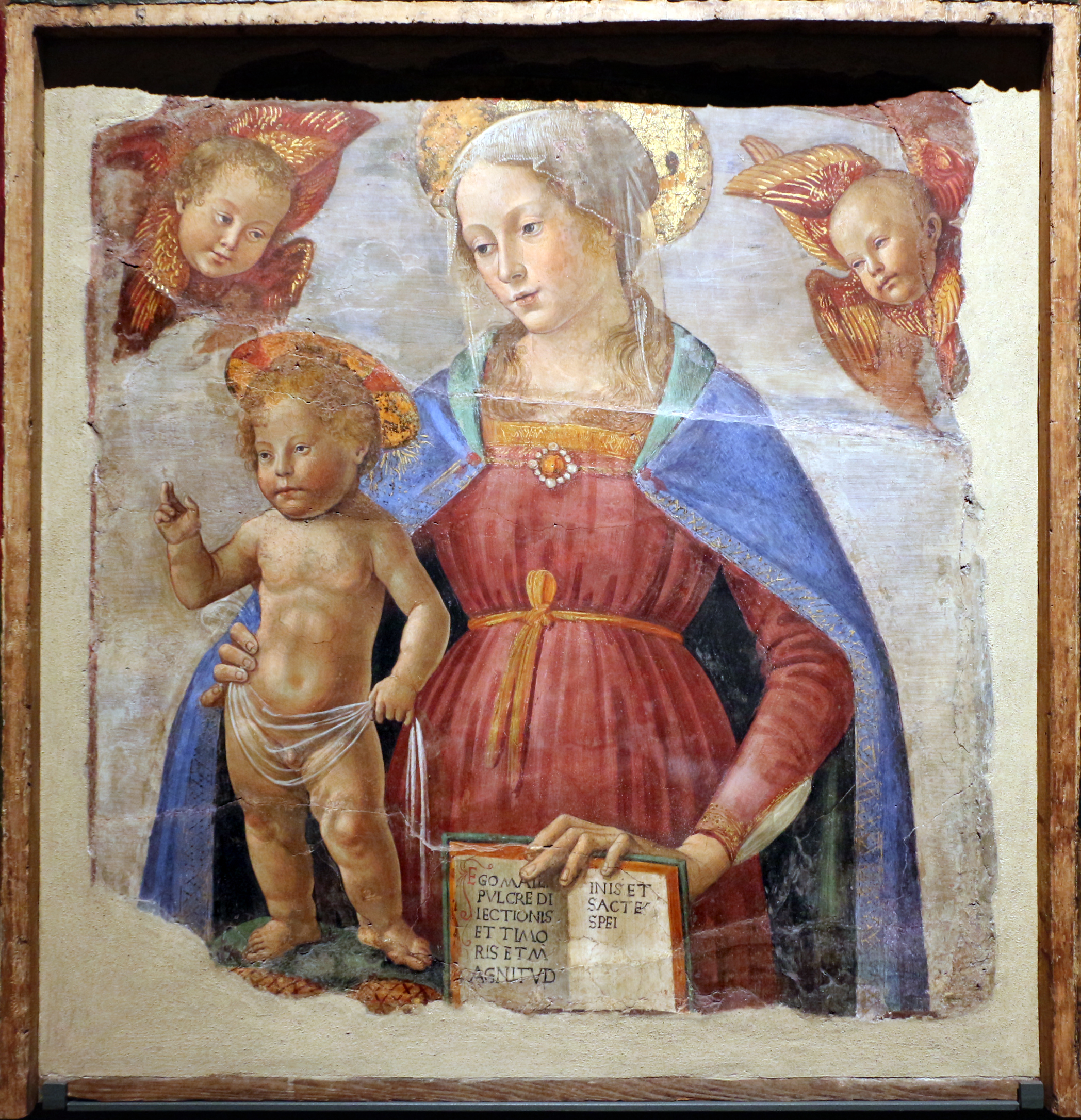
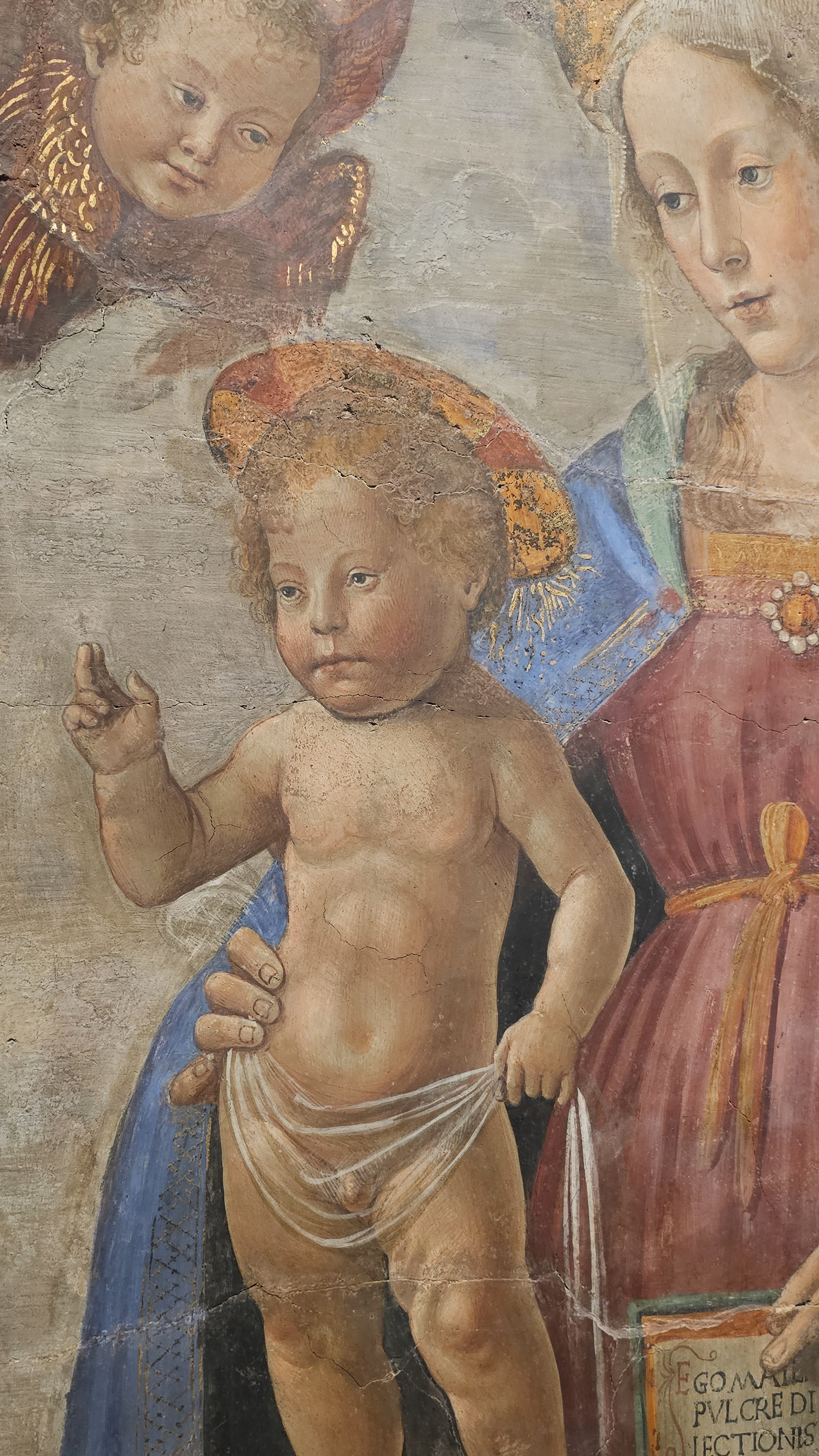
Madonna and Child with Two Seraphim
Second half of 15th century
Circle of Domenico Ghirlandaio
This face appears in a fresco from the workshop of Domenico Ghirlandaio. It comes from the church of the Orbatello Hospice. Madonna holds open a book that reads "Ego mater pulchrae dilectionis, et timoris, et agnitionis, et sanctae spei", which in turn means: "I am the mother of beautiful love, and of fear, and of knowledge, and of holy hope.". Much like the future popstar, this Madonna therefore seems to have plenty of confidence. This baby Jesus is alright with it, though. He is looking in another direction, perhaps as if he's addressing a crowd of admirers. Perhaps he is just practicing, but he's getting good. And he knows it.
The Circle of Domenico Ghirlandaio refers to the group of painters and assistants working in and around Ghirlandaio’s prolific Florentine workshop in the late fifteenth century, producing frescoes, altarpieces, and domestic devotional panels that reflect his hallmark qualities of clear drawing, balanced compositions, and bright, harmonious color; artists in this circle—responsible for large collaborative projects such as those in Santa Maria Novella and other Florentine churches—maintained a disciplined, narrative‑driven style rooted in orderly spatial construction and calm, readable figural interaction, ensuring the workshop’s steady output and helping to define the polished, accessible visual language that shaped mainstream Florentine painting on the eve of the High Renaissance.
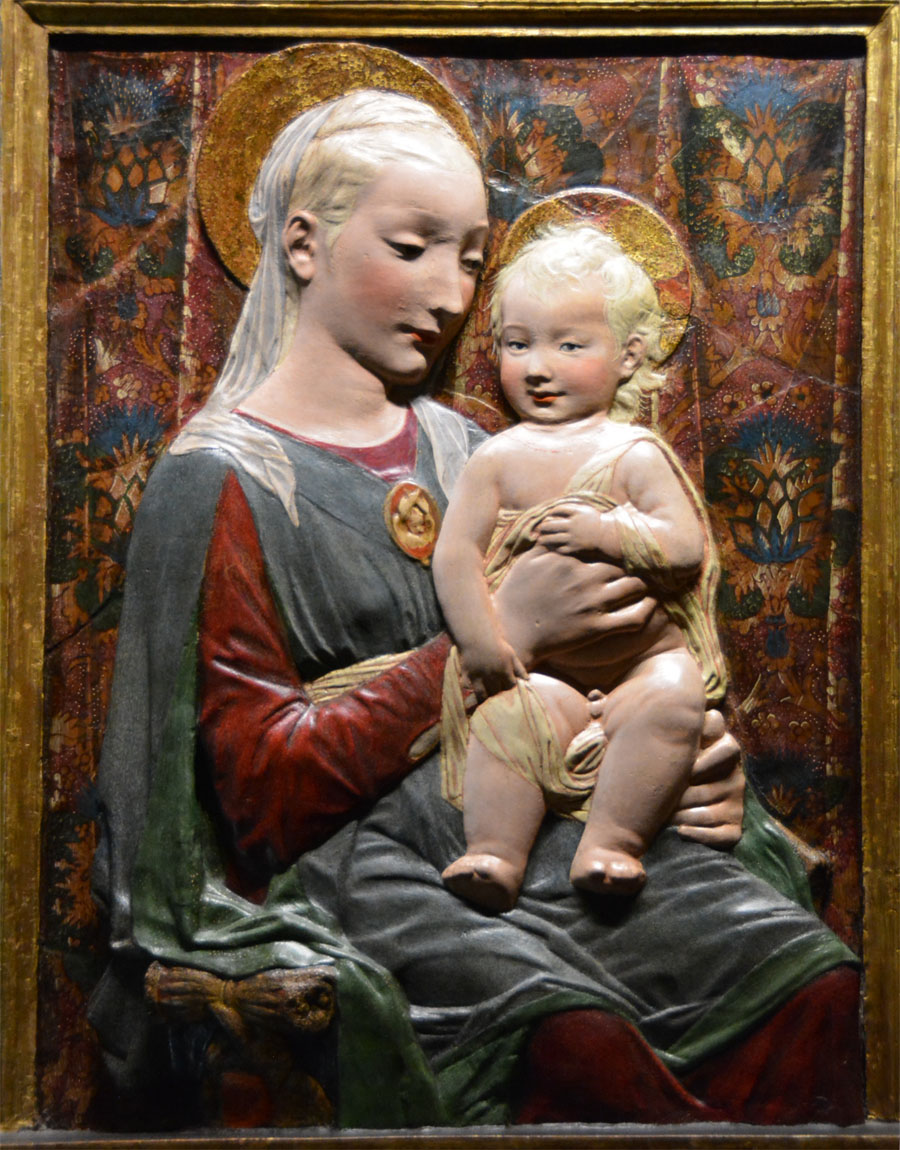
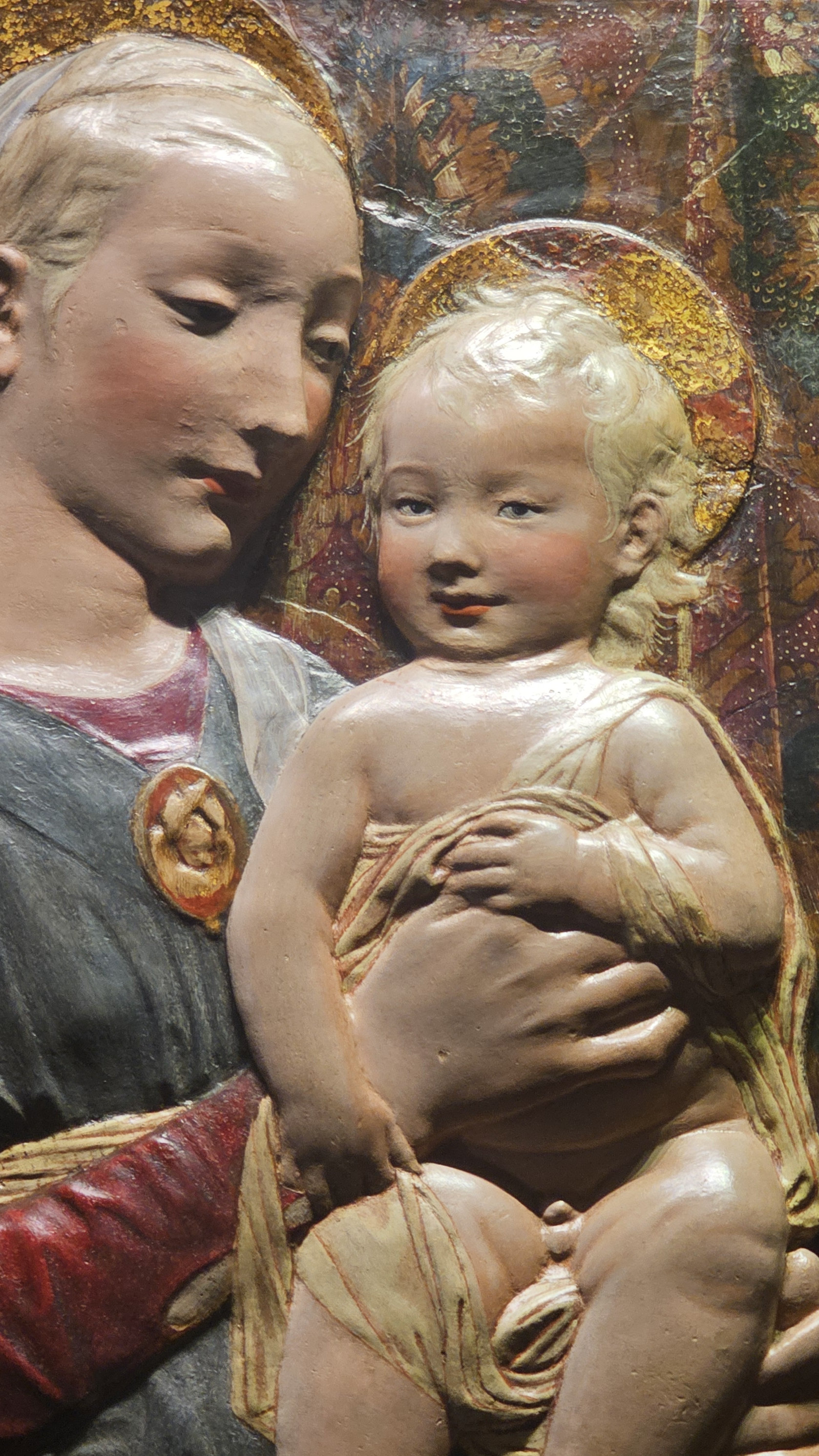
Madonna and Child
1462-1463
Maestro della Nativita di Castello (after Antonio Rossellino)
This face appears in a polychromed and gilded stucco relief with an outstanding three-dimensional quality. The work is a replica of a widely celebrated Madonna schema in the 15th century and many other replicas exist. It is attributed to Antonio Rossellino and was most likely aimed for private devotion in a merchant or noble family home. Among all other replicas, though, this version stands out to give us the most soft and almost female strange baby Jesus face, with a michievous (I had to look up how to spell that word) smile. 'Come over here ... ', he seems to tell us, '... and I'll tell you a funny story'.
Maestro della Natività di Castello, an anonymous Florentine painter active in the later fifteenth century and stylistically close to Antonio Rossellino’s circle. He was a good friend of another anonymous painter, called 'Unknown'. He produced small devotional panels marked by gentle modeling, clear contours, and a soft, tender emotional tone that reflects the fusion of sculptural sensitivity with the pictorial idiom of mid‑Quattrocento Florence; his works—often centered on the Nativity or intimate Marian themes—show careful attention to delicate facial expressions, balanced compositions, and a refined decorative touch, embodying the graceful, quietly devotional aesthetic associated with Rossellino’s milieu and contributing to the broader tradition of polished, domestic religious imagery in fifteenth‑century Florence.
Madonna and Child with Saints
1472-1473
Neri di Bicci
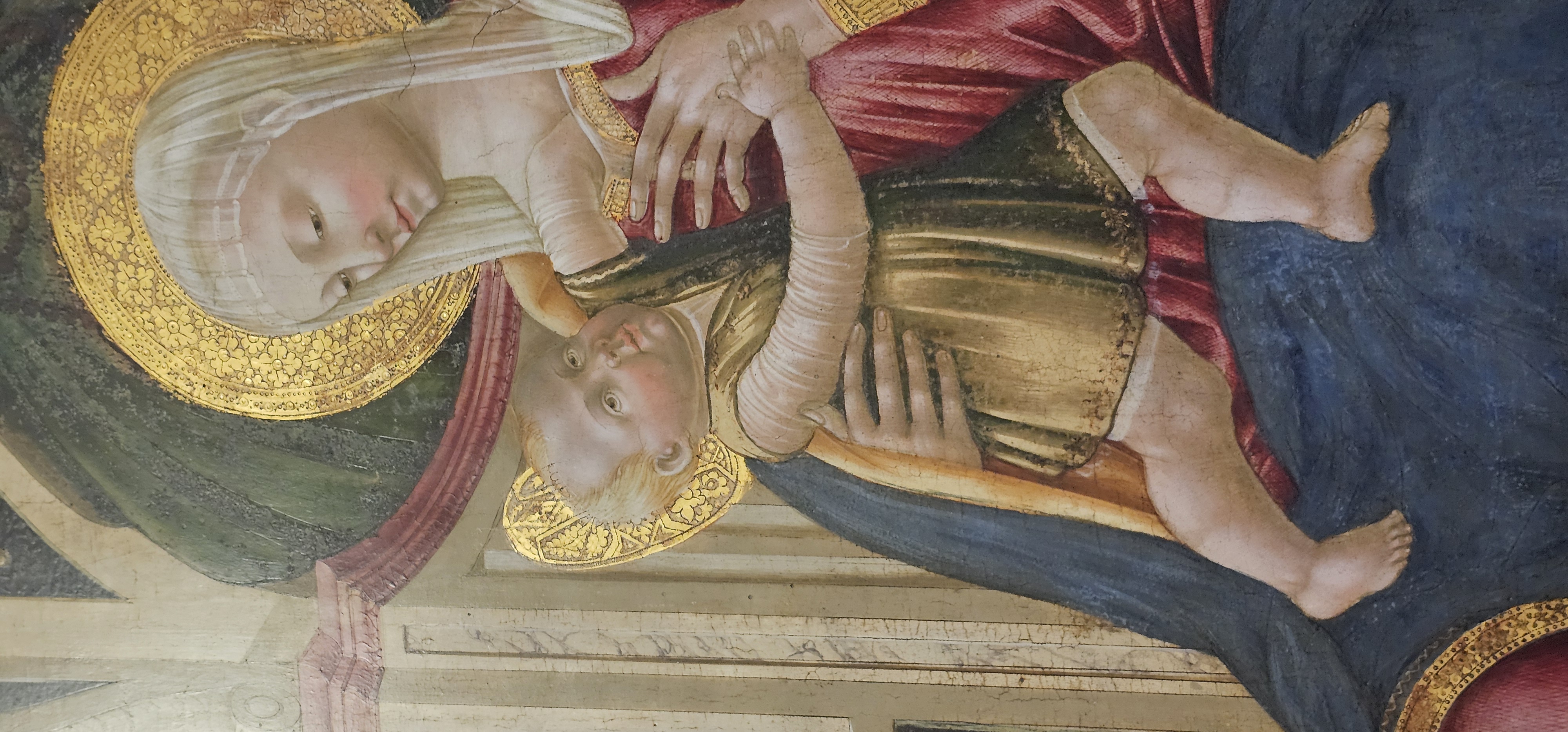
This face appears in a mid-Quattrocento Florentine Madonna. It is painted by the famous Neri di Bicci and one is left to guess at the intentions of this strange baby Jesus. Neri di Bicci is the last in a line of three great Florentine artists: He studied under his father, Bicci di Lorenzo, who had in turn studied under his father, Lorenzo di Bicci, whose name he just turned inside out. In this painting, the youngest di Bicci leaves us guessing at the intentions of this strange baby Jesus: 'Does the expression of an old man on his face highlight his wisdom and experience?'. 'Is he playful or thoughtful?'. And 'Wait, what is he doing with his hands there??'. 'Was Jesus a sex offender??'
Neri di Bicci (1419–1491) was a prolific Florentine painter whose large workshop sustained the city’s conservative devotional tradition well into the later fifteenth century; working for parish churches, confraternities, and private patrons, he produced countless altarpieces, tabernacles, and domestic panels marked by clear outlines, stable compositions, and a reliance on established iconographic formulas inherited from his father Bicci di Lorenzo and grandfather Lorenzo di Bicci. His paintings—characterized by bright, orderly color, calm figural arrangements, and meticulous attention to decorative detail—reflect a steady, craftsmanlike approach that prioritized reliability over innovation, making him a key figure in maintaining the continuity of Florentine Gothic‑derived practice during a period increasingly dominated by more progressive artists like Fra Filippo Lippi and Verrocchio.
Madonna and Child in Glory with Saints and Angels
Late 14th / early 15th century
Francesco di Vannuccio
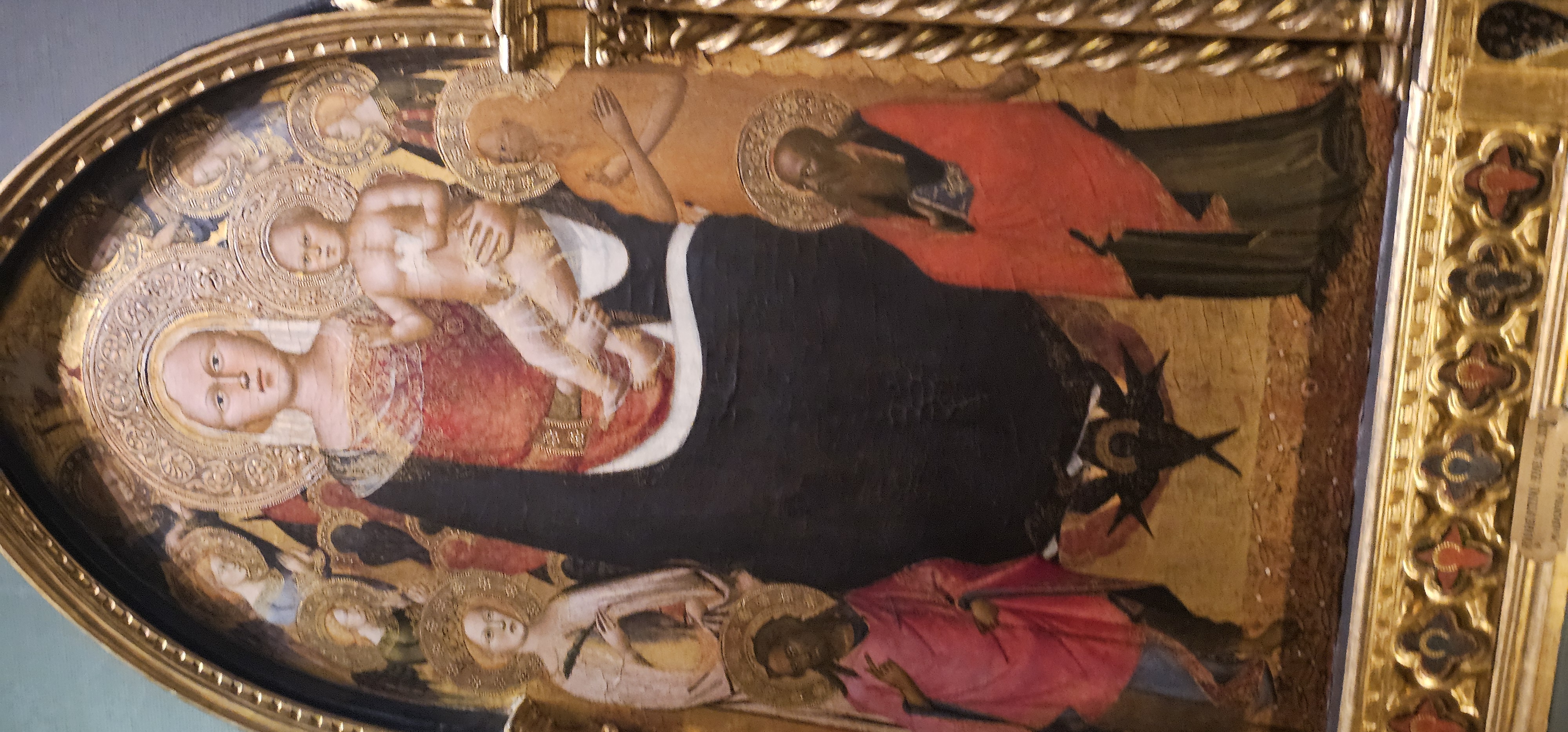
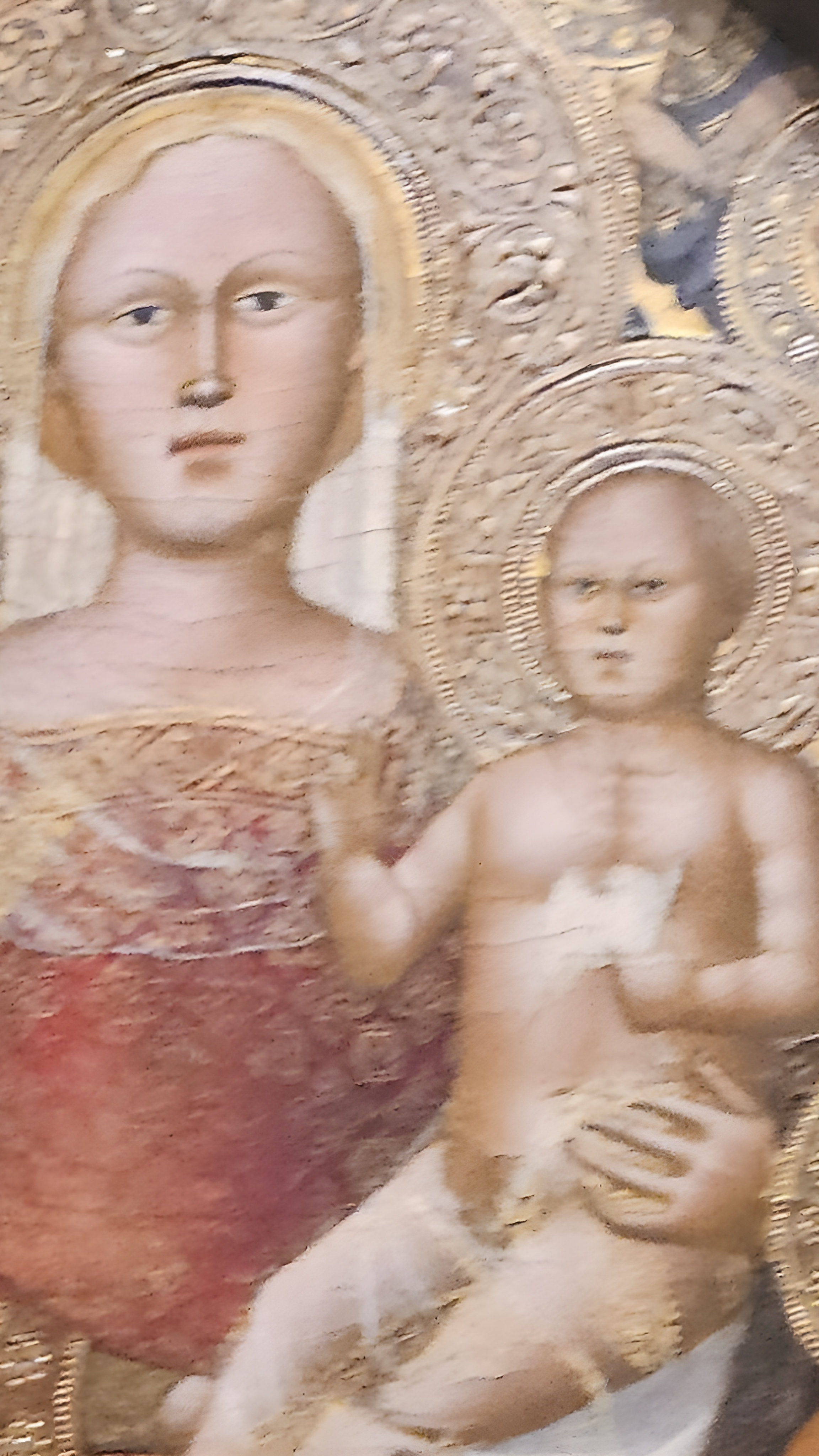
This face appears in a late-Trecento gold-ground panel where Francesco di Vannuccio paints a delicate, linear and luminous scene that gives this strange baby Jesus a clear iconic presence. Unfortunately, the same craftsmanship cannot be attributed to the author of this website, who also happens to be the photographer of this artwork. The blurriness of this picture does a lot to hide the wonderful wonderful strangeness in this baby Jesus face. The face looks like uncannily like John Litgow from the sitcom '3rd rock from the sun' (which is earth, btw). And perhaps it is this resemblance that is meant to signify the other-worldliness of this holy son.
Francesco di Vannuccio, active in Siena during the late fourteenth century, was a painter working within the refined Gothic tradition that defined Sienese art before the full arrival of Renaissance naturalism; documented through a small but distinctive body of devotional works, he favored elongated figures, elegant linear rhythms, and rich, decorative surfaces that echo the legacy of artists like Simone Martini and the Lorenzetti. His surviving panels—often marked by delicate color harmonies and a lyrical, courtly sensibility—reflect the continuity of Siena’s poetic visual language at a moment when neighboring Florence was moving toward more volumetric, spatially coherent forms. Though not a major innovator, Francesco di Vannuccio contributed to sustaining the city’s characteristic blend of spiritual intensity and ornamental grace in the decades before early Renaissance influences began reshaping local practice.
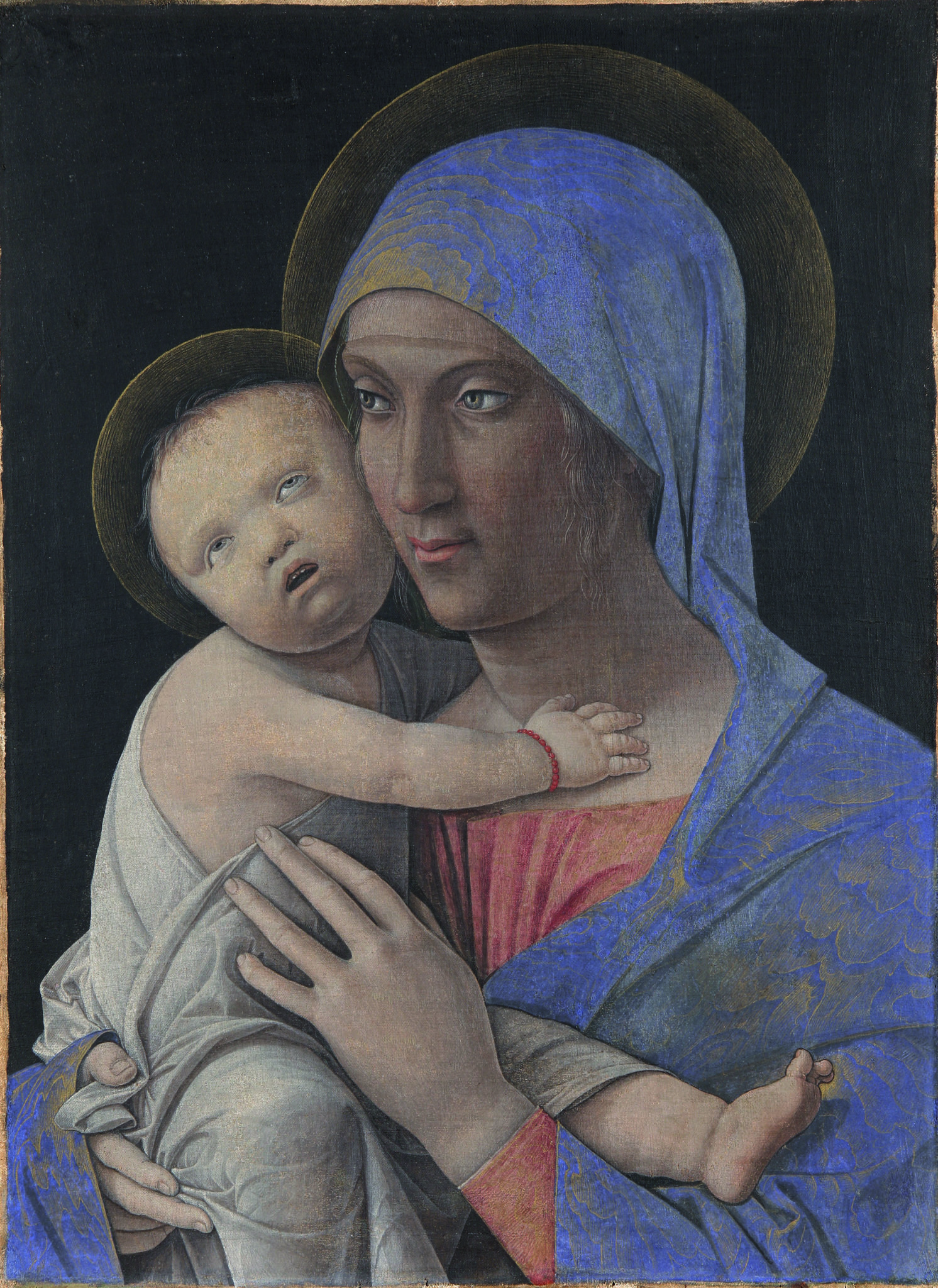
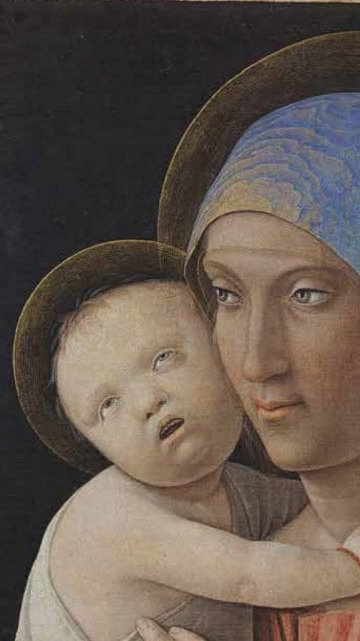
Virgin and Child (Madonna of the Caves)
1488-1490 circa
Andrea Mantegna
This face appears in a small tempera panel entitled 'Madonna of the Caves'. Looking at the rock wall and the sarcophagus in the background of the larger piece (not depicted on this website), we see that the artist quietly foreshadows the Flagellation, Passion and Burial of Jesus later in life. This is done to highlight and deepen the melancholy shared by Mother and Son in this painting. Unfortunately, this is all overshadowed by the expression on this strange baby Jesus face, which far exceeds melancholy and rather approaches the look of someone who is both posessed and anally probed by an alien simultaneously,
Andrea Mantegna (c. 1431–1506) was one of the most influential painters of the Italian Renaissance, renowned for his rigorous mastery of perspective, sculptural treatment of the human figure, and deep engagement with classical antiquity; active in Padua and later as court painter to the Gonzaga family in Mantua, he produced works marked by sharply defined contours, marble‑like bodies, and boldly constructed spatial settings, with masterpieces such as the *Ovetari Chapel* frescoes, the *Camera degli Sposi*, and the *Dead Christ* demonstrating his ability to fuse archaeological precision with dramatic emotional intensity. His distinctive visual language—rooted in linear force, compressed space, and a powerful sense of monumentality—shaped generations of artists across northern Italy and established him as a central architect of the early Renaissance’s intellectual and formal ambitions.
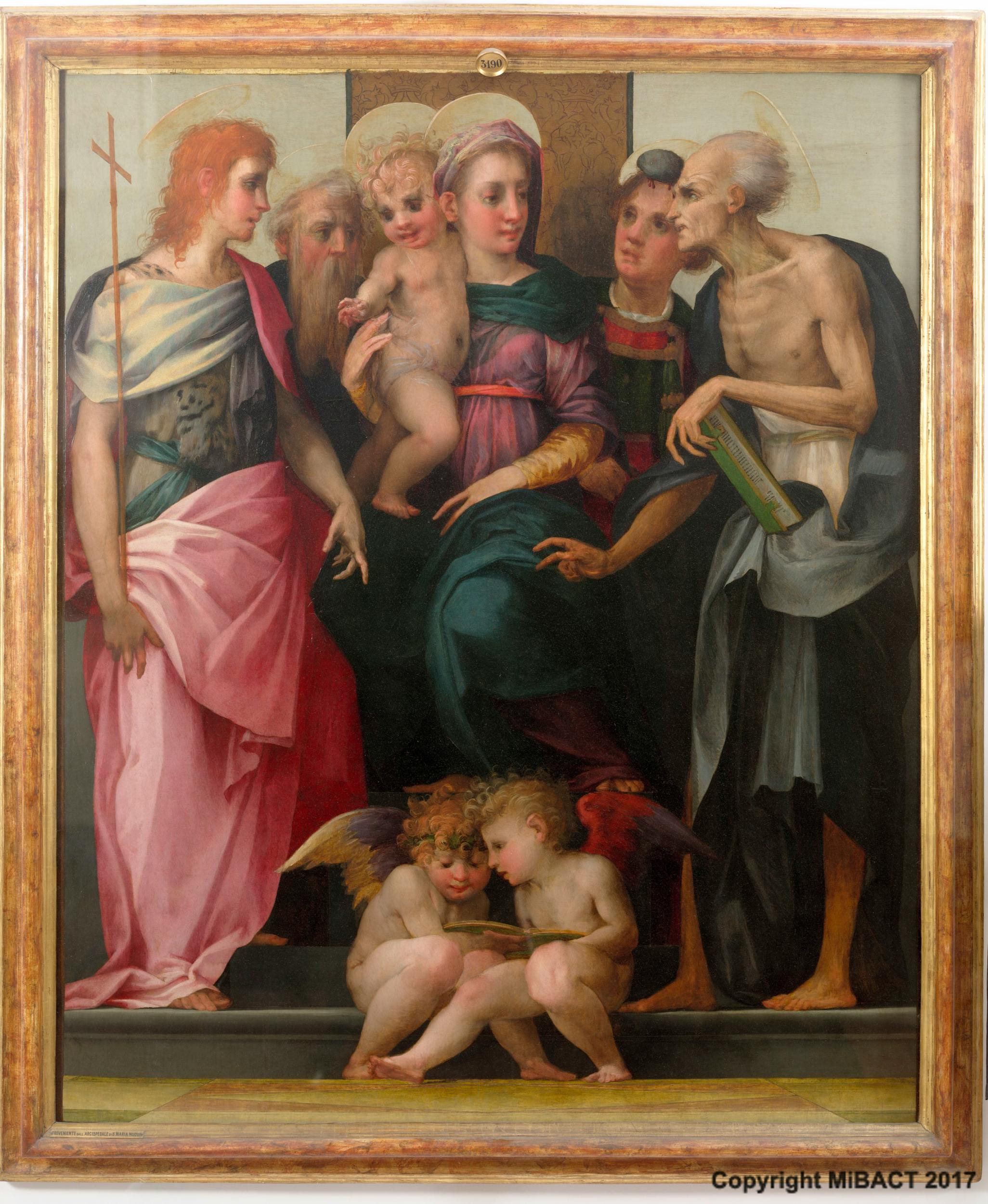
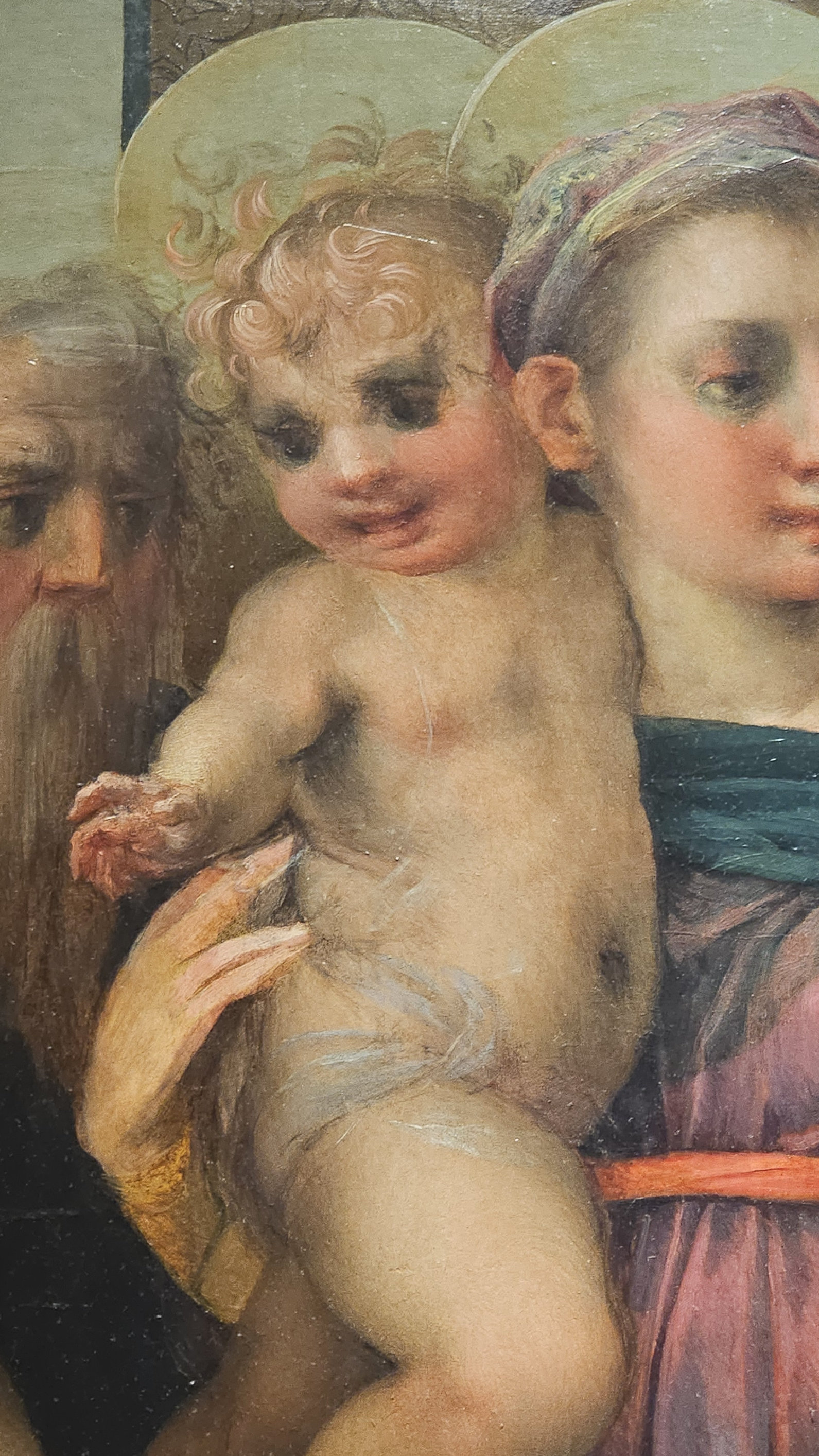
Madonna and Child Enthroned with Saints John the Baptist, Anthony Abbot, Stephen and Jerome (Spedalingo Altarpiece)
1518
Rosso Fiorentino (Giovanni Battista di Jacopo)
This face appears in an oil-panal altarpiece where Rosso Fiorentino gives his figures an almost acidic colour. The angels at the bottom are inspired by Raphael and Fra Bartolomeo. In the end, we can only congratulate the artist here for his beautiful strange baby Jesus face. It takes a true artist to be able to depict the son of God as indistinguishable from Harley Quinn in the Suicide Squad movies. Now that I think about it, this comparison seems more apt than what we might expect at first. Did Jesus in fact not have his Apostles (his 'squad')? And did he not die for our sins (his 'suicide')? Perhaps Jesus and his apostles were the very very very first Suicide Squad on this planet. And the artist has brought this to our understanding.
Rosso Fiorentino (Giovanni Battista di Jacopo, 1494–1540) was one of the defining figures of early Mannerism, known for a sharply expressive, unconventional style that broke decisively with the balanced harmony of the High Renaissance; working between Florence, Rome, and later France, he developed compositions marked by acidic color, angular anatomy, and tense, emotionally charged figural interactions, with works like the *Deposition* in Volterra and the *Moses and the Daughters of Jethro* showing his taste for dramatic distortion and psychological intensity. After the Sack of Rome, he entered the service of Francis I at Fontainebleau, where he helped establish the court’s new artistic language through frescoes and decorative schemes that fused Italian invention with French elegance, making him a central force in shaping both the emergence of Mannerism and the birth of the Fontainebleau style.
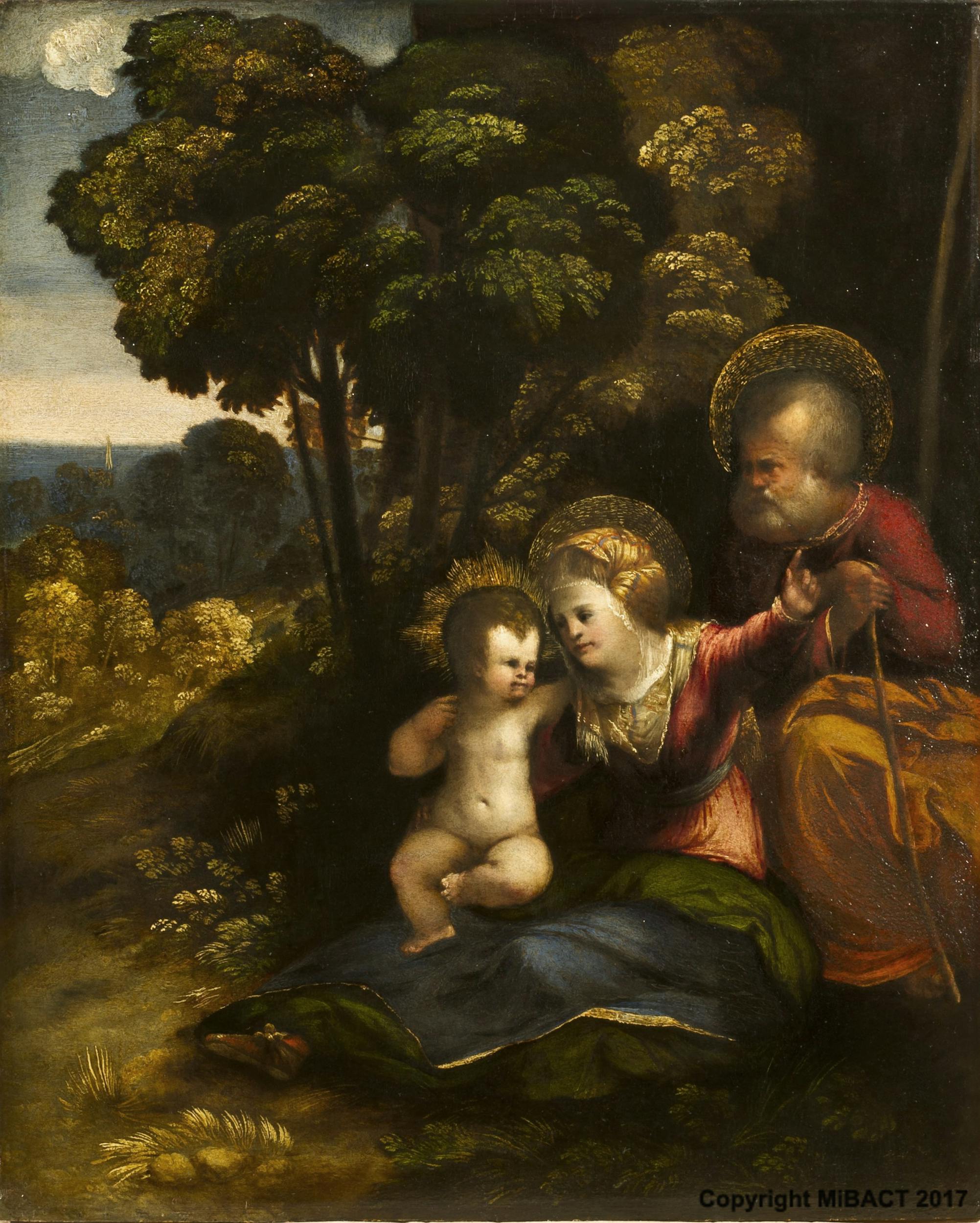
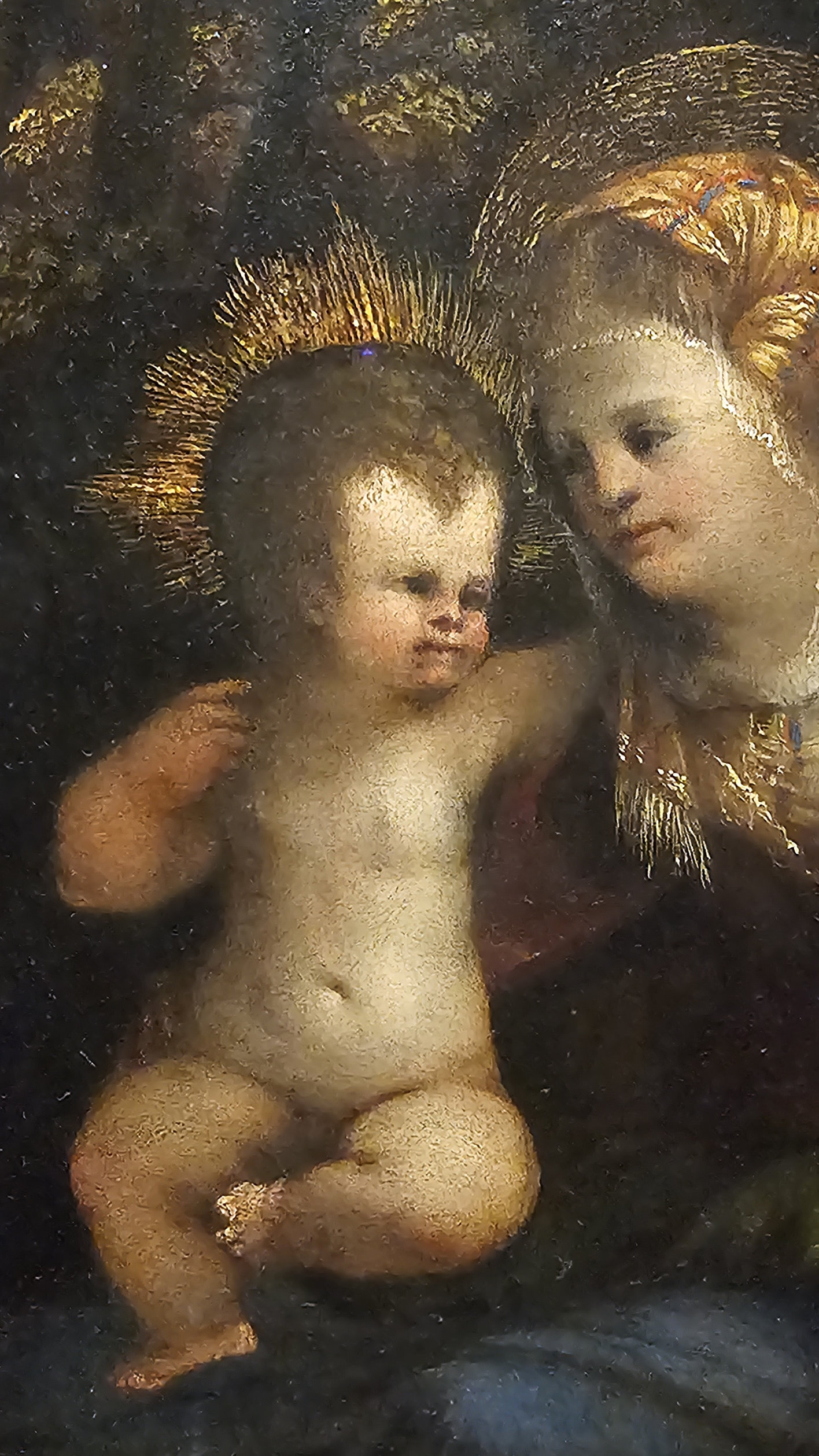
Rest on the Flight into Egypt
c. 1515
Dosso Dossi
This face appears in a tempora-panel scene where Dosso Dossi paints ... well ... this. Dossi was still young when he painted this, so we can perhaps forgive him. His intention was clearly to paint a lush rustic dream of the Holy Family in a pause during their flight to Egypt from the massacre of the innocents.This massacre was purported to be ordered by Herod the Great, when he ordered every child under the age of two to be killed in and around Bethlehem. Looking at this strange baby Jesus face, it seems as if Herod the Great succeeded, and his parents just don't know it yet.
Dosso Dossi (c. 1486–1542) was the leading painter of the Ferrara court under Alfonso I and Ercole II d’Este, known for a poetic, atmospheric style that blends Venetian colorism with a distinctly imaginative, sometimes enigmatic approach to narrative; working across mythological, allegorical, and religious subjects, he favored soft, saturated color, fluid brushwork, and dreamlike settings that give his figures a lyrical, almost theatrical presence. His paintings—such as *Jupiter, Mercury and Virtue* and *Melissa*—show a taste for ambiguity, fantasy, and subtle psychological nuance, reflecting the intellectual culture of the Este court and its fascination with literature, magic, and classical mythology. Dosso’s work stands apart for its fusion of painterly sensuality and inventive storytelling, making him one of the most distinctive voices of the northern Italian Renaissance.
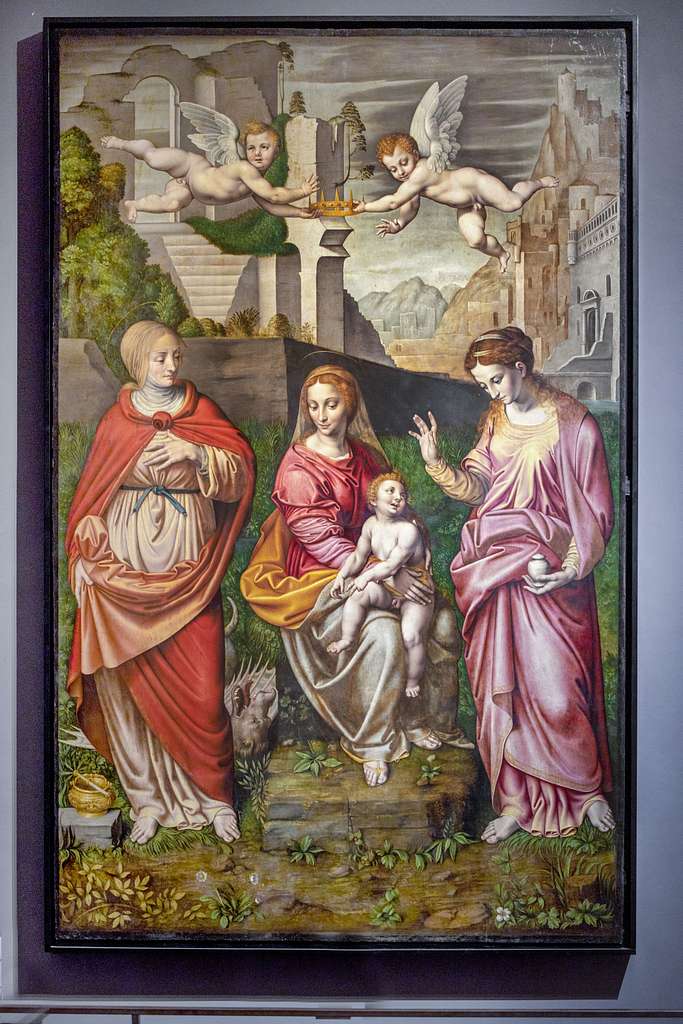
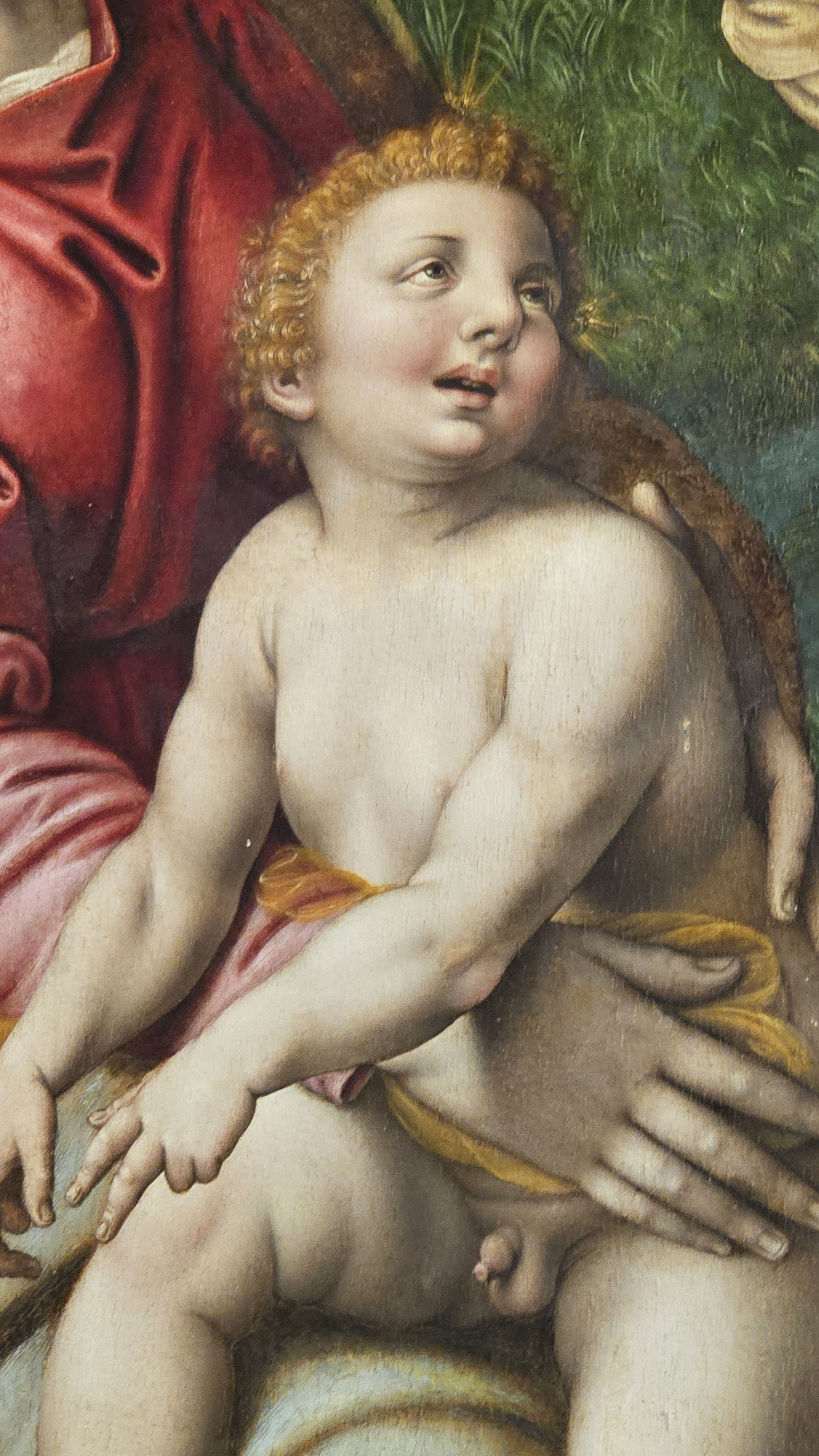
Madonna and Child with Saints Martha and Mary Magdalene
1559-1560
Girolamo Figino
This face appears in an oil panel altarpiece where Girolamo Figino uses his Lombard skills and soft Leonardesque modelling to give this strange baby Jesus a happy and also slightly rounded presence. Jesus' hair is almost depicted as red, a daring choice even today. The architectural ruins behind the Virgin symbolise the fall of paganism, while the poised figures of Martha and Mary Magdalene frame the scene with a calm, Raphael-inspired harmony. This baby Jesus is delighted by it all and expresses this with a facial expression that seems to say: 'I just ate the most amazing pancake, please let me enjoy it as much as I want'.
Girolamo Figino (c. 1520–1590) was a Milanese painter and draughtsman active during the Lombard late Renaissance, known for a refined, naturalistic approach shaped by the influence of Leonardo’s legacy in Milan; working primarily for civic and religious patrons, he produced portraits, devotional panels, and careful studies of plants and objects, with his drawings—especially botanical sheets—showing a precise observational method that reflects the scientific curiosity characteristic of the Milanese milieu. His paintings combine clear contours, balanced compositions, and a gentle handling of light, contributing to the steady, craftsmanlike continuity of Lombard art in the decades between the Leonardesque generation and the rise of more dramatic Baroque tendencies.
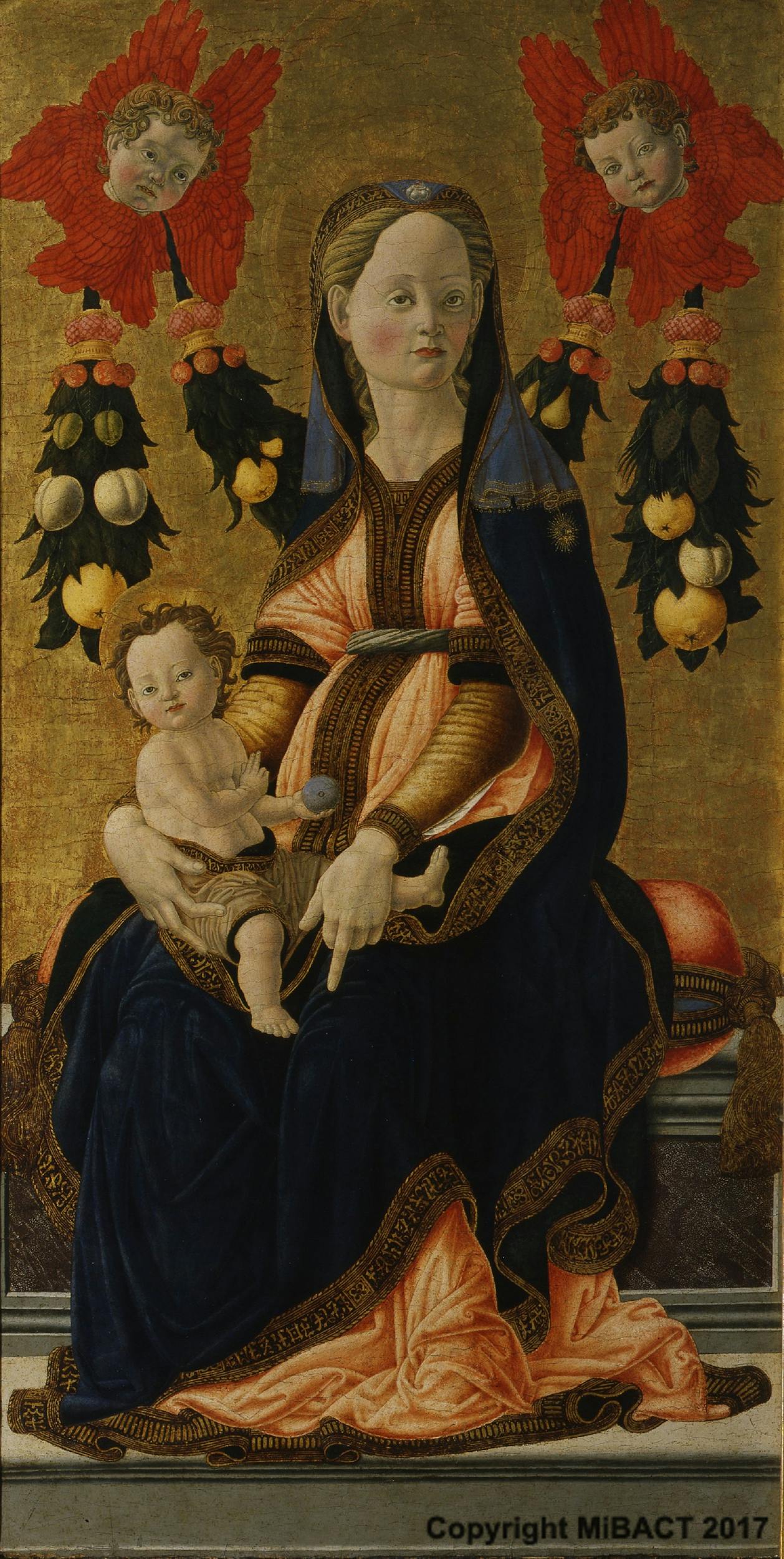
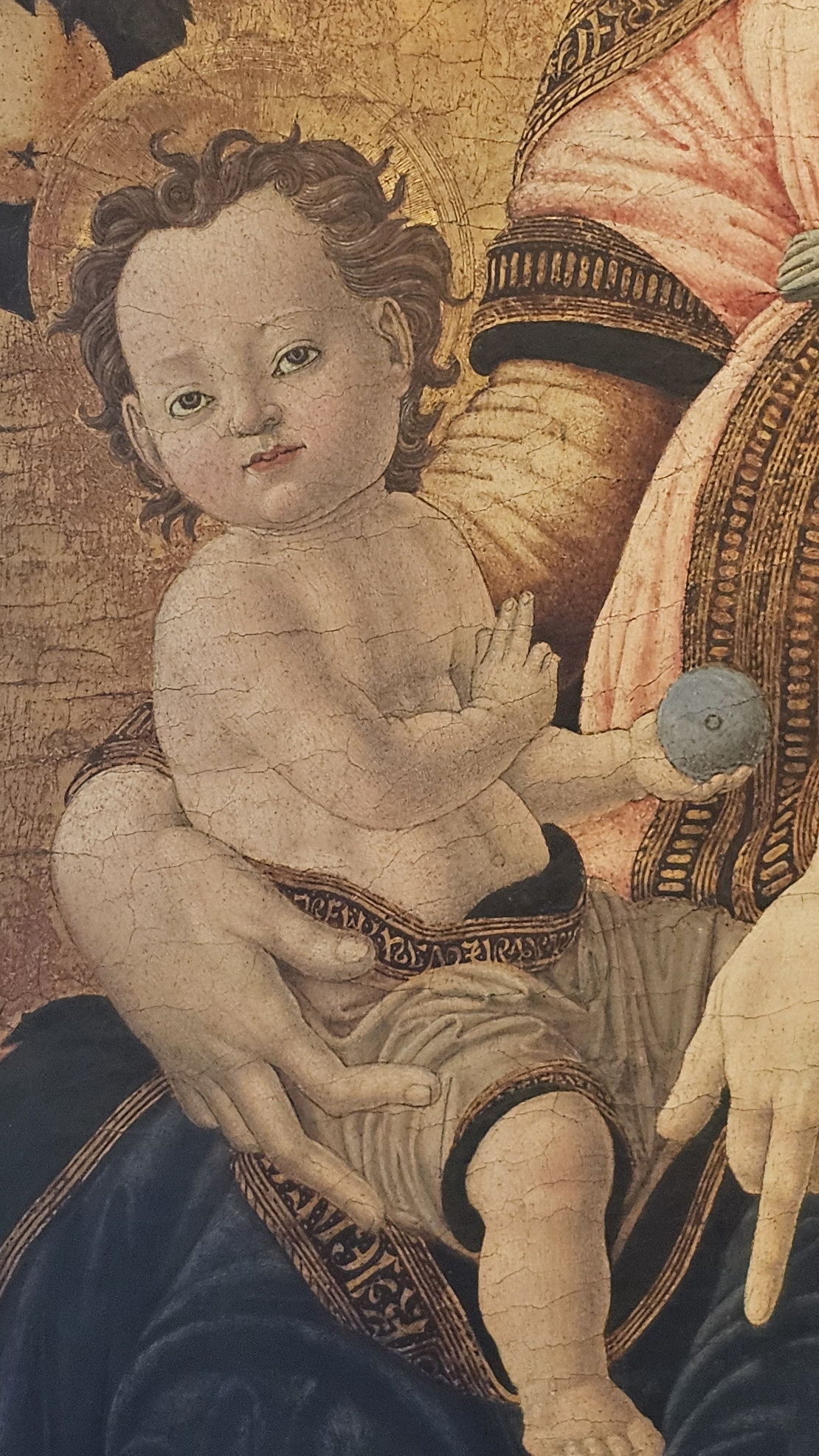
Madonna with Child
1451-1459
Giovanni di Franco di Piero
This face appears in a tempera on wood Madonna where Giovanni di Franco di Piero's artistic qualities really shine through. The unusual facial type, recalling Fra Angelico's more disenchanted Madonnas, combines with the Padua-derived festivity of fruit and putti and creates a hybrid of Florentine clarity and Donatellesque ornament. This strange baby Jesus has it all figured out, it seems. Loki was Jesus, as it turns out! Who would have thought?
Giovanni di Franco di Piero, active in Florence during the early fifteenth century, was a painter associated with the transitional moment when Florentine art was moving from late Gothic conventions toward the more structured naturalism of the early Renaissance; documented as working on commissions for Santa Maria Novella and other local institutions, he produced altarpieces and devotional panels characterized by firm linear drawing, clear narrative organization, and a reliance on established iconographic patterns typical of Florentine workshops of his generation. Although not a major innovator, his work reflects the steady, craftsmanlike production that supported the city’s religious and civic visual culture in the decades leading up to the breakthroughs of artists like Masaccio and Fra Angelico.
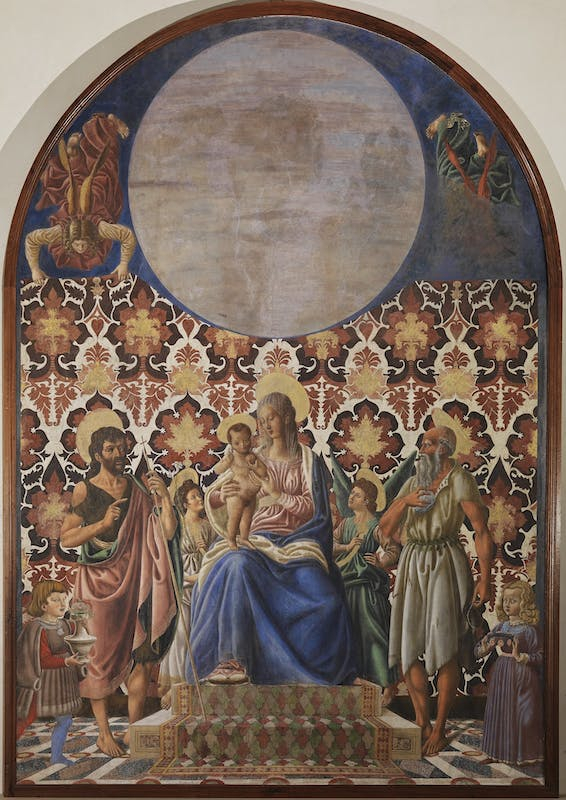
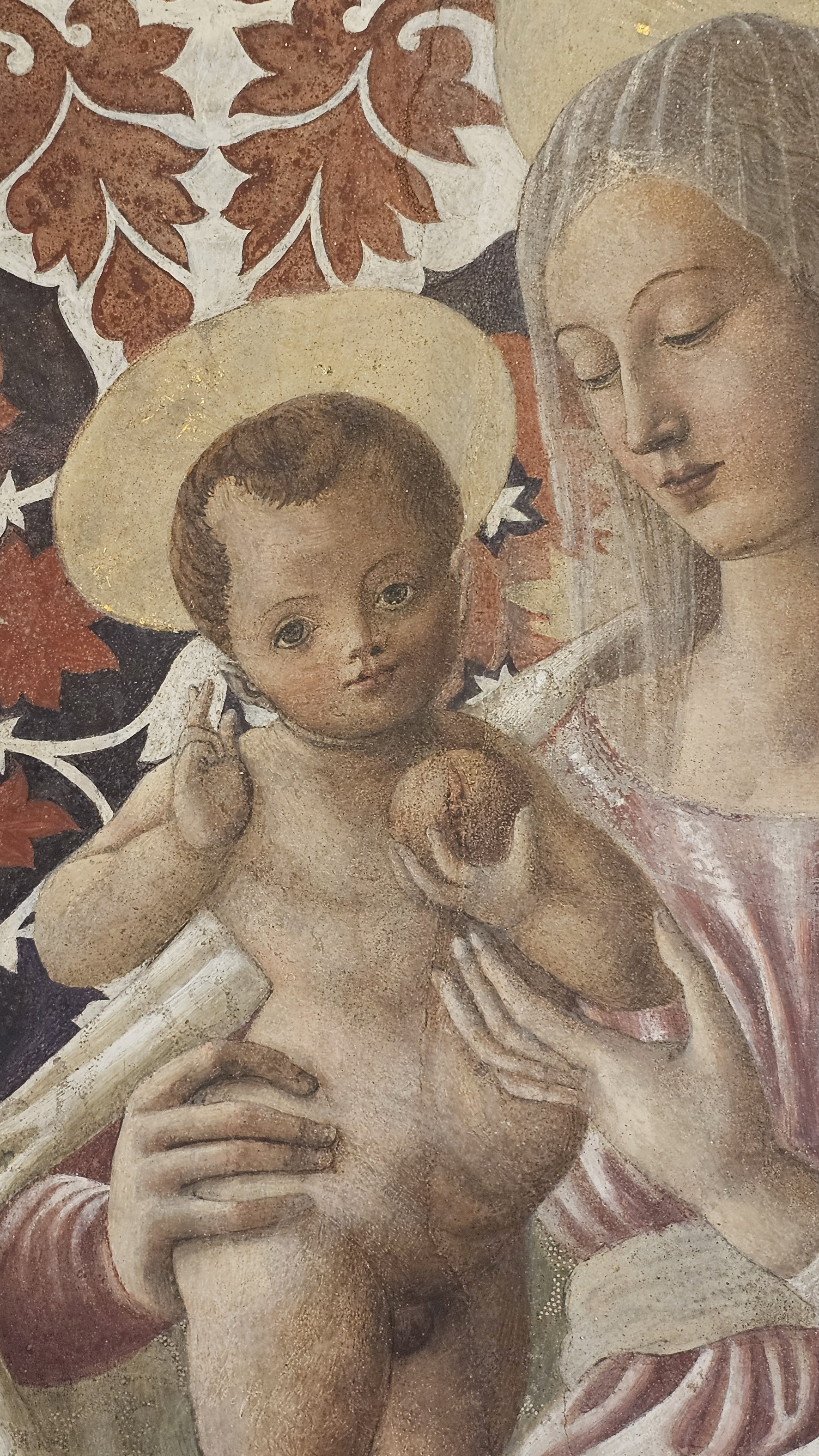
Madonna and Child enthroned with Saints Jerome and John the Baptist, two angels, and two children from the Pazzi family
1445-1448 circa
Andrea del Castagno
This face appears in a detached fresco where Andrea del Castagno paints the Madonna and baby Jesus not only in the company of Saint Jerome and John the Baptist and two angels, but also with two children from the Pazzi family. This was common practice in the fifteenth century and was used as a type of propaganda for the family. By signifying their own closeness to these holy figures, the painting acted in a way to elevate them above normal people. This painting originates from the castle of Trebbio in Pontassieve, which also belonged to the Pazzi family. This strange baby Jesus seems to find it all somewhat amusing. 'Nobody can be as amazing as I am', he seems to think. 'But you can try ...'
Andrea del Castagno (c. 1421–1457) was one of the most forceful and innovative painters of the early Florentine Renaissance, known for his dramatic use of perspective, sharply defined contours, and powerful, sculptural figures that convey an intense physical presence; active in Florence and Venice, he produced frescoes and panel paintings that reveal a bold, almost aggressive approach to composition, with works such as the *Last Supper* at Sant’Apollonia and the *Eminent Men and Women* cycle demonstrating his mastery of illusionistic space and his interest in monumental, heroically scaled forms. His style—marked by strong chiaroscuro, firm drawing, and a preference for dynamic, expressive poses—helped push Florentine painting toward greater psychological and physical intensity, making him a pivotal figure in the transition from the calm balance of early Quattrocento art to the more dramatic tendencies that would emerge later in the century.
Pala della Madonna della Neve (Madonna of the Snow Altarpiece)
c. 1432
Stefano di Giovanni detto il Sassetta
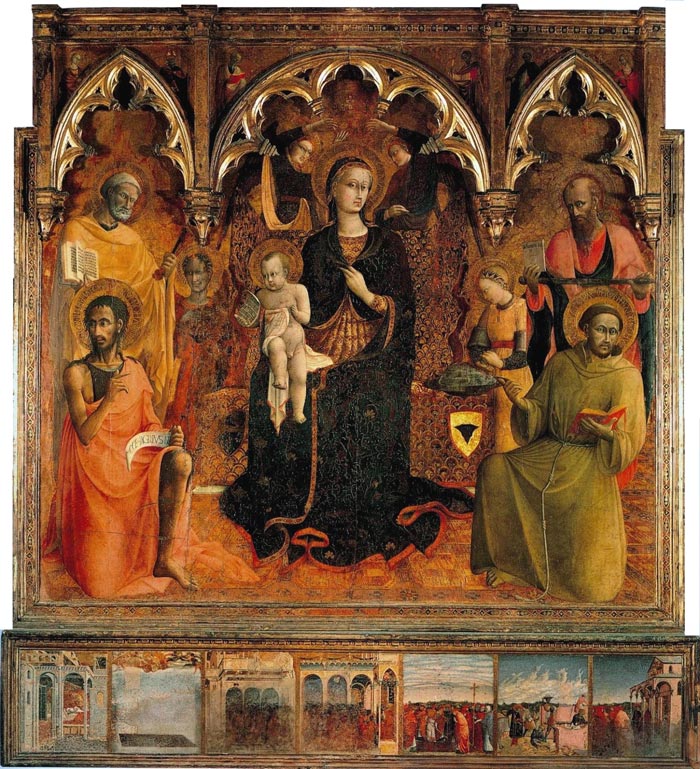
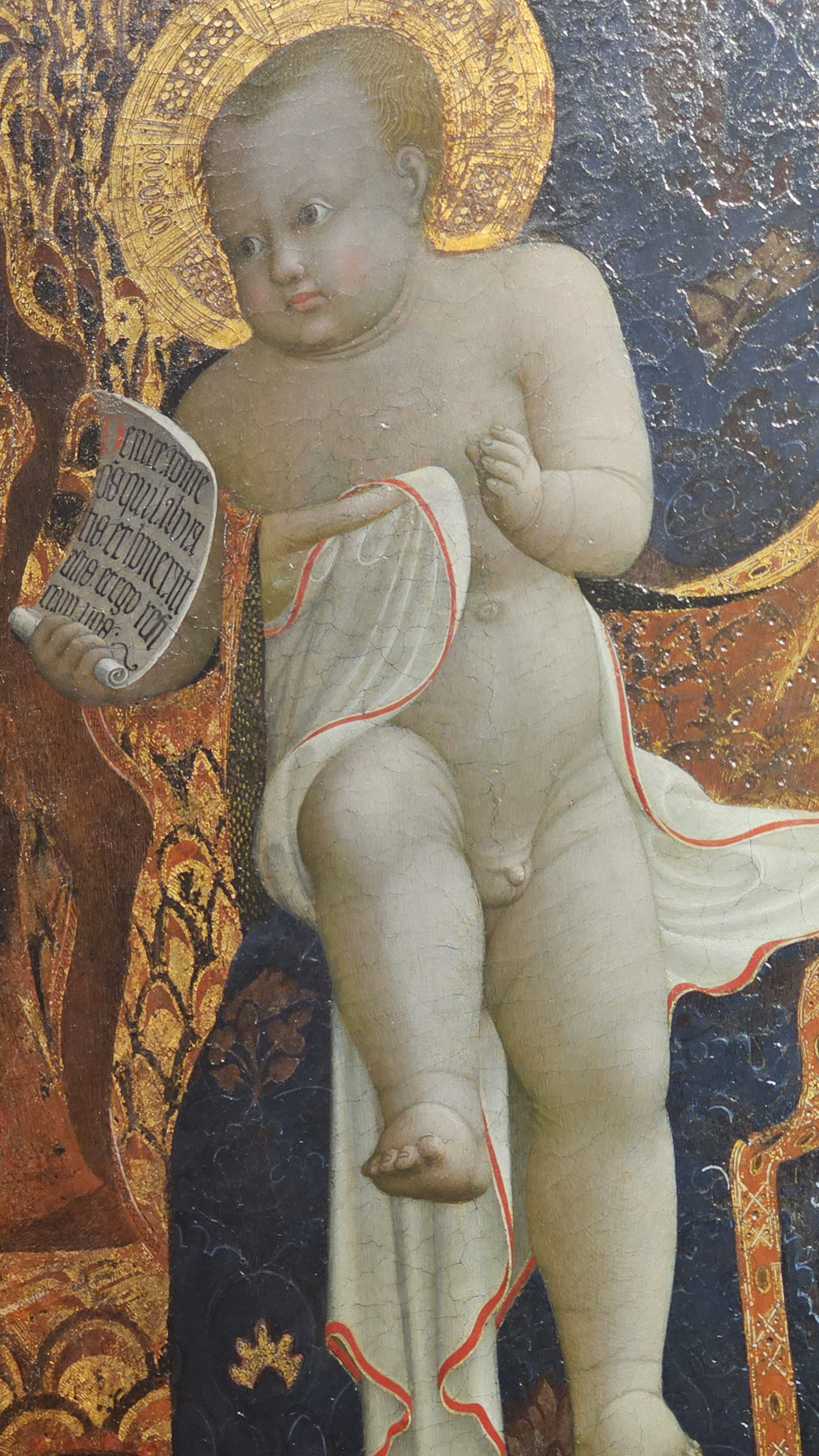
This face appears in a gold ground altarpiece and depicts the 'Madonna of the Snow'. This schema honours the role of snow during the foundation of one of the most important Catholic churches in Rome and perhaps in the world: the Santa Maria Maggiore. You very seldom see white powdery snow in a city like Rome. The story goes that both a Roman nobleman and the pope had a dream where snow was falling over one of Rome's seven hills. When they searched for this snow, they found both the miraculous snow and eachother. They then proceeded to trace out the outline of the Santa Maria Maggiore in the snow and this became the founding story of this church. In the early 15th century, this event was commemorated by a painting comissioned by Ludovica Bertini. This strange baby Jesus is content with that story and maybe - just maybe - he knows that he is the one responsible and that causes that slight glimmer of happiness in his face.
Stefano di Giovanni, known as **il Sassetta** (c. 1392–1450), was one of the leading painters of early Renaissance Siena, celebrated for combining the city’s long Gothic tradition with emerging Quattrocento interests in spatial coherence and more naturalistic figuration; active primarily in Siena and nearby towns, he produced altarpieces and narrative panels marked by refined color, delicate contours, and carefully structured compositions, with major works such as the *San Sepolcro Altarpiece* and the *Borgo San Sepolcro predella* showing his ability to blend lyrical detail with clear storytelling. His career illustrates how Sienese painting adapted new Renaissance ideas while preserving its distinctive visual identity, and his influence shaped the next generation of artists working in the region.
Madonna and Child
c. 1310
Uccello di Nerio (formerly attributed to Duccio)
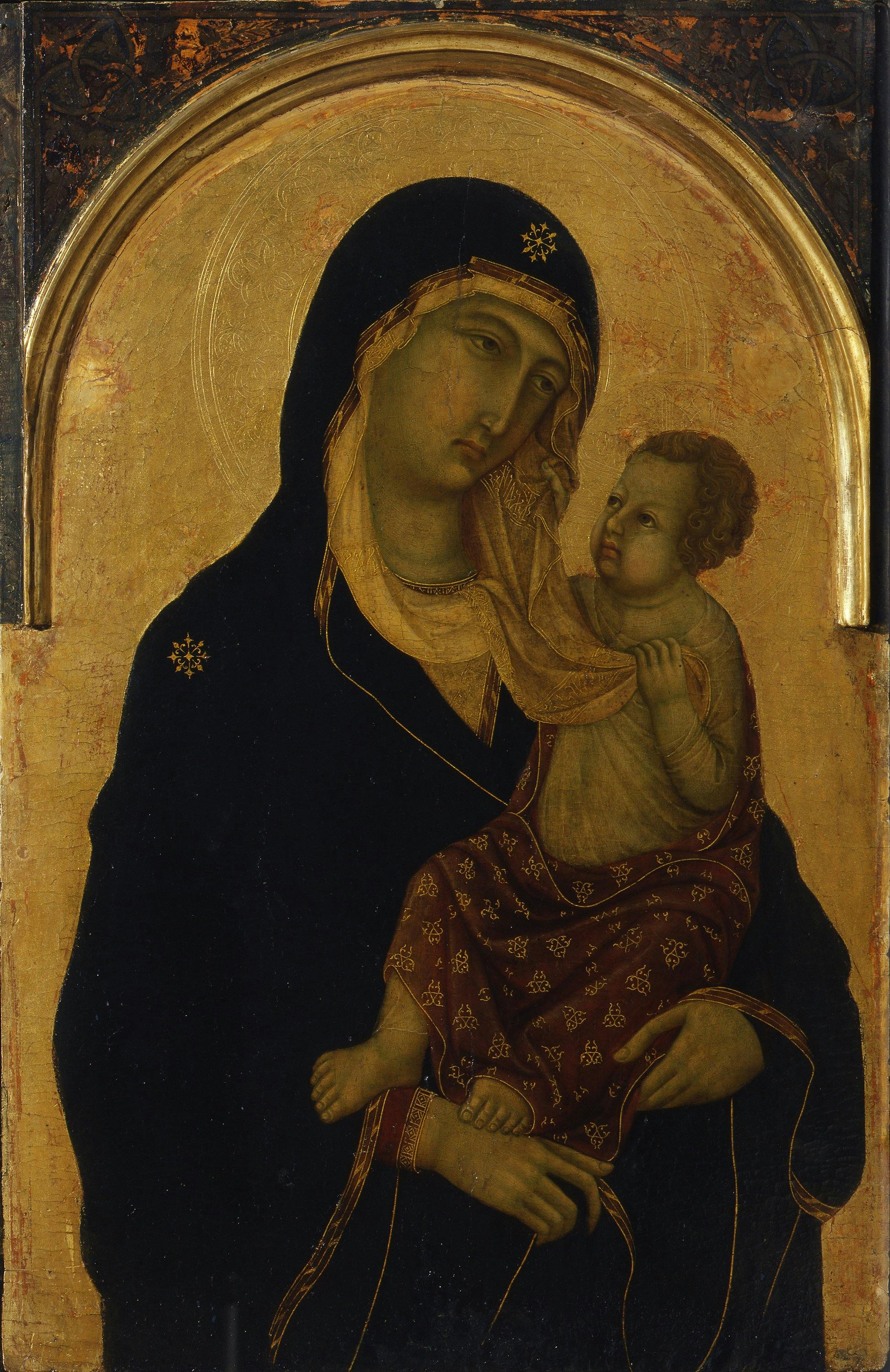
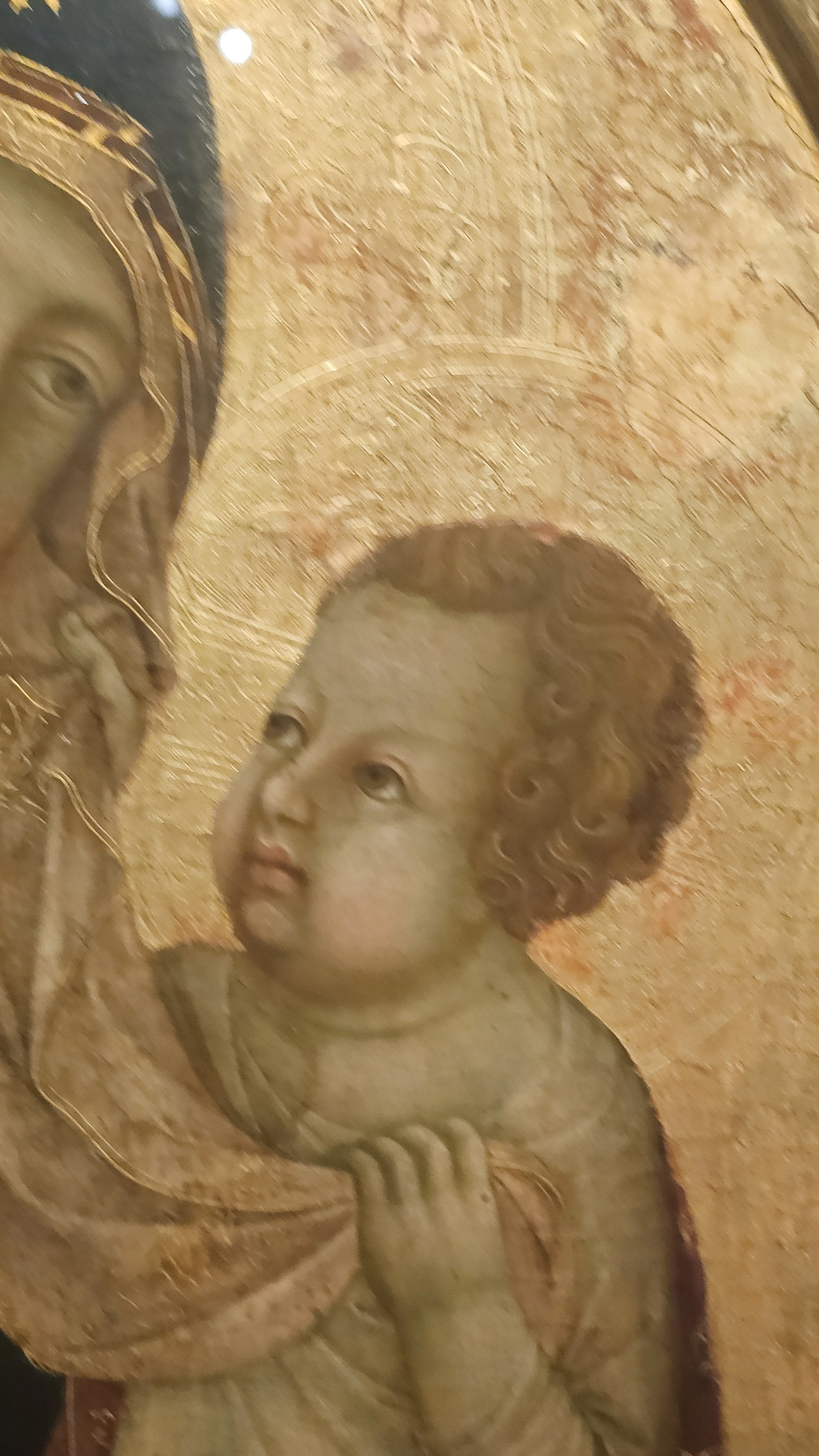
This face appears on a gold-ground tempera panel in which a Florentine painter of the early Trecento, Ugolino di Nerio, softens the once rigid Byzantine schema. This strange baby Jesustugs gently at the Virgin's veil, which perhaps references the shroud in which he will be wrapped after his crucifiction in the future. The painting was originally not attributed to Ugolino di Nerio, but to his master: Duccio di Boninsegna. Although we cannot spot any interest in this strange baby Jesus face, we must appreciate such a masterpiece on the boundary of cultures and times.
Uccello di Nerio, active in Florence in the early fourteenth century, was a painter associated with the generation that helped consolidate the city’s Gothic pictorial language before the innovations of Giotto fully transformed local practice; documented as working on commissions for Santa Croce, he produced altarpieces and devotional panels characterized by firm outlines, clear narrative structure, and a reliance on established iconographic formulas typical of Florentine workshops of the period. His surviving works show steady craftsmanship and a preference for compact, frontal compositions, reflecting the transitional moment when Florentine painting was moving from linear Gothic conventions toward greater spatial coherence. Although not a major innovator, Uccello di Nerio contributed to the steady production of religious imagery that shaped Florence’s visual culture in the decades preceding the early Renaissance.
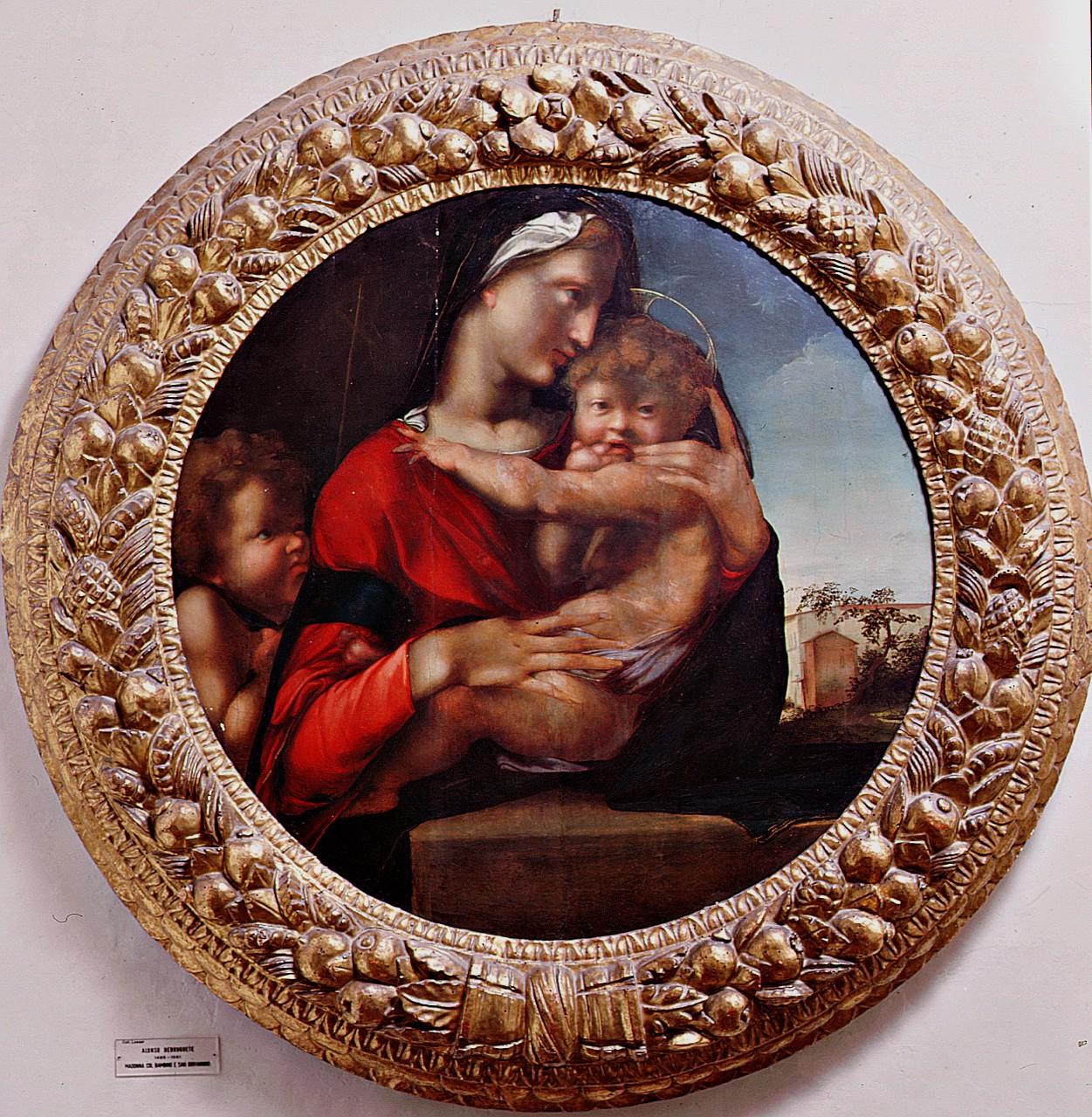
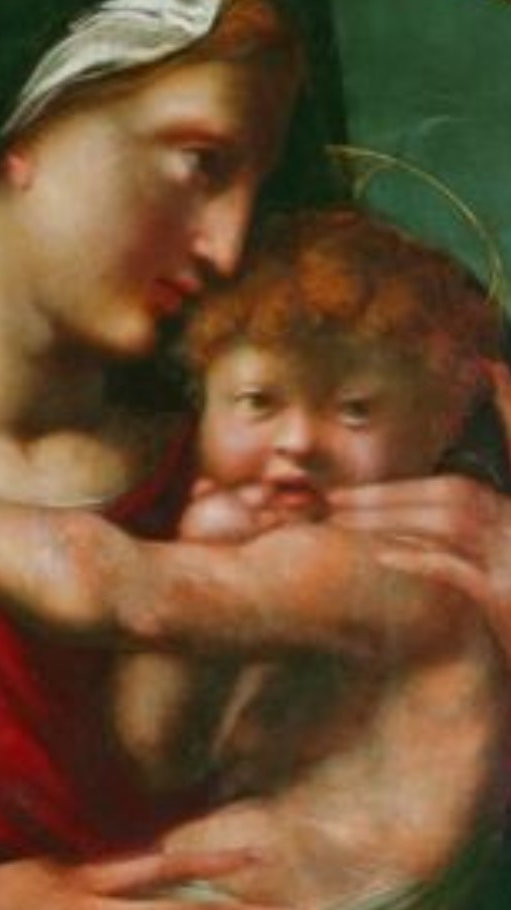
Madonna and Child
c. 1517
Alonso Berruguete
This face appears in an oil panel of the typical 'Madonna and Child' motive, where Alonso Berruguete's Tuscan training clearly shows. Interestingly, Berruguete was one of several Spanish artists in Tuscany in the early sixteenth century. Here they established the Mannerist movement. Mannerism clearly departs from the more typical Renaissance art. The emphasis in the Ranaissance typically was on imitating exact proportion, balance and effectively 'ideal' beauty. Mannerism on the other hand exaggerated certain facial expressions and physical features in order to enhance these qualities even more. The paintings therefore feel more unnatural and asymmetrical. Speaking of unnatural, it is this strange baby Jesus face that shines in its depiction of a child in pain. This baby Jesus has bitten off more than he can chew: his right index finger. Which is ironic, to lose a finger before you even become a carpenter. We wish him well with this and many more problems he will have to face.
Alonso Berruguete (c. 1488–1561) was one of the most dynamic artists of the Spanish Renaissance, known for introducing a sharply expressive, highly animated style that broke with the calmer, more measured traditions of earlier Iberian painting and sculpture; after training in Italy—where he absorbed elements of Michelangelo’s and the Roman maniera—he returned to Spain and became a leading sculptor for major ecclesiastical commissions, producing altarpieces and choir stalls marked by twisting figures, abrupt contrasts, and a strong sense of emotional intensity. His work in Valladolid, especially the sculptural ensembles for the Cathedral and the Monastery of San Benito el Real, shows how he fused Italian influences with local traditions to create a new visual language that emphasized movement, tension, and psychological charge. Berruguete’s career established him as a central force in shaping the expressive turn of sixteenth‑century Spanish art.
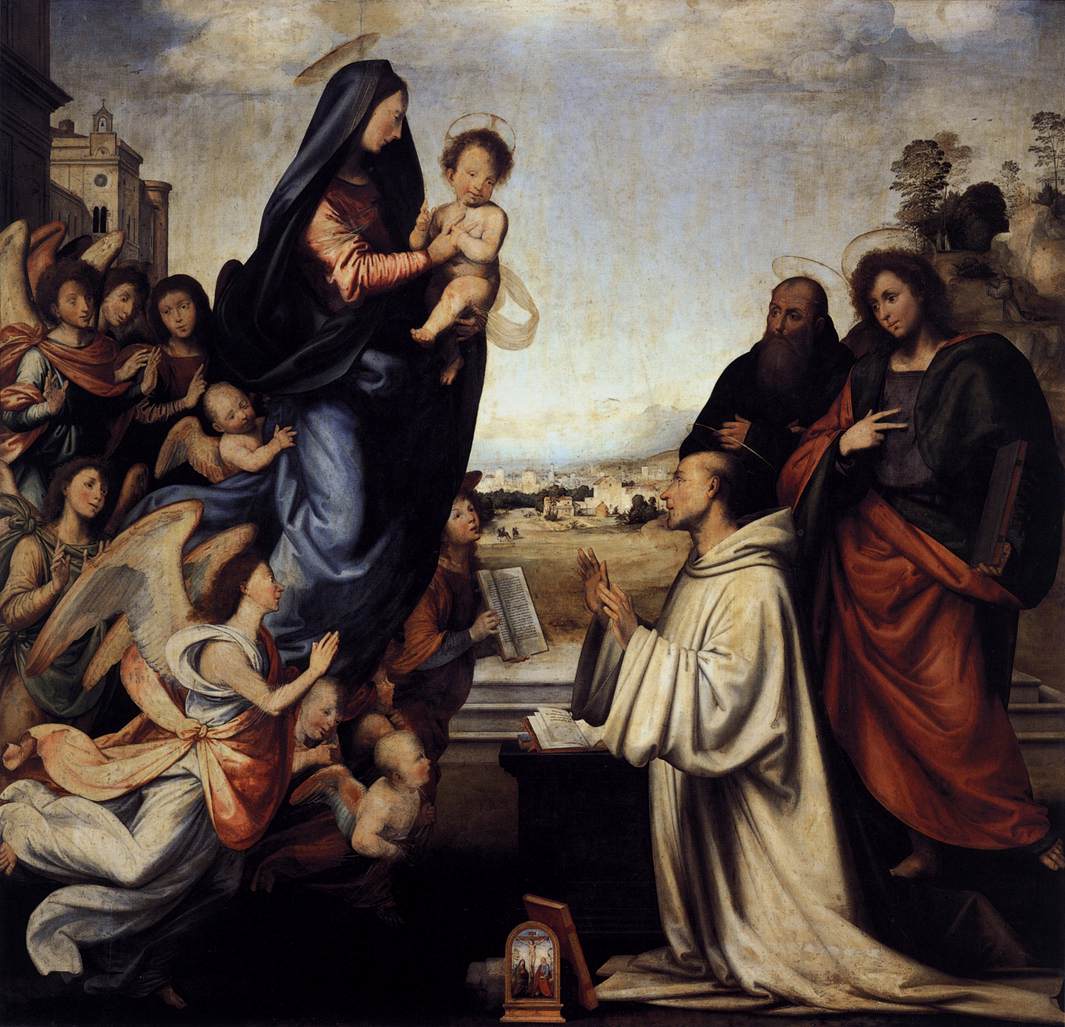
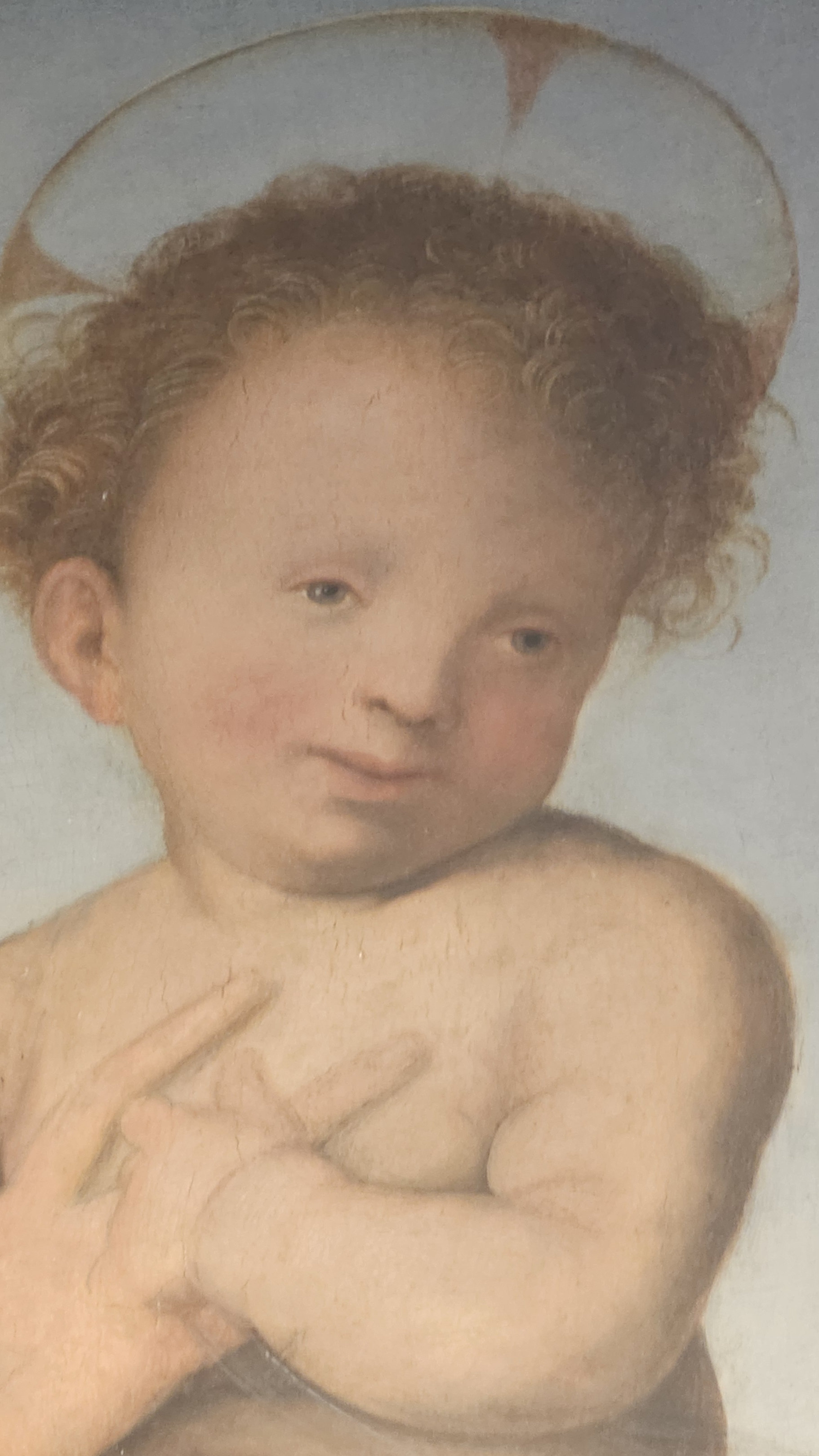
The Vision of St. Bernard
1504-1507
Fra Bartolomeo
This face appears in an oil on wood altarpiece from Fra Bartolomeo. The prefix 'Fra' often confuses many people who first dive into the world of strange baby Jesus faces paintings, as many of the artists have this prefix before their name. The explanation, though, is very simple. 'Fra' is simply a religious title similar to 'brother' in English (think, for example, of the origin of the word fraternity). It was a title given to Dominican friars. Here, 'Dominican' of course does not refer to the country, but rather to the 'original' St. Dominic. It is this saint after which the country and Vin Diesel's character in the Fast and Furious movies are named after. This painting shows the virgin Mary's apparition to St. Bernard (of dog fame). She is holding the strange baby Jesus, who seems to be in a wholly separate world. Not being bothered by anything that's going on around him. He deserves that.
Fra Bartolomeo (1472–1517) was a central figure in the Florentine High Renaissance, known for integrating the compositional discipline of the Quattrocento with the broader, more monumental vision emerging in the early sixteenth century; trained in the workshop of Cosimo Rosselli and later deeply influenced by Savonarola’s reform movement, he developed a style marked by firm drawing, controlled modeling, and carefully organized spatial structures, producing altarpieces and devotional works that balance measured figural presence with a strong sense of architectural order. After entering the Dominican convent of San Marco, he continued to paint, eventually collaborating with and influencing artists such as Raphael, and his mature works—like the *Vision of St. Bernard* and the *Marriage of St. Catherine*—show how he helped shape the transition toward larger, more unified compositions that defined the Florentine High Renaissance.
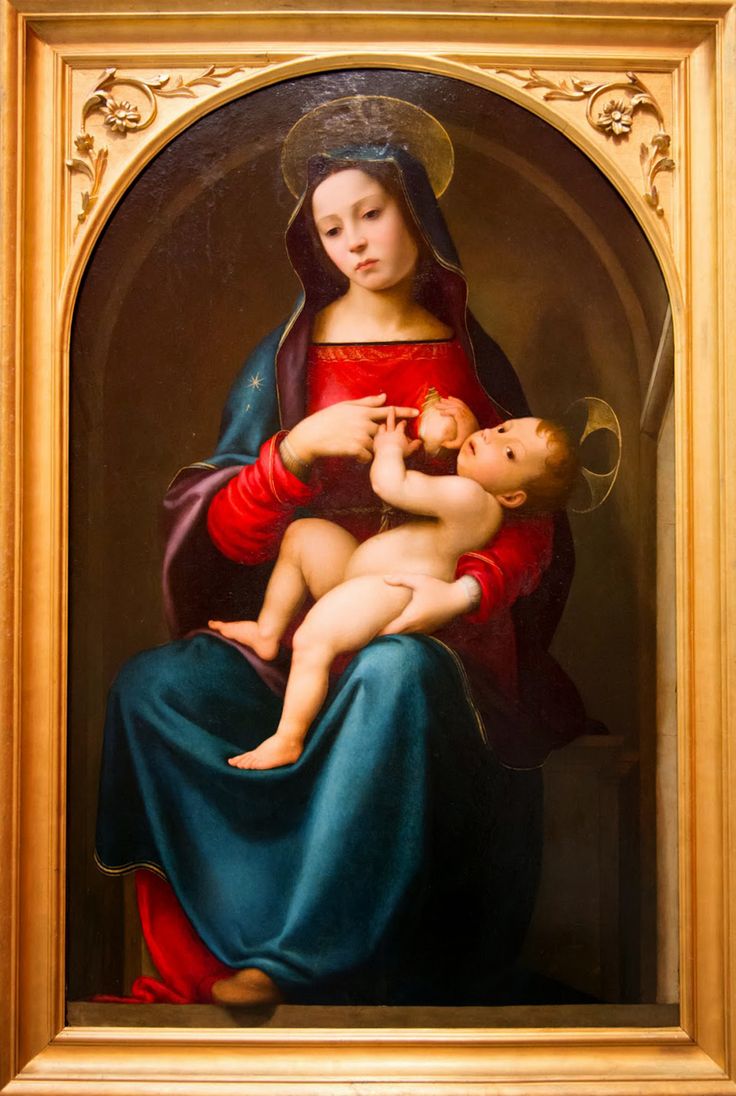
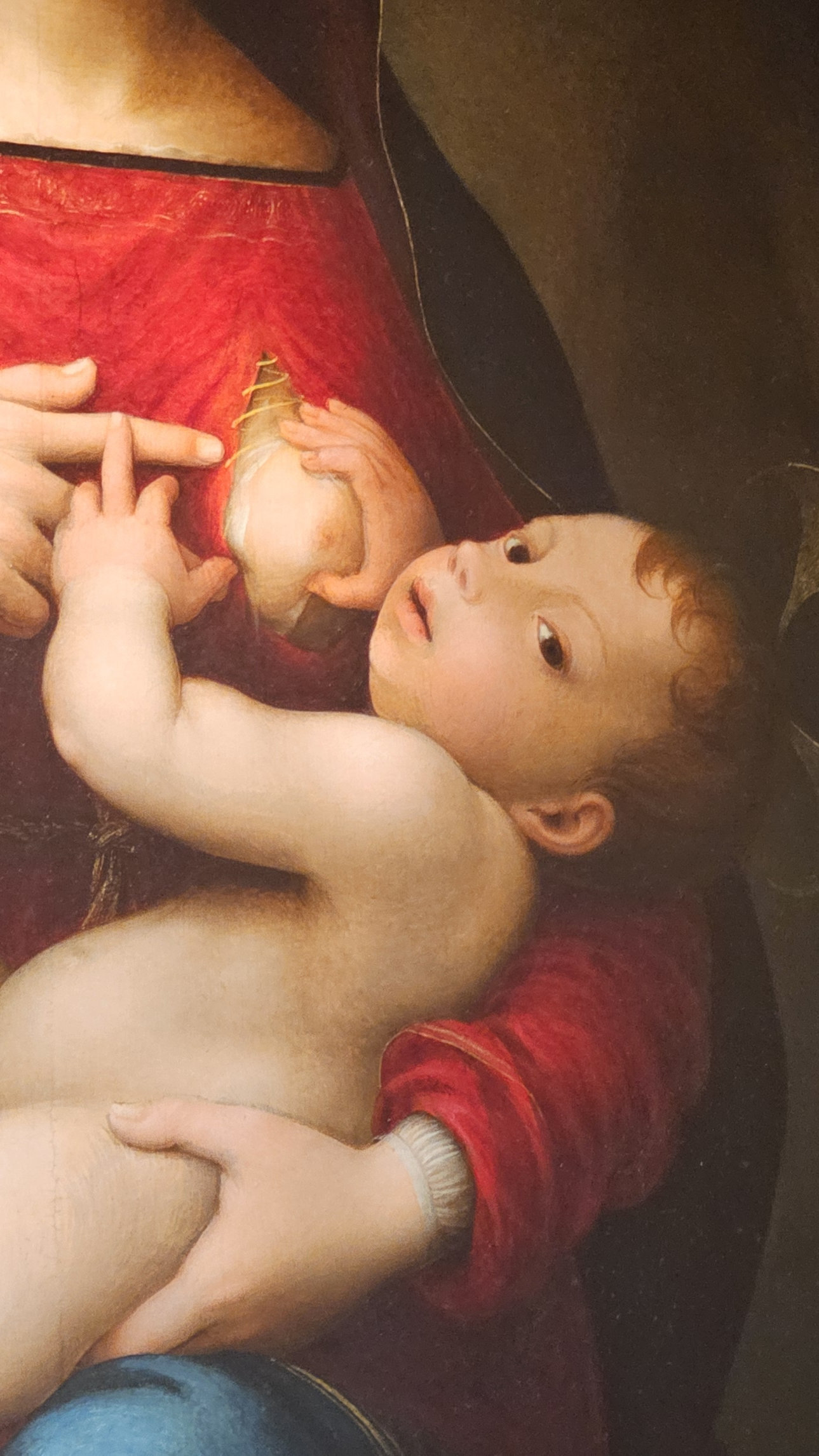
Madonna and Child (Madonna of the Milk)
c. 1518
Giuliano Bugiardini
This face appears in an oil on wood, and was painted by Giuliano Bugiardini. The theme of this painting still shocks people today, but was actually very common and well-accepted in its day. It is called 'Madonna of the milk' or 'Nursing Madonna' and shows Madonna breastfeeding the little baby Jesus. In fact, in some interpretation of this theme it is Madonna who shoots the baby milk into baby Jesus his mouth while he is sitting relatively far away. This makes it almost look like a carnival trick and can cause quite some confusion in the eyes of the beholder. This painting, however, shows a soft Leonardesque chiaroscuro and its gentle modelling give the infant a tender, intimate presence. There is that face, though, with the baby looking at the viewer and apparently saying: 'Mine! This milk is mine! Not for you! Mine!'
Giuliano Bugiardini (1475–1555) was a Florentine painter trained in Ghirlandaio’s workshop and closely connected to Michelangelo, whose circle shaped his clear draftsmanship, steady contours, and preference for balanced, straightforward compositions; active through the High Renaissance, he produced altarpieces, portraits, and mythological scenes marked by calm figural interaction and moderate lighting, with works such as *The Three Fates* and several *Madonna and Child* panels illustrating his role as a reliable, conservative craftsman who sustained mainstream Florentine practice during a period dominated by more experimental contemporaries.
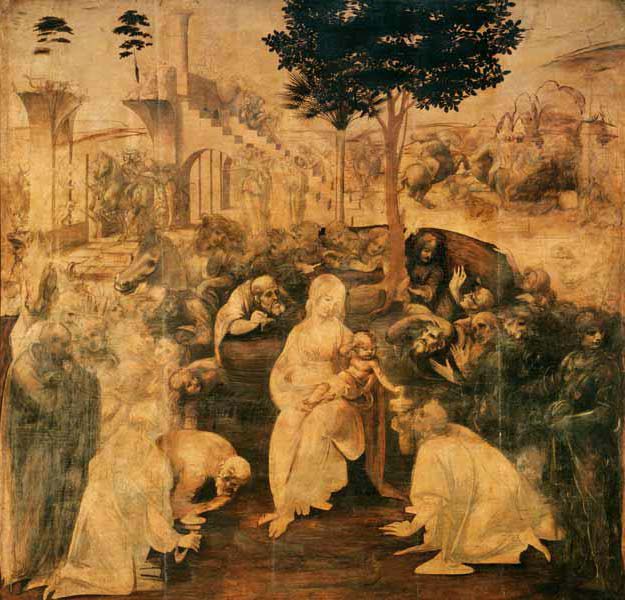
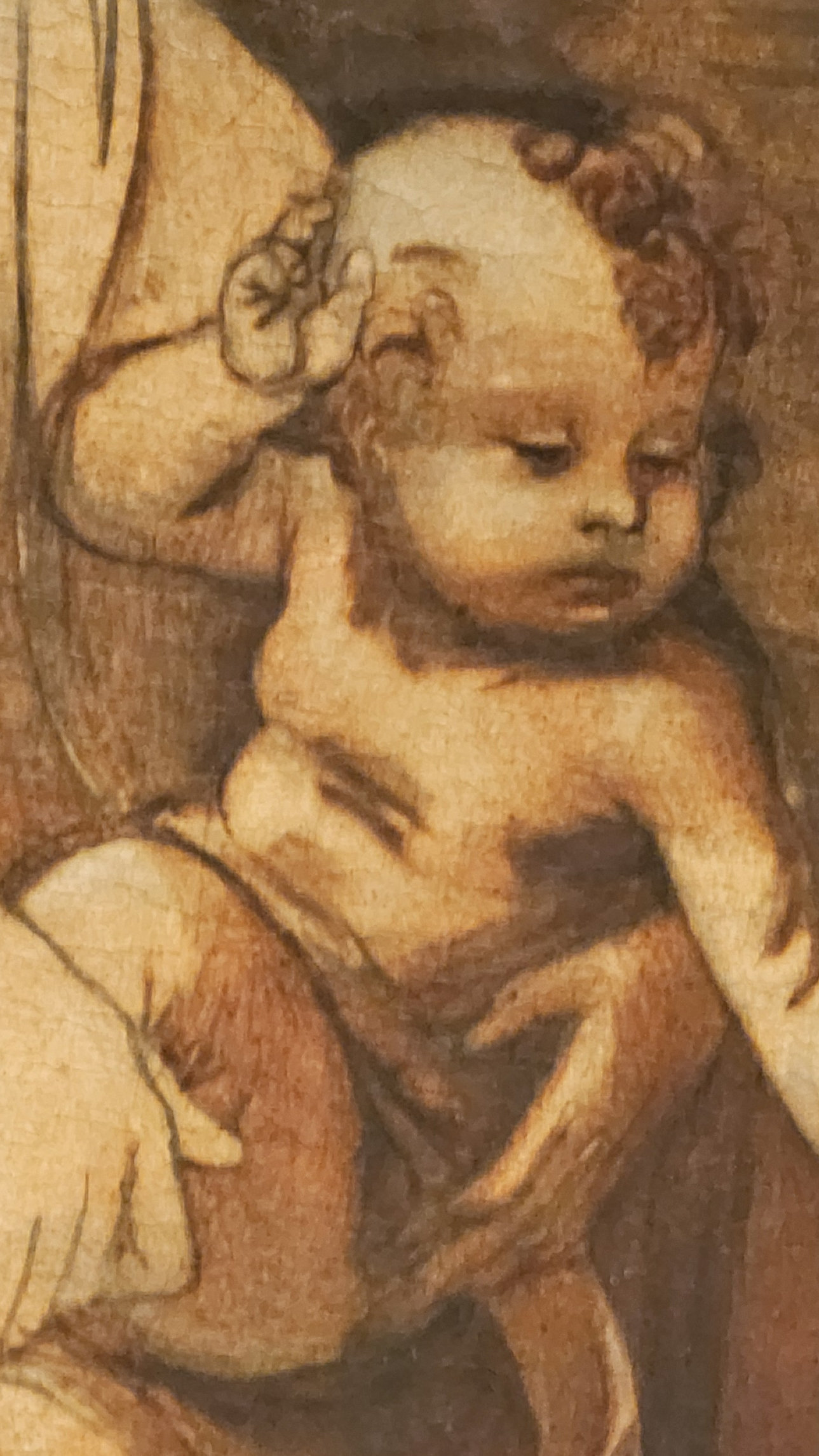
Anatomical study
undated
Leonardo da Vinci
This drawing is a pen and ink anatomical study by the late great Leonardo: It exhibits precise line, cross-hatching and close observation of musculature. This shows how dissection informed both his scientific inquiry and his art, producing images that are at once analytical diagrams and expressive studies of the human body. This piece was commisioned for an altar piece of the San Donato Scopeto church just outside Florence, but was never finished by Leonardo. Instead, the church chose to place a piece of art by Filippo Lippi instead. This did not seem to bother Leonardo, though. He was rebellious. As was this strange baby Jesus face. Because let's be honest, have you ever seen baby Jesus with a curly mohawk before? In fact, have you ever seen a curly mohawk before, full stop? Really? In real life?
Of course, the great Leonardo can't be left out. If only there was a Baby Mutant Ninja Turtle, I'm sure that he would have a strange face out there. Leonardo da Vinci (1452–1519) was the most broadly inventive figure of the Renaissance, a painter, engineer, anatomist, and theorist whose work reshaped the possibilities of artistic and scientific inquiry. Trained in the workshop of Andrea del Verrocchio, he absorbed the discipline of precise drawing and controlled technique, then expanded it into a far more exploratory practice grounded in direct observation and relentless experimentation. As a painter, Leonardo developed a visual language built on subtle transitions of light (*sfumato*), carefully constructed anatomy, and complex psychological interaction between figures. Works such as the *Virgin of the Rocks*, *The Last Supper*, and the *Mona Lisa* show his ability to integrate naturalistic detail with layered symbolic meaning and sophisticated spatial design. His drawings—ranging from anatomical studies to mechanical inventions—reveal a mind probing structure, movement, and underlying principles with exceptional rigor. Leonardo’s notebooks demonstrate his wide intellectual reach: hydraulics, optics, flight, geology, urban planning, and military engineering all appear alongside artistic theory. His approach to knowledge was empirical and integrative, treating observation as the foundation for both artistic and scientific understanding. Although many of his projects remained unfinished or unrealized, his influence on painting, scientific method, and the broader culture of inquiry is profound. He stands as a central figure in the shift toward a Renaissance worldview grounded in investigation, structure, and the search for underlying causes.
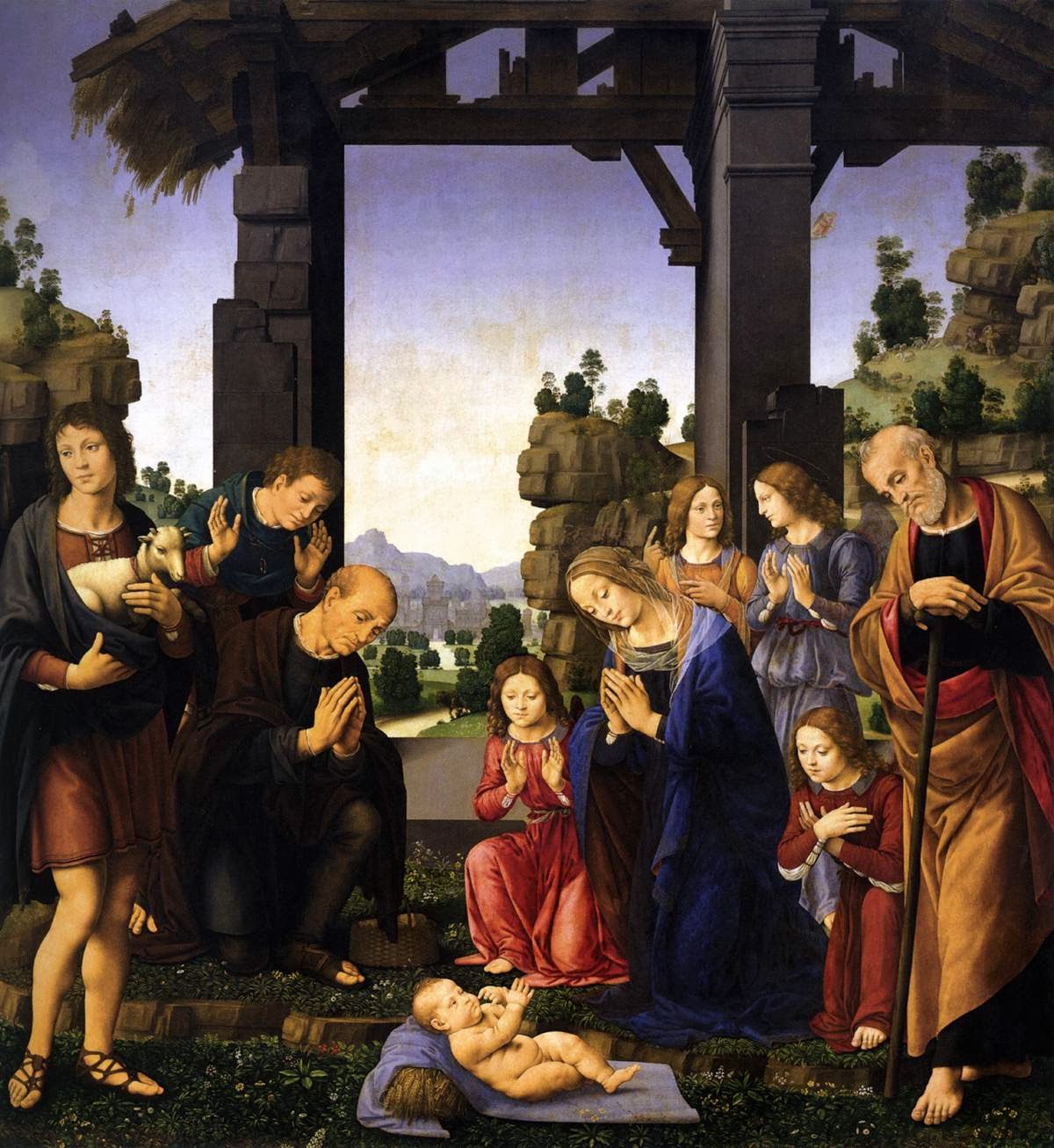
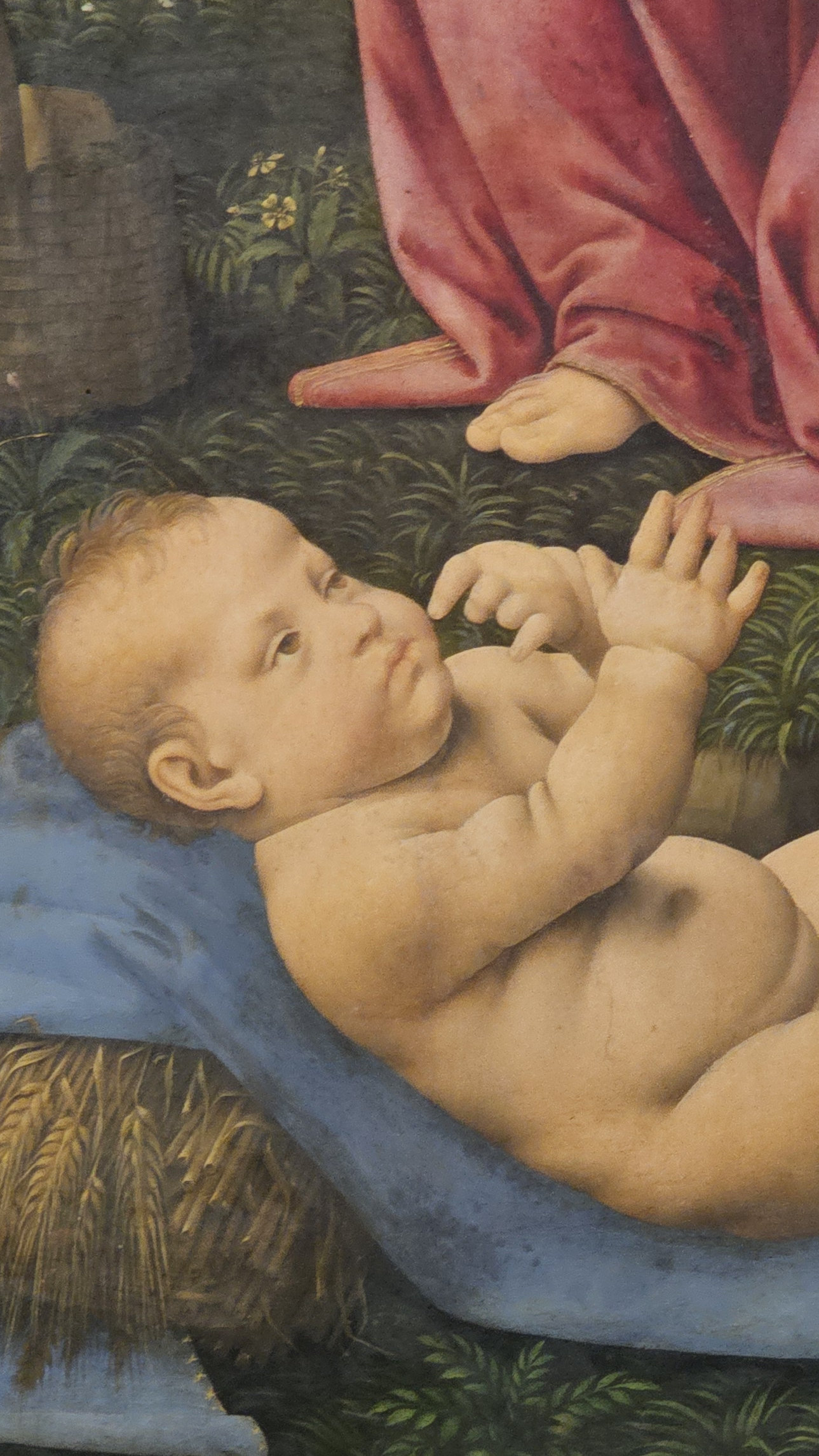
Nativity of Jesus and the Adoration of the Shepherds
c. 1495-1497
Lorenzo di Credi
This face appears in an oil on panel altarpiece where Lorenzo di Credi's serene artistic style gives this strange baby Jesus a calm, sculptural presence. The painting clearly takes its inspiration from Verrocchio, Leonardo and Perugino, which places it squarely within late-Quattrocento Florentine painting. This painting shows a thematic choice often made by the workshop of di Credi: Jesus was not a skinny baby. Look at his rolls, look at his folds. Look at his rummy bummy tummy. He would surely be the 'baby of the year', as Sam Richardson would say.
Lorenzo di Credi (c. 1456–1537) was a key figure in the generation of Florentine painters shaped by the workshop of Andrea del Verrocchio, where he trained alongside artists such as Leonardo da Vinci and Pietro Perugino. His work is marked by meticulous technique, steady draftsmanship, and a controlled, polished finish that reflects the disciplined environment of Verrocchio’s studio. Lorenzo specialized in devotional paintings—particularly *Madonna and Child* compositions—built on calm symmetry, smooth transitions of light, and carefully rendered surfaces. He became one of the workshop’s most reliable painters, completing commissions left unfinished by Verrocchio and maintaining the studio’s reputation for precision. His altarpieces and panel paintings show a consistent focus on clarity of form and a measured, orderly approach to composition. In later years, Lorenzo’s style grew even more restrained, reflecting his deepening religious convictions and a preference for quiet, contemplative imagery. His career illustrates how Florentine art balanced innovation with disciplined craft, and his work remains an important example of the refined, technically exacting side of the late fifteenth century.
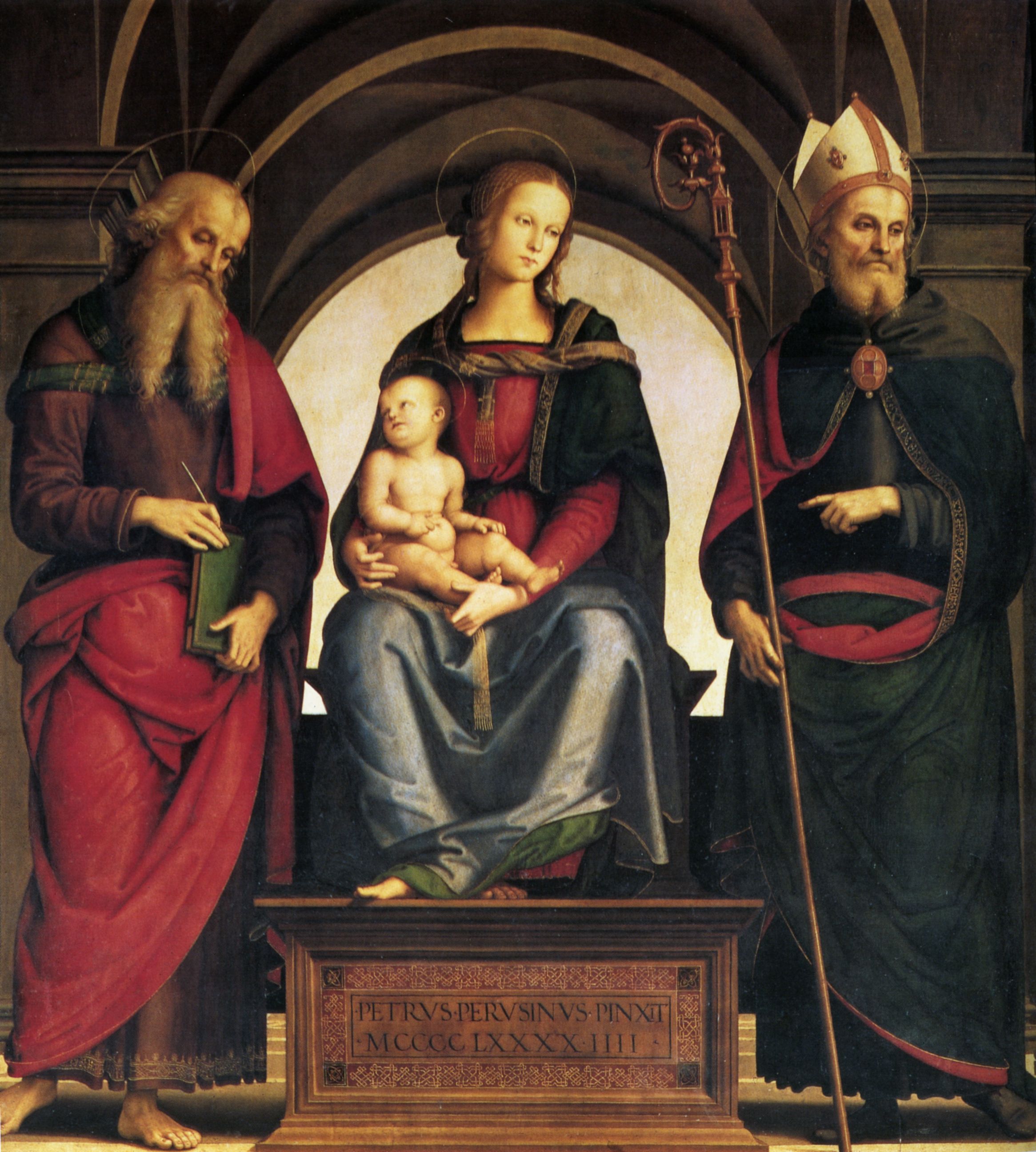
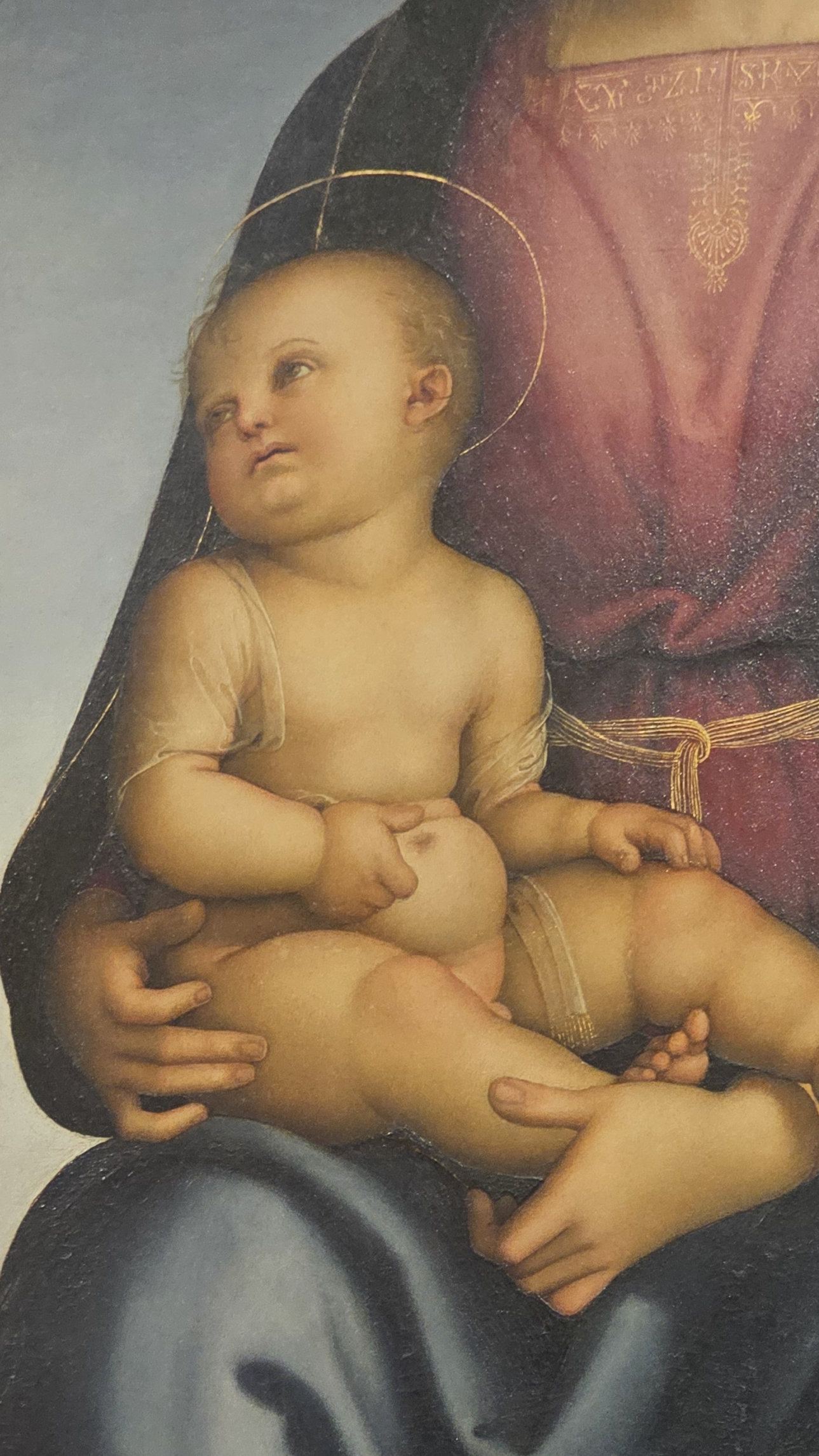
Vergine in trono col Bambino e i santi Sebastiano e Giovanni Battista; Virgin and Child enthroned between SS. Sebastian and John the Baptist
1493
Il Perugino Pietro Vannucci detto
This face appears in an oil on panel from Pietri il Perugino. It shows Jesus placed within John the Baptist and saint Sebastian. saint Sebastian is an interesting figure in early Christianity, having lived between 255 and 288 A.D. (33 years old, just like 'you know who'). The story goes that the roman emperor Diocletian, also nicknamed Jovius (or Jon Bon Jovius, as I like to call him), started a persecution of all believers in Christianity. During this persecution, saint Sebastian was tied to a tree and hit with arrows. Miraculously, though, this did not kill or hurt him. Saint Sebastian was subsequently healed and rescued by Irene of Rome. And what was the first thing he did? He went straight to Diocletian of course, to warn him about his sins. Naturally, this lead to him being clubbed to death as if he was the Matrix theme song or a Canadian seal. And well ... let's put our cards on the table: this is likely the least strange baby Jesus face on this website. It's actually quite beautiful when you look at it. So let's just do that. Everyone deserves a good face after a few strange ones.
Il Perugino, born **Pietro Vannucci** around 1450, was one of the most influential painters of the Italian Renaissance, known for shaping the calm, measured visual language that defined much of late‑Quattrocento and early Cinquecento art. Trained in Florence—likely in Verrocchio’s orbit—he absorbed the city’s emphasis on clear drawing and balanced composition, then fused it with the softer, more atmospheric sensibility characteristic of Umbrian painting. Working between **Perugia**, **Florence**, and later **Rome**, Perugino developed a style marked by steady contours, controlled perspective, and a quiet, contemplative mood. His figures often inhabit spacious, orderly landscapes or architectural settings that create a sense of equilibrium and gentle rhythm. The **Delivery of the Keys to Saint Peter** in the Sistine Chapel is his most celebrated achievement, a landmark of Renaissance spatial construction and serene narrative clarity. Perugino’s workshop became one of the most productive in Italy, supplying altarpieces, devotional panels, and portraits to patrons across the peninsula. It was also the training ground for **Raphael**, whose early works reflect Perugino’s compositional discipline and calm figural presence. Although Perugino’s reputation declined in his later years—partly due to changing tastes and the rise of more dramatic styles—his contribution to the formation of the High Renaissance is fundamental. He helped establish the visual vocabulary of balance, order, and measured harmony that shaped an entire generation of painters.
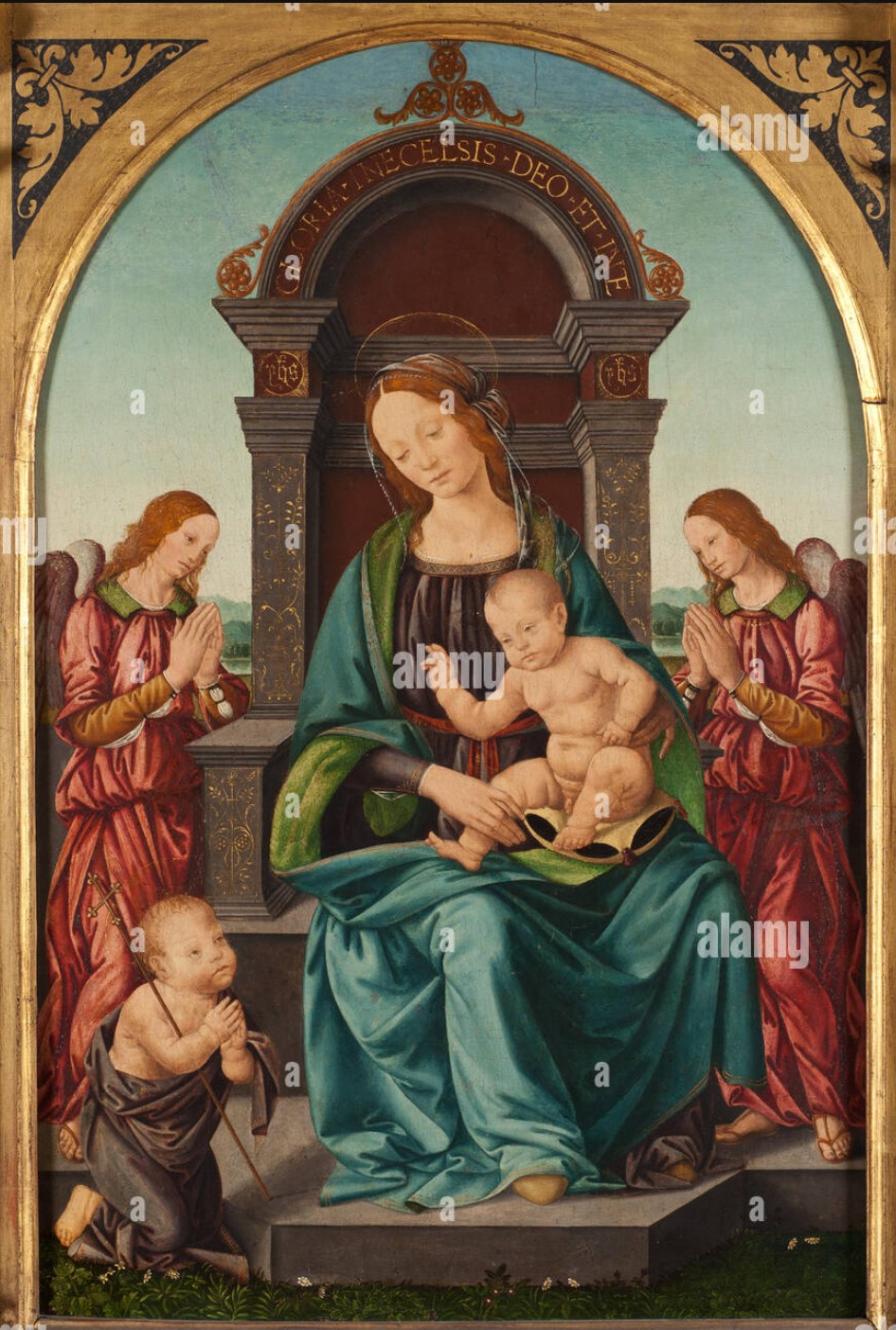
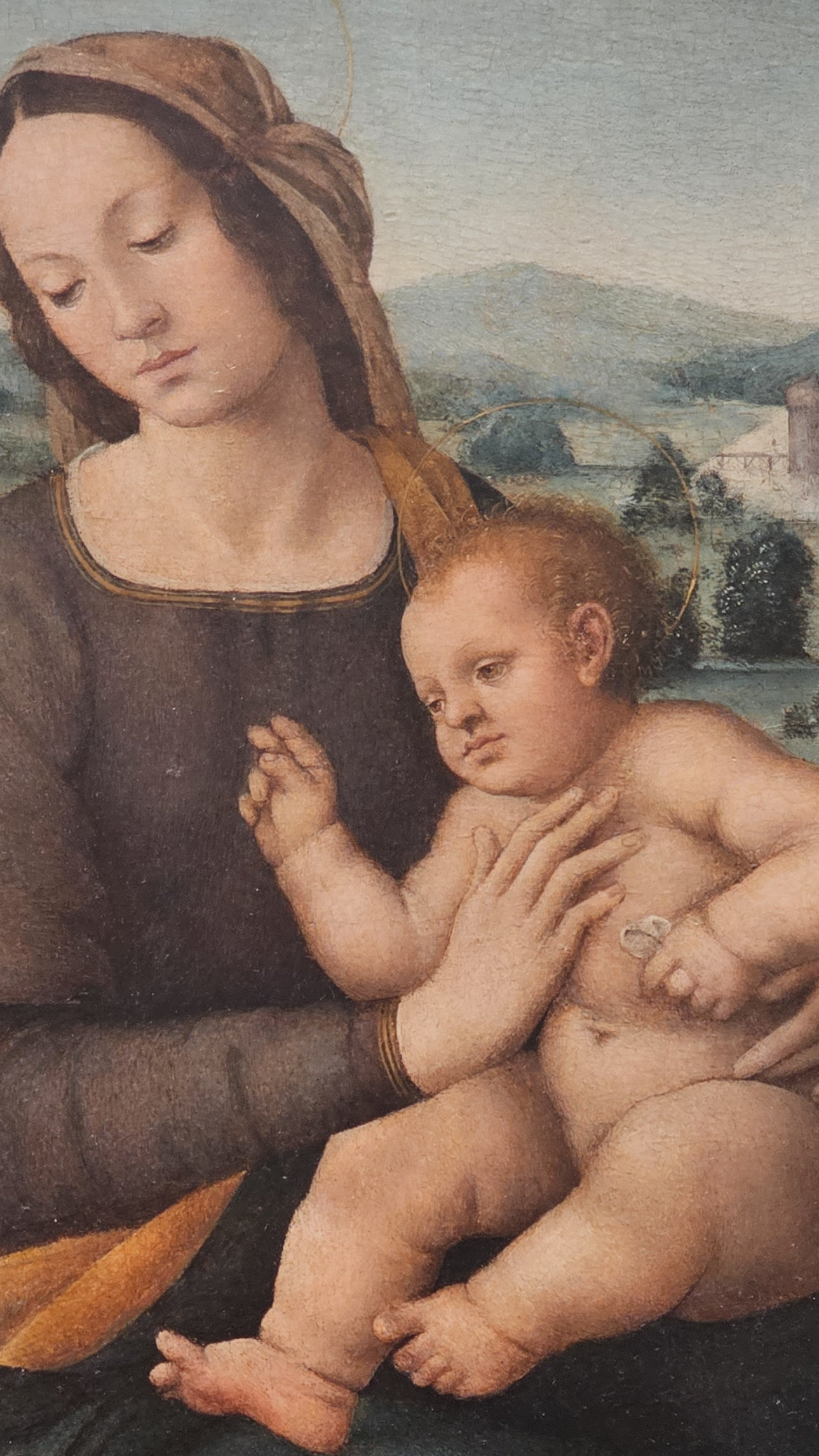
Madonna and Child with the Young St. John the Baptist and Angels
c. 1500-1520
Lorenzo di Credi e bottega
This face appears on a tempera on wood tondo from Lorenzo di Credi's workshop. It is one of several versions coming out of the same workshop, which is highlighted by the full image of the painting on this website, which is in fact a different alteration from the same workshop. The main features of these paintings were often painted by the master of the workshop, in this case di Credi, and the painting was then finished by his apprentices. There are many versions of this painting, but the rare 17th-century carved and painted frame - of which we see the zoomed-in strange baby Jesus face - is the most valuable. This baby Jesus seems to know this. Looking equal parts bored and godlike at the same time, Jesus is content with the adoration he is receiving. But not for long ...
Lorenzo di Credi (c. 1456–1537) was a key figure in the generation of Florentine painters shaped by the workshop of Andrea del Verrocchio, where he trained alongside artists such as Leonardo da Vinci and Pietro Perugino. His work is marked by meticulous technique, steady draftsmanship, and a controlled, polished finish that reflects the disciplined environment of Verrocchio’s studio. Lorenzo specialized in devotional paintings—particularly *Madonna and Child* compositions—built on calm symmetry, smooth transitions of light, and carefully rendered surfaces. He became one of the workshop’s most reliable painters, completing commissions left unfinished by Verrocchio and maintaining the studio’s reputation for precision. His altarpieces and panel paintings show a consistent focus on clarity of form and a measured, orderly approach to composition. In later years, Lorenzo’s style grew even more restrained, reflecting his deepening religious convictions and a preference for quiet, contemplative imagery. His career illustrates how Florentine art balanced innovation with disciplined craft, and his work remains an important example of the refined, technically exacting side of the late fifteenth century.
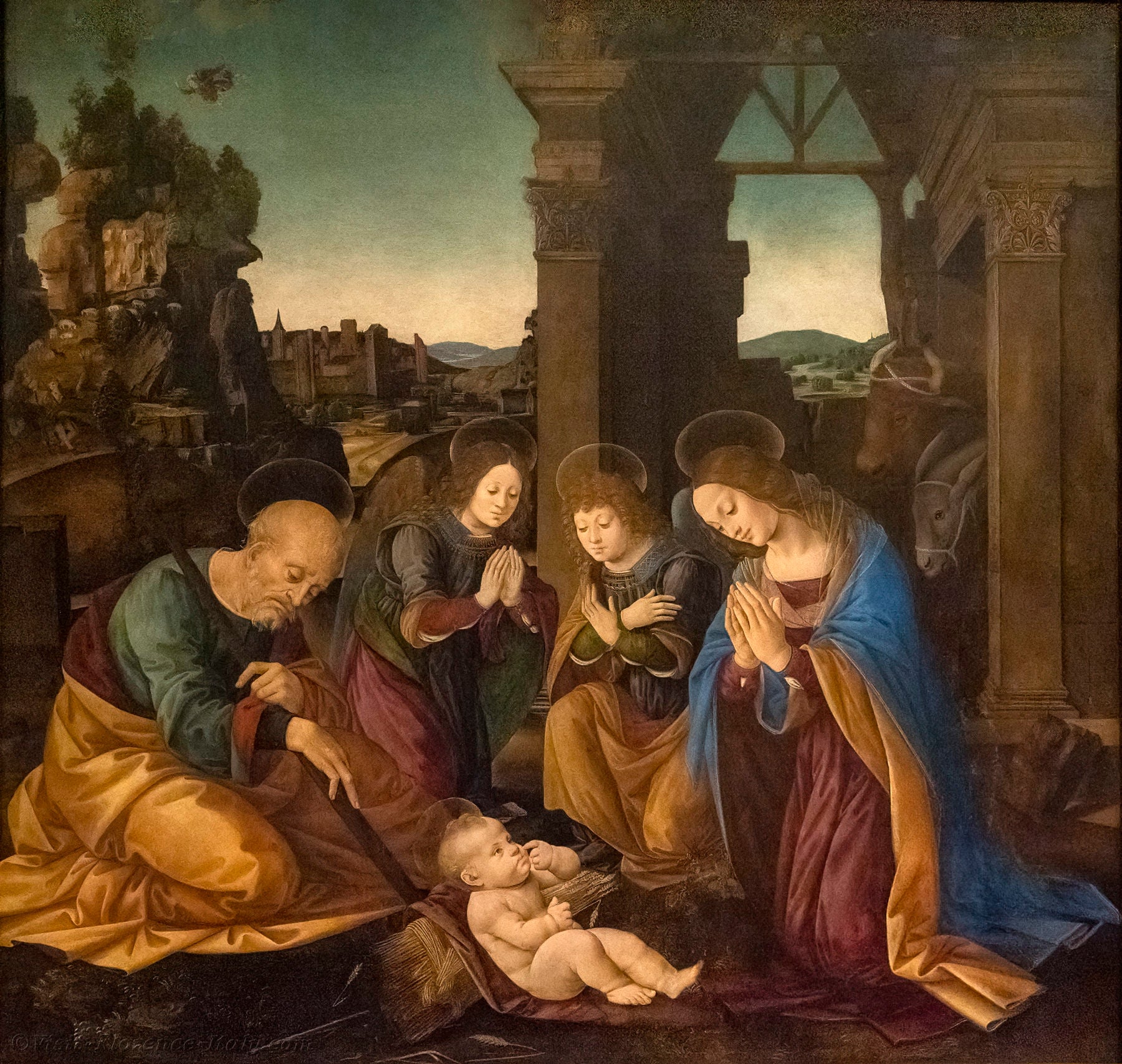
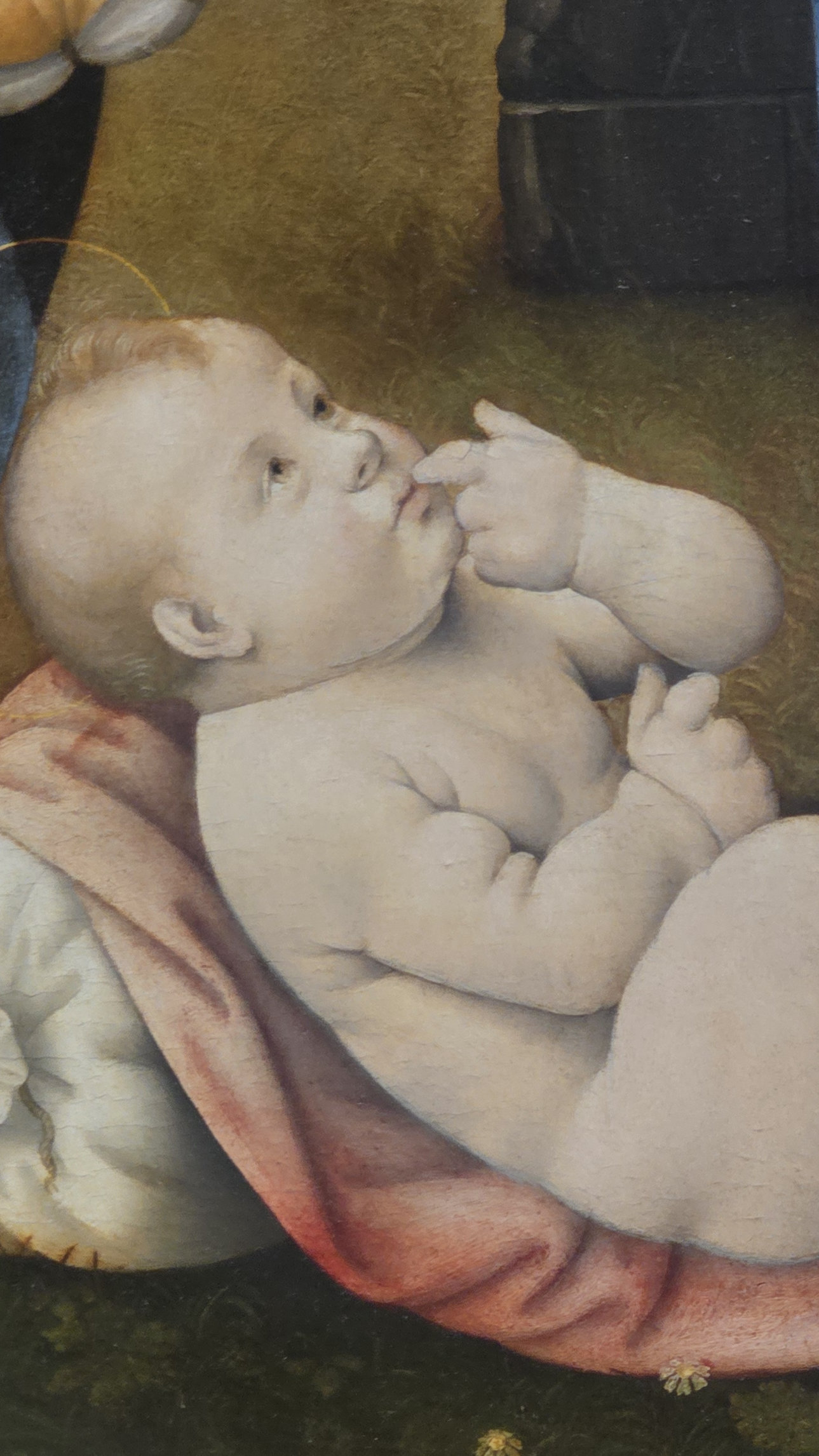
Adoration of the Christ Child (La Vergine che adora il Figlio e un Angelo)
c. 1505-1515
Lorenzo di Credi
This face appears on a tempera on wood tondo from the workshop of Lorenzo di Credi. It is one of several versions coming out of the same workshop, which is highlighted by the full image of the painting on this website, which is in fact a different alteration from the same workshop. The main features of these paintings were often painted by the master of the workshop, in this case di Credi, and the painting was then finished by his apprentices. It is a clear example of the typical approach in such workshops in 15th and 16th century Italy. Or better yet, 15th and 16th century Florence, seeing as it was still two and a half centuries away from being unified under the leadership of the most French sounding Italian leader in history: Viktor Emmanuel II. The painting has been recorded in the collection of the Uffizi as early as 1704, which highlights its place within Florentine collecting traditions. Perhaps it was also this strange baby Jesus face that inspired the iconic pose of dr. Evil in the 1997 comedy classic 'Austin Powers: International Man of Mystery'. The price of this painting? 'One million dollars!'
Lorenzo di Credi (c. 1456–1537) was a key figure in the generation of Florentine painters shaped by the workshop of Andrea del Verrocchio, where he trained alongside artists such as Leonardo da Vinci and Pietro Perugino. His work is marked by meticulous technique, steady draftsmanship, and a controlled, polished finish that reflects the disciplined environment of Verrocchio’s studio. Lorenzo specialized in devotional paintings—particularly *Madonna and Child* compositions—built on calm symmetry, smooth transitions of light, and carefully rendered surfaces. He became one of the workshop’s most reliable painters, completing commissions left unfinished by Verrocchio and maintaining the studio’s reputation for precision. His altarpieces and panel paintings show a consistent focus on clarity of form and a measured, orderly approach to composition. In later years, Lorenzo’s style grew even more restrained, reflecting his deepening religious convictions and a preference for quiet, contemplative imagery. His career illustrates how Florentine art balanced innovation with disciplined craft, and his work remains an important example of the refined, technically exacting side of the late fifteenth century.
Adoration of the Child
1478-1480 circa
Filippino Lippi
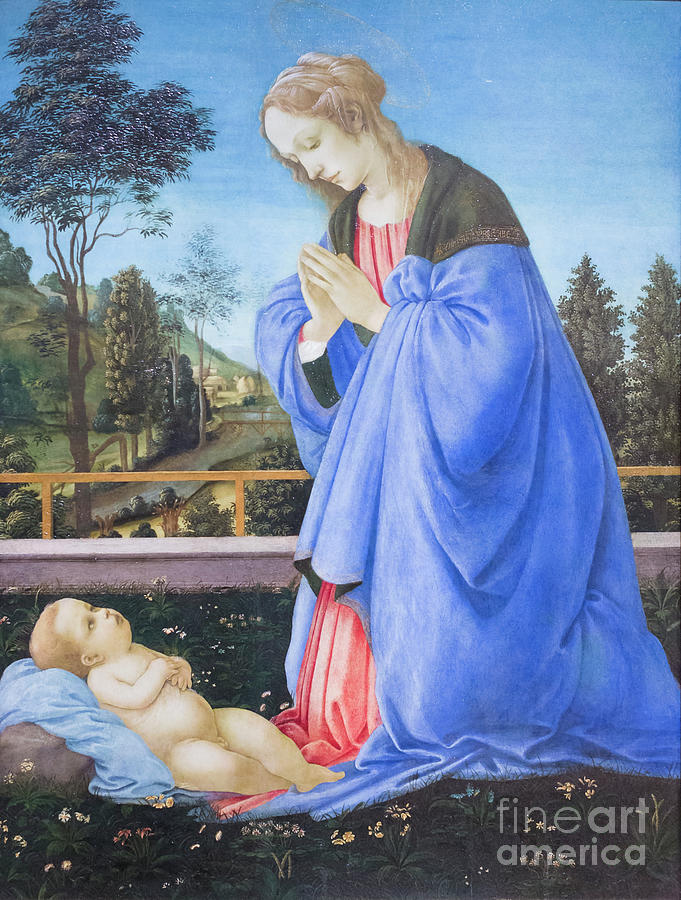
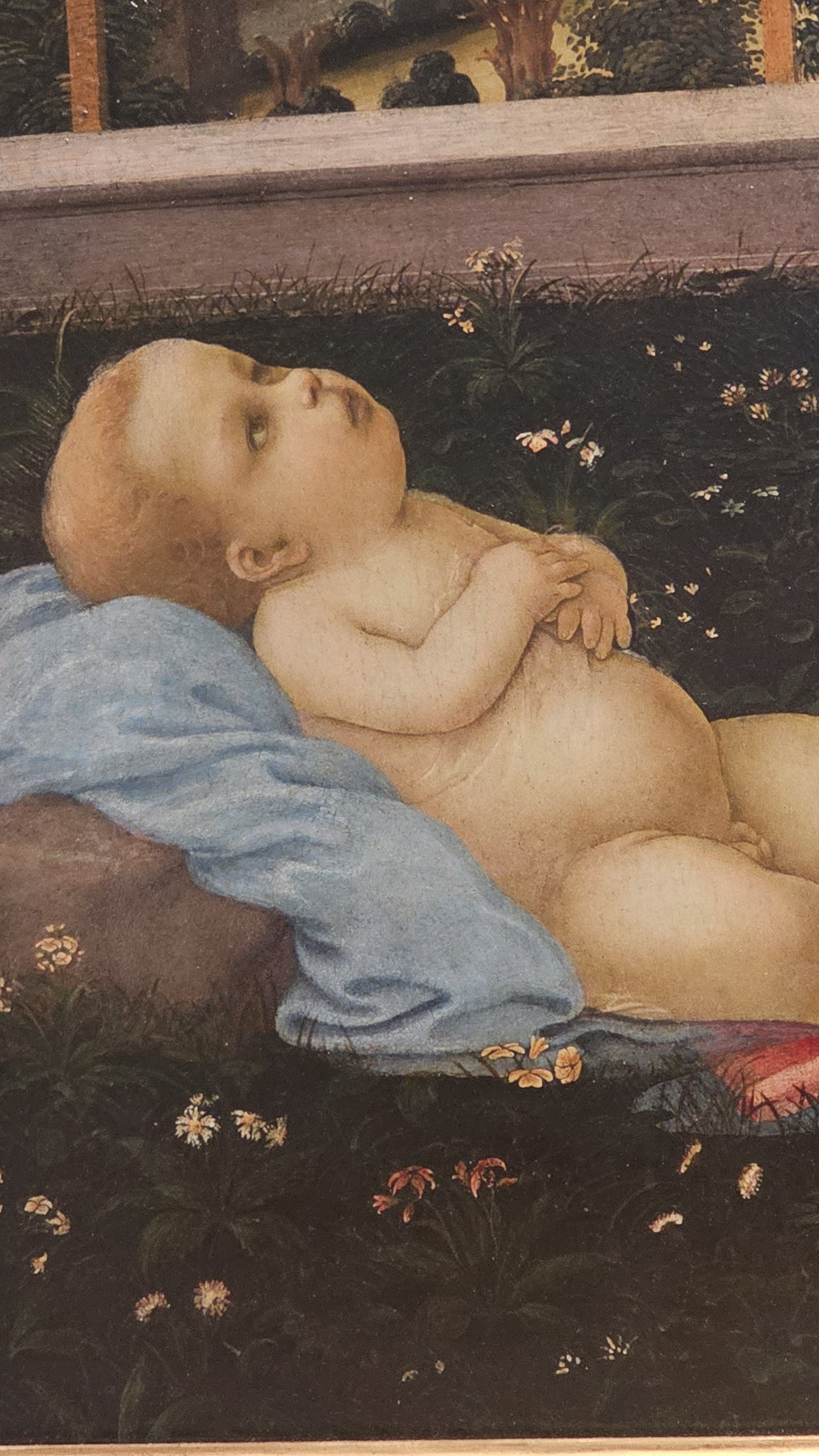
This face appears on a tempera on panel by Filippino Lippi's made for private devotion. This piece was clearly painted during Lippi's early 'Botticellian'-phase. This phase of the artist even lead to his nickname, given later by art historians: 'Sandro's friend'. With 'Sandro' being the first name of Sandro Botticelli. This is not the most ideal classification as an artist. Could you imagine how Christiano Ronaldo would react, if we were to call him 'Messi's friend'?. As an artist, you'd try to contort yourself into all kinds of weird positions just to get out of this classification. And perhaps this was the iconography that Lippi was trying to get across when painting the right-angle neck of this particular strange baby Jesus.
Domenico Veneziano (c. 1410–1461) was a central figure in the development of early Renaissance painting, known for introducing a new clarity of light and color that helped shift Florentine art toward a more measured and atmospheric approach. Trained within the circles that absorbed lessons from both Masaccio and the International Gothic tradition, he developed a style marked by balanced compositions, steady modeling, and a distinctive use of soft, luminous tones that gave his figures a calm, grounded presence. His *Santa Lucia dei Magnoli Altarpiece* is a landmark of fifteenth‑century painting, showing how carefully controlled light can unify space and create a coherent sense of environment. Veneziano worked alongside and influenced artists such as Piero della Francesca, contributing to the broader move toward rational perspective and spatial harmony. His career illustrates a moment when Florentine art embraced new technical and optical ideas, and his paintings remain essential for understanding the transition from early Quattrocento experimentation to a more mature Renaissance vision.
Adoration of the Christ Child with the Young St. John the Baptist
c. 1478-1480
Filippino Lippi
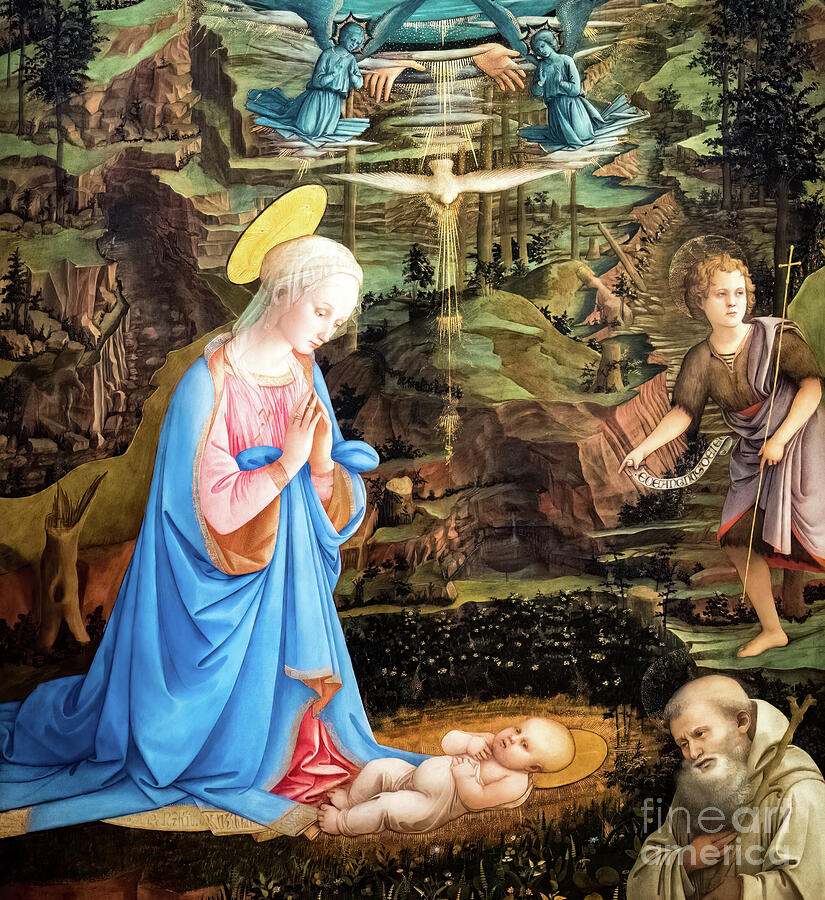
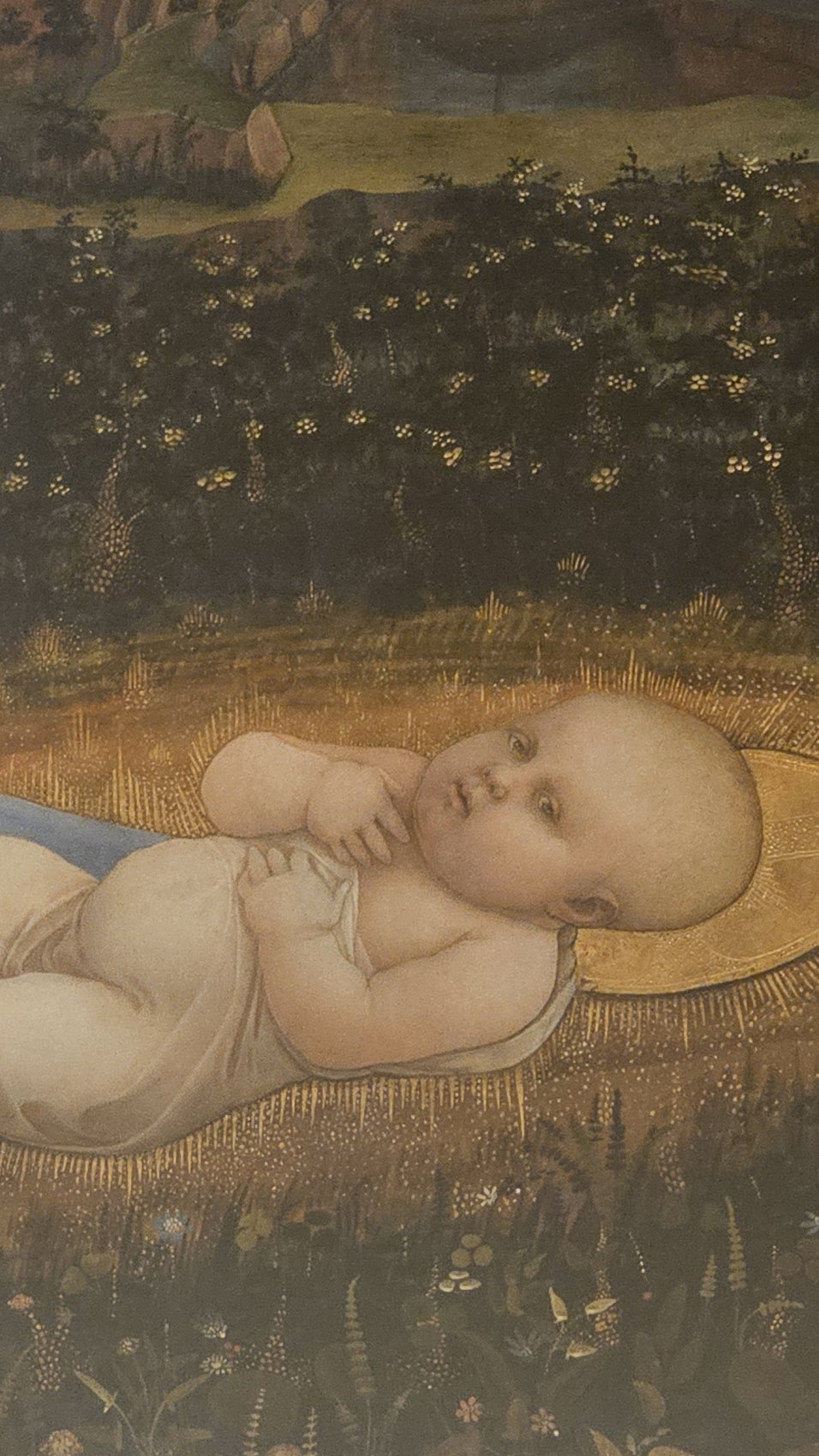
This face appears on a tempera on wood panel from early on in the great Filippino Lippi's career. Although this claim was contested for a long time after its aquirement by the Uffizi in the 19th century. It was only after considerable restauration in 2004 that its provenance could be confirmed. And boy oh boy, the painting ... it is a big one. Not just the painting, but also the face. Also the forehead. Fivehead? Sixhead? Anyone? Let's settle at seven and call it a day. Which seems to be exactly what this strange baby Jesus is saying.
Domenico Veneziano (c. 1410–1461) was a central figure in the development of early Renaissance painting, known for introducing a new clarity of light and color that helped shift Florentine art toward a more measured and atmospheric approach. Trained within the circles that absorbed lessons from both Masaccio and the International Gothic tradition, he developed a style marked by balanced compositions, steady modeling, and a distinctive use of soft, luminous tones that gave his figures a calm, grounded presence. His *Santa Lucia dei Magnoli Altarpiece* is a landmark of fifteenth‑century painting, showing how carefully controlled light can unify space and create a coherent sense of environment. Veneziano worked alongside and influenced artists such as Piero della Francesca, contributing to the broader move toward rational perspective and spatial harmony. His career illustrates a moment when Florentine art embraced new technical and optical ideas, and his paintings remain essential for understanding the transition from early Quattrocento experimentation to a more mature Renaissance vision.
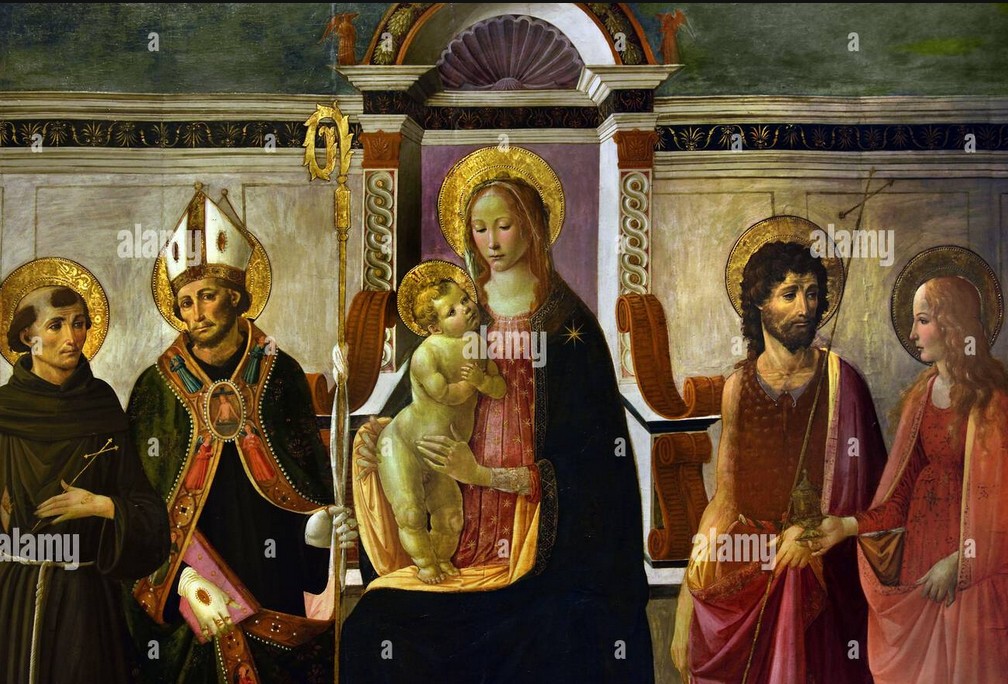
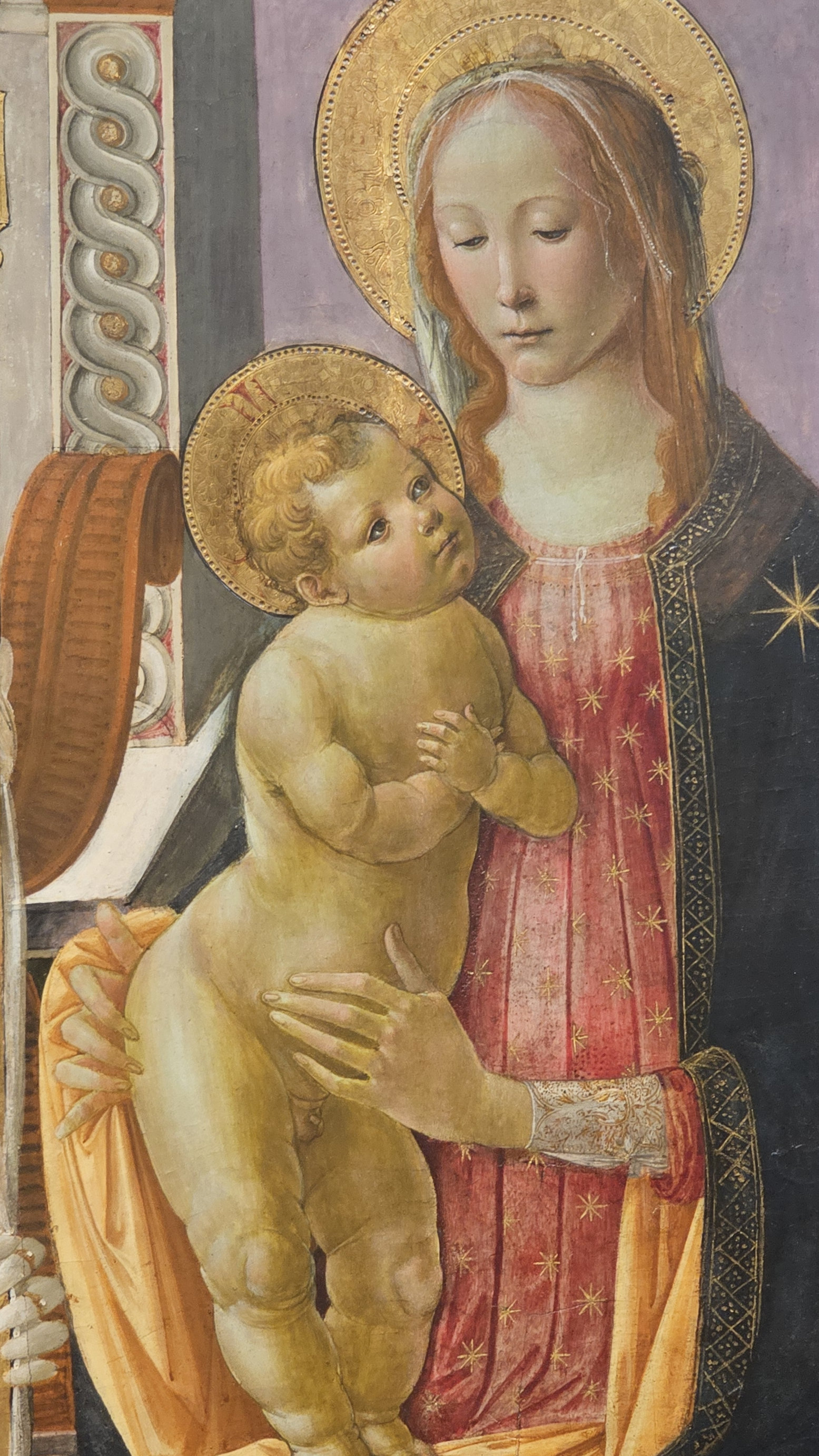
Madonna and Child Enthroned with St. Francis, a Sainted Bishop, St. John the Baptist and St. Mary Magdalen
c. 1470-1475
Gherardo di Giovanni
This face appears on a tempera on wood panel attributed to Gherardo di Giovanni. The artist was an interesting fellow, and in particular was known as an artist 'in general'. He was not only a great painter, but also a great organist and mosaic artist (mosaicician? If that's not already a word, I want to be its inventor). He was even such a talented painter, that this baby Jesus face, does not stand out on this website as being particularly strange. Just a little, though. Which is enough.
Gherardo di Giovanni (c. 1445–1497) was a versatile Florentine artist whose work spans painting, illumination, and decorative arts, reflecting the broad range of skills cultivated in the city’s workshops during the late fifteenth century. A member of the well‑known di Giovanni family of artists, he produced small devotional panels, manuscript miniatures, and designs for luxury objects, all marked by clear drawing, bright color, and a steady, craftsmanlike approach. His paintings often show compact compositions and direct, readable narratives, while his illuminations demonstrate careful attention to ornament and finely controlled detail. Gherardo worked for both civic and private patrons, contributing to the visual culture that surrounded everyday religious practice in Florence. Although not a major innovator, he played a meaningful role in sustaining the city’s artistic production, illustrating how skilled workshop painters supported the broader creative environment of the Florentine Renaissance.
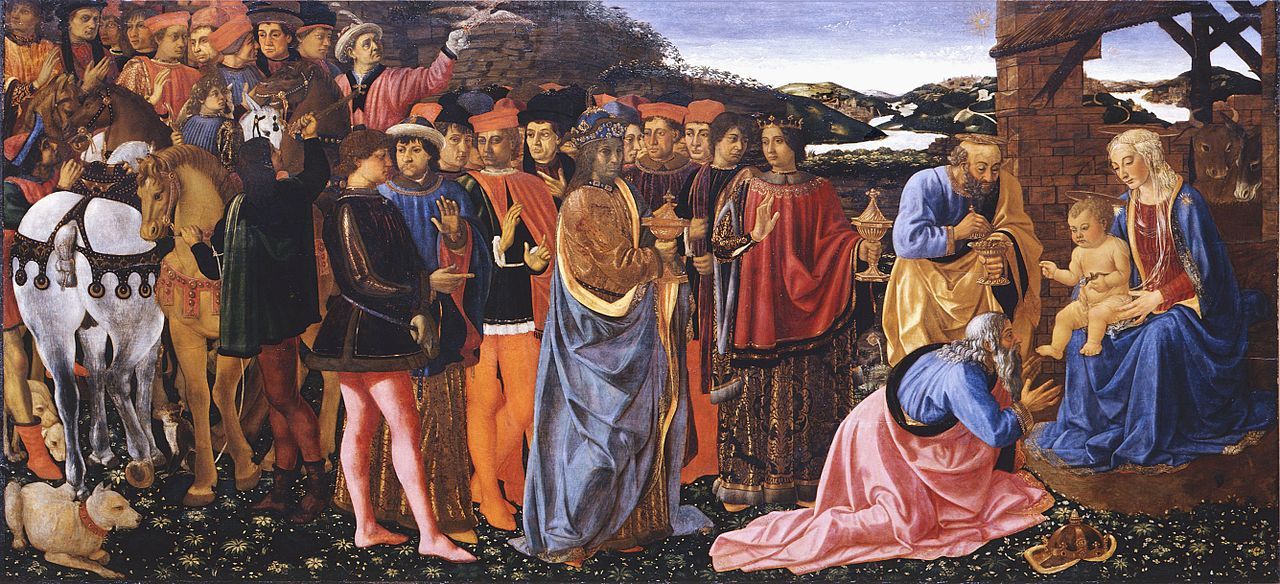
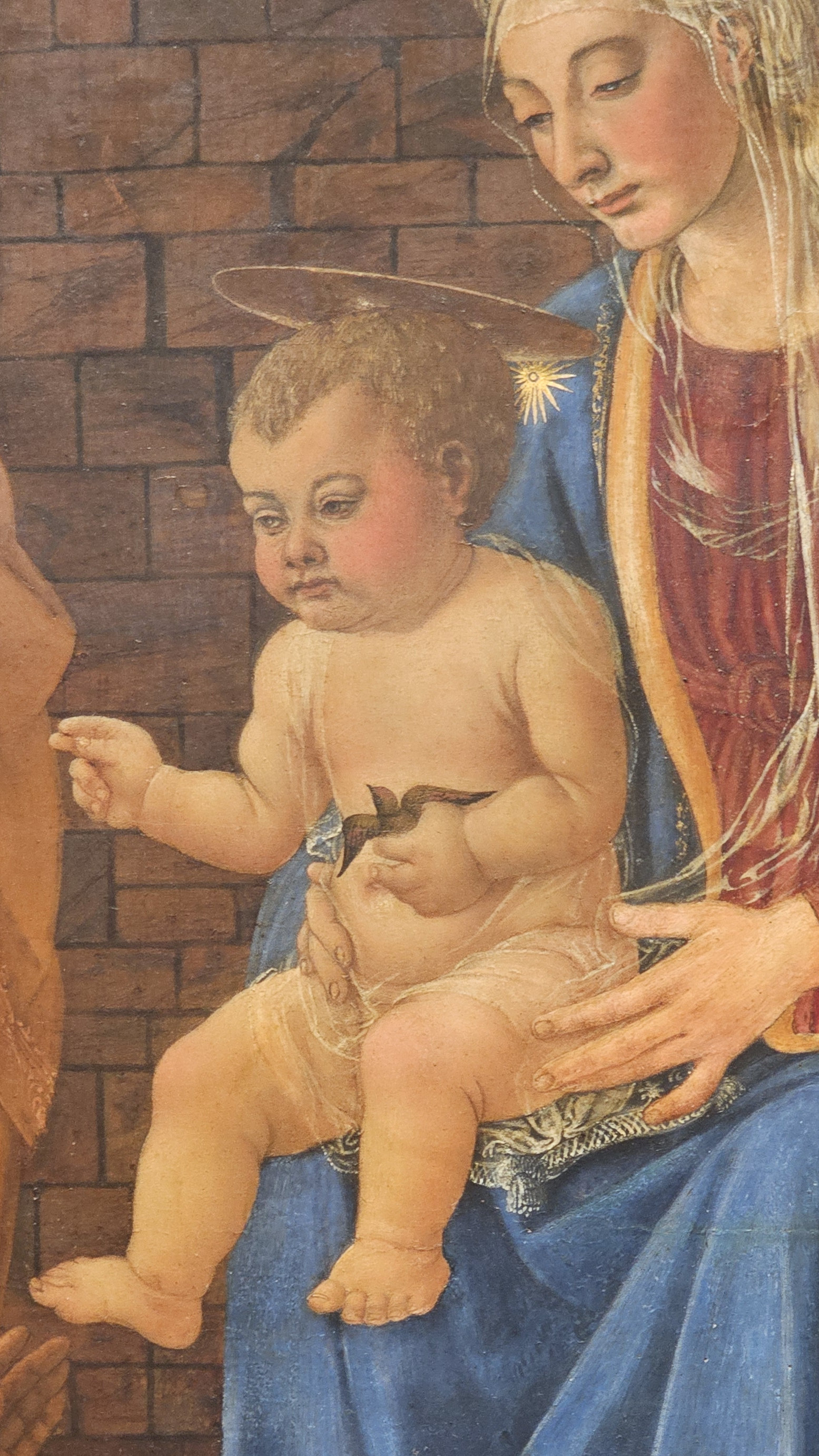
Adoration of the Magi
c. 1475
Cosimo Rosselli
This face appears in a tempera on wood panel by Cosimo Rosselli, which is depicts a typical subject in the Nativity of Jesus: The visitation by the three wisemen. The term Magi is used to refer to the three wisemen and can eventually be traced back to 'magâunô', which is a term for priests in Zoroastrianism. Although the provenance of this painting is unknown, the inclusion of the family crest of the Medici family implies a strong connection to the most famous merchant family that has ever lived on this planet. This baby Jesus, however, is not impressed. He is tired, ready for bed, but this annoying batch of eastern royalty have insisted on disturbing his sleep. They say they want to adore him. 'Fine ...' Jesus seems to say '... but only for a minute.'
Cosimo Rosselli (1439–1507) was a Florentine painter whose career reflects the disciplined, orderly side of late‑Quattrocento art, shaped by clear drawing, firm contours, and a steady commitment to established workshop practice. Trained within the Florentine tradition and active in several major commissions, he is best known for his role in decorating the Sistine Chapel, where his frescoes—such as the *Sermon on the Mount* and the *Last Supper*—show careful organization, bright color, and a direct narrative approach that appealed to his patrons. Rosselli also produced numerous altarpieces and devotional panels, works that emphasize structured compositions, readable gestures, and a consistent, methodical technique. Although not an innovator on the scale of some contemporaries, he played an important part in sustaining the visual language of Florentine painting during a period of intense artistic activity. His workshop trained several younger painters, including Piero di Cosimo, helping to transmit the city’s stylistic foundations into the next generation.
Madonna and Child with St. Francis, St. John the Baptist, St. Zenobius and St. Lucy
c. 1445-1447
Domenico Veneziano
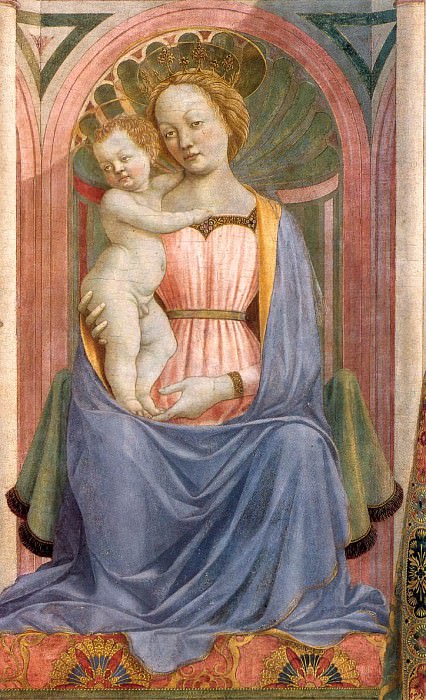
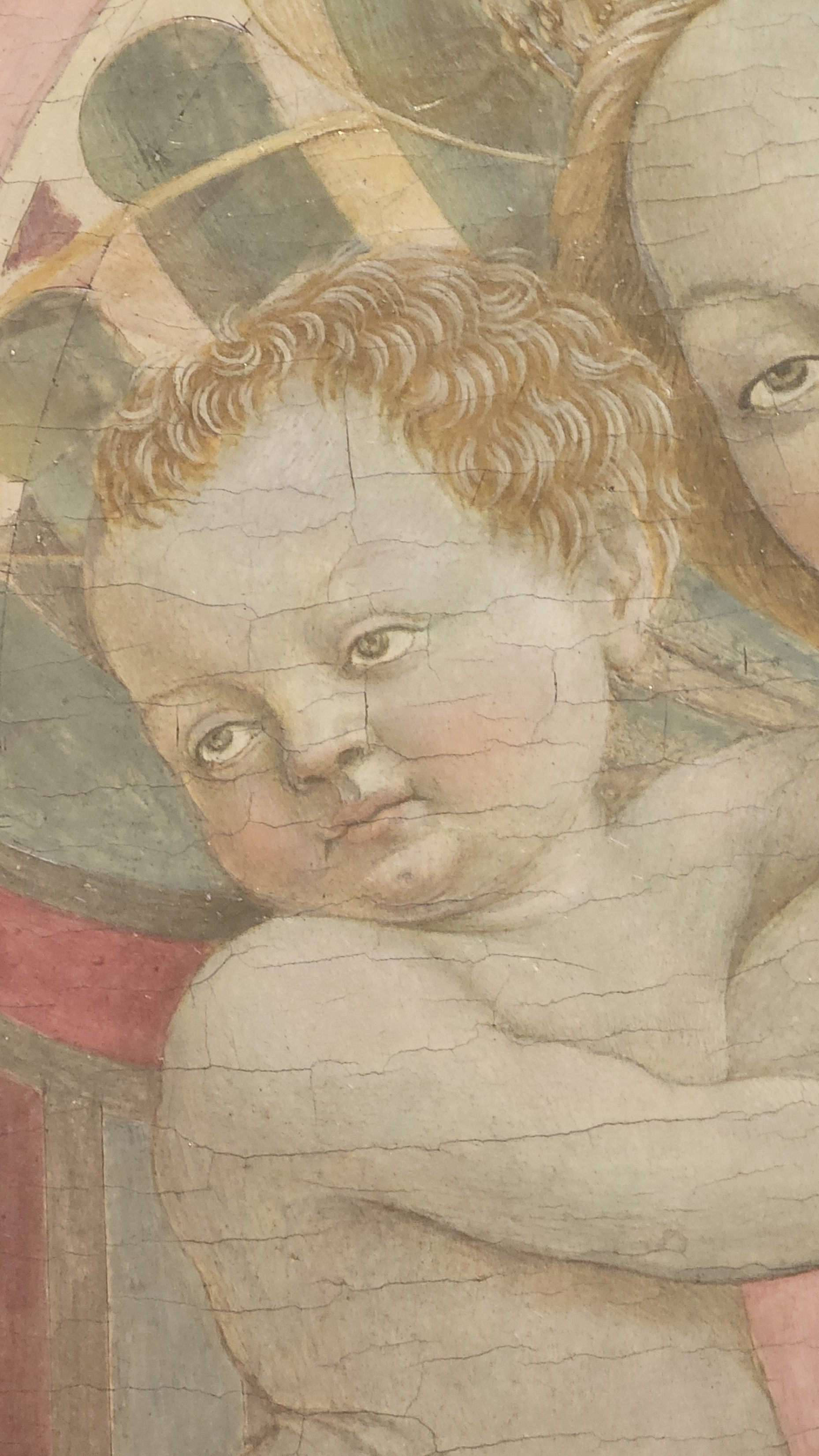
This face appears on a tempera on wood altarpiece in the church of Santa Lucia dei Magnoli in Florence. It was painted by Domenico Veneziano's, and proudly signed by him as well. What is especially remarkable in this painting is the use of light, which resembles but predates the luminous morning light paintings by the Dutch master Vermeer. It is softer than the harsh and constrasting Chiaroscuro technique, often associated with Caravaggio. Instead, the soft lighting acts to enhance the softness of the faces of Mary and Christ. If only they were happy about this. From the painting, it looks as if both are hollywood stars having just sat through a full day of interviewers. This is the last interviewer of the day and he is asking again for a funny story about their co-stars. Jesus has told this story about seventeen times today and just wants to go home and have a nap in his crib.
Domenico Veneziano (c. 1410–1461) was a central figure in the development of early Renaissance painting, known for introducing a new clarity of light and color that helped shift Florentine art toward a more measured and atmospheric approach. Trained within the circles that absorbed lessons from both Masaccio and the International Gothic tradition, he developed a style marked by balanced compositions, steady modeling, and a distinctive use of soft, luminous tones that gave his figures a calm, grounded presence. His *Santa Lucia dei Magnoli Altarpiece* is a landmark of fifteenth‑century painting, showing how carefully controlled light can unify space and create a coherent sense of environment. Veneziano worked alongside and influenced artists such as Piero della Francesca, contributing to the broader move toward rational perspective and spatial harmony. His career illustrates a moment when Florentine art embraced new technical and optical ideas, and his paintings remain essential for understanding the transition from early Quattrocento experimentation to a more mature Renaissance vision.
Madonna and Child with angels, St. John the Baptist and St. Jerome
1460-1470
Matteo di Giovanni
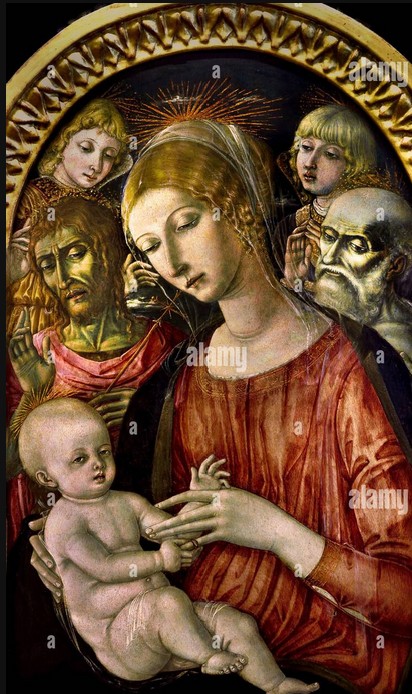
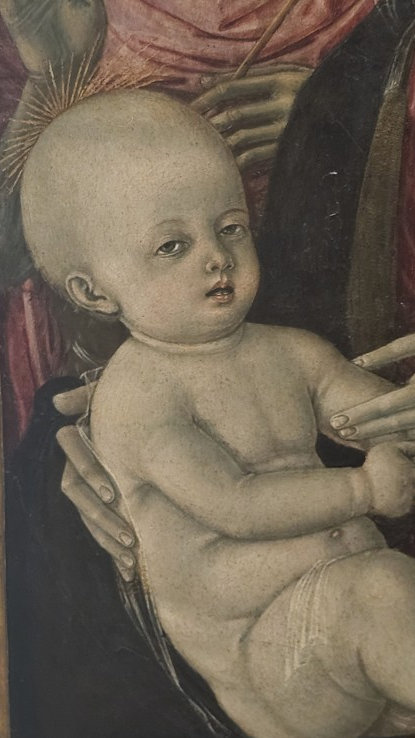
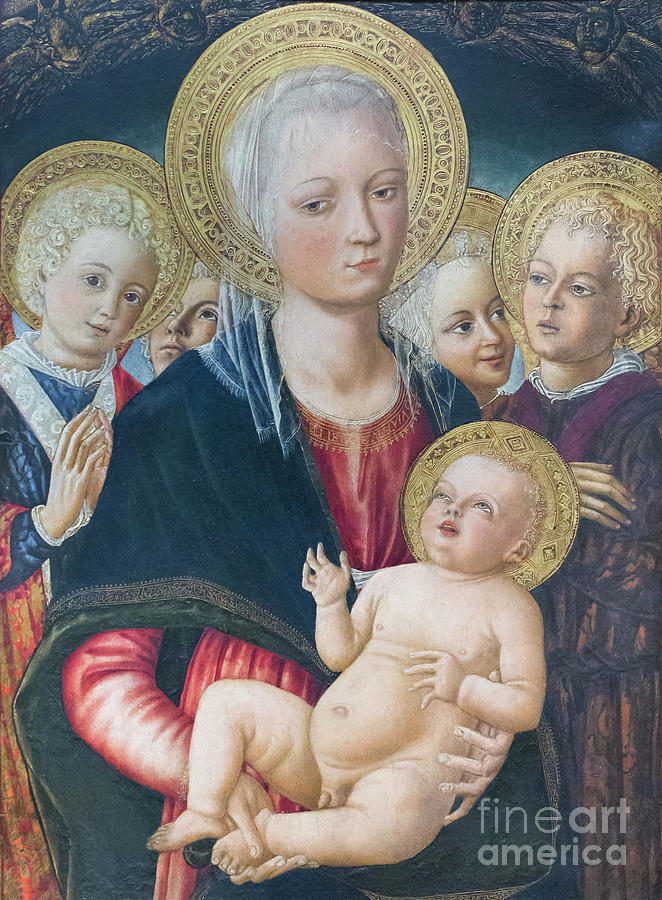
This face appears on a tempera on panel that reflects Matteo di Giovanni's establishment as the foremost strange baby Jesus painter of his time. It depicts the Madonna with child, as well as John the Baptist, St. Jerome and some angels hanging about. The inclusion of John the Baptist is most significant in this painting. John the Baptist is a Jewish preacher that plays a significant role in the Baha'i, Druze, Mandaeism and all three Abrahamic religions. He is also known as Yahya ibn Zakariya in the Islamic faith. Even though John was only born six years before Christ, he anticipated the coming is a Messiah, even though he himself was sort of 'Jesus, version 1'. In fact, it was Jesus who identifies John the Baptist in the Gospel of Matthew as 'Elijah, who is to come'. This is in reference to the old testament, where Elijah is essentially the messenger, who is to come before the coming of the Messiah. Looking at this painting, though, who could have predicted that the eventual Messiah would look like an alien from a C-rated science fiction movie?
Matteo di Giovanni (c. 1430–1495) was a leading painter of the Sienese Renaissance, known for combining the city’s long‑standing interest in linear clarity and vivid color with a more forceful emotional tone that marked the period’s artistic shift. Active primarily in Siena, he produced altarpieces, devotional panels, and narrative works that show firm drawing, sharply defined contours, and a direct approach to storytelling. His *Massacre of the Innocents* paintings are among his most striking achievements, revealing his ability to handle dramatic subjects with intensity while maintaining the compositional discipline characteristic of the Sienese school. Matteo also created numerous Madonnas and saints for local churches, works that balance strong figural presence with careful attention to pattern and surface. His career illustrates how Siena adapted Renaissance ideas while preserving its own visual identity, and his paintings remain central to understanding the city’s artistic development in the fifteenth century.
Madonna and Child with angels
1464-1475
Matteo di Giovanni
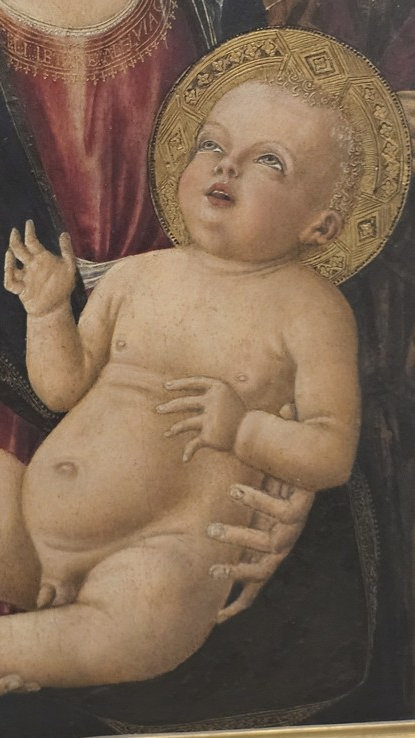
This face appears on a tempera on wood panel, which was most likely intended for private devotion in the house of rich citizens of Siena in the late 15th century. The artist is Matteo di Giovanni, a prosperous painter located in and heavily associated with Siena around that period. Unfortunately, this work by Giovanni has suffered from its many restorations in the past. It is a Madonna with Christ painting, where both are surrounded my archetypal figures resembling angels. The deprecation of the painting shows most clearly in the clothing of the angelic figure on the right-hand side, which has lost most of its intricate detail. It seems as if the baby Jesus is aware of this horror and has contorted his face into a permanent expression of desparation. As an additional act of rebellion, Jesus seems to have broken his pinky finger in two separate places, to taunt the very restaurationists whose acts have irreversibly deprecated this painting.
Matteo di Giovanni (c. 1430–1495) was a leading painter of the Sienese Renaissance, known for combining the city’s long‑standing interest in linear clarity and vivid color with a more forceful emotional tone that marked the period’s artistic shift. Active primarily in Siena, he produced altarpieces, devotional panels, and narrative works that show firm drawing, sharply defined contours, and a direct approach to storytelling. His *Massacre of the Innocents* paintings are among his most striking achievements, revealing his ability to handle dramatic subjects with intensity while maintaining the compositional discipline characteristic of the Sienese school. Matteo also created numerous Madonnas and saints for local churches, works that balance strong figural presence with careful attention to pattern and surface. His career illustrates how Siena adapted Renaissance ideas while preserving its own visual identity, and his paintings remain central to understanding the city’s artistic development in the fifteenth century.
Madonna and Child
c. 1455
Pellegrino di Mariano
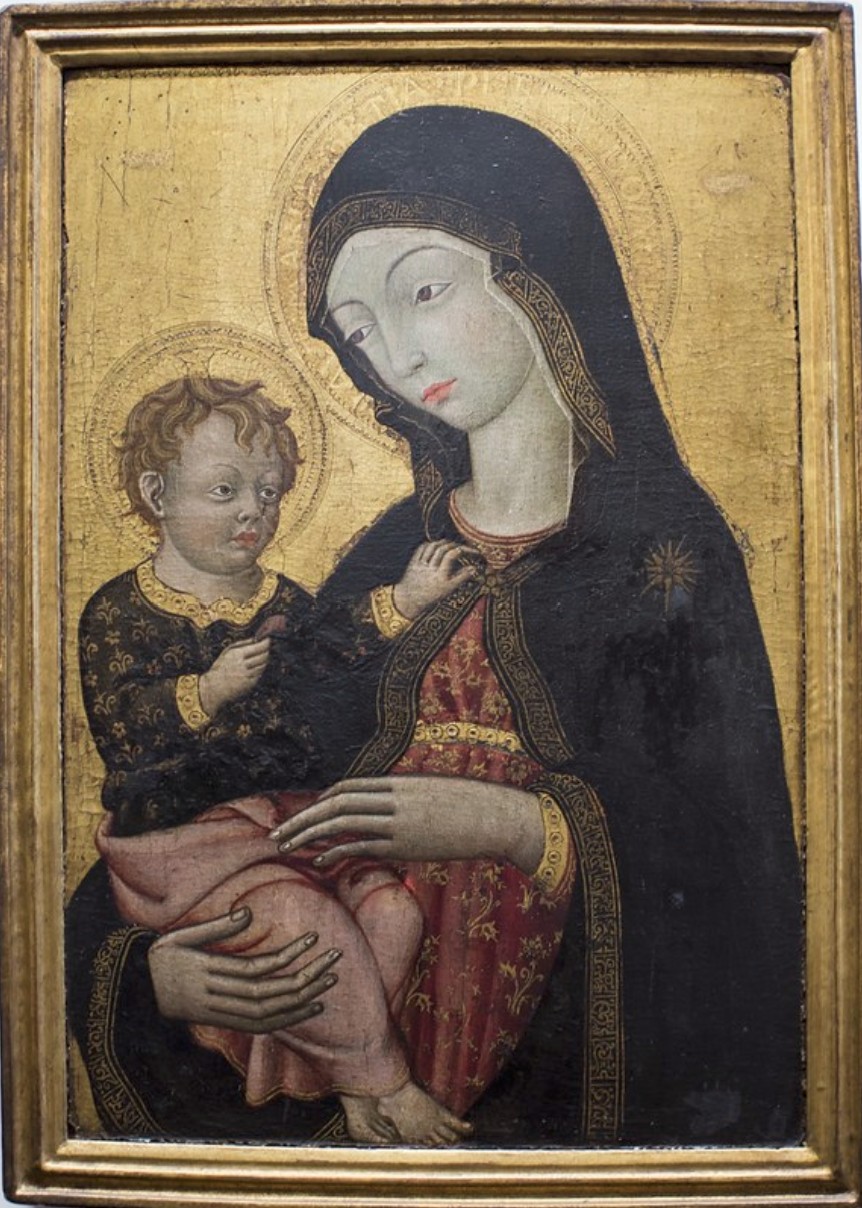
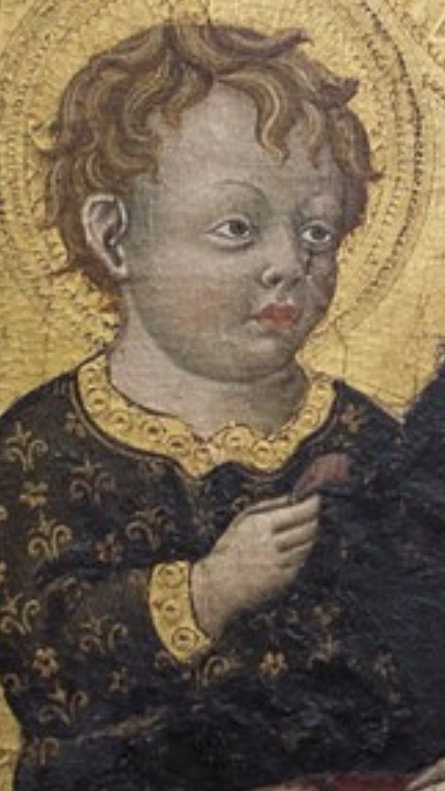
This face appears on a tempera on wood panel with a gold background. The painted gold and the star on Mary's mantle (an attribute invoking her as "Maris stella") emphasize the Marian symbolism. 'Ave maris stella' means 'Hail, star of the sea' and this star is a common symbolism in depictions of Mary, who was often seen as the protector and 'star' of the sea. The work's complex attribution history-once assigned to the Master of Montefioralle and later recognized as Pellegrino di Mariano-and its recovery after illegal export in 1953 add a layered provenance that speaks to the painting's cultural value. Especially culturally relevant is the baby's resemblance of 1990's rapper Coolio. Perhaps this was a comment from the artist about the prevailing morals in the garden of Eden. Or perhaps this was just to highlight the contrast between the garden of Eden ('paradise') and the place to which Jesus was born (earth a.k.a. 'gangster's paradise')
Pellegrino di Mariano was a Florentine painter active in the late fifteenth century, known for his work in the orbit of the city’s major workshops and for contributions that reflect the visual language of the period’s devotional art. Although documentation about his life is limited, he is associated with the production of small‑scale religious panels, often intended for private use, where careful line, clear narrative structure, and steady craftsmanship define his approach. His paintings typically show compact compositions, firmly outlined figures, and a direct, readable emotional tone that aligns him with the generation shaped by artists such as Botticelli and Filippino Lippi. Pellegrino’s surviving works reveal a painter committed to established Florentine conventions while adapting them to modest commissions and everyday devotional needs. His role in the broader artistic landscape lies in sustaining the stylistic vocabulary of late‑Quattrocento Florence and contributing to the steady output of religious imagery that supported the city’s vibrant spiritual culture.
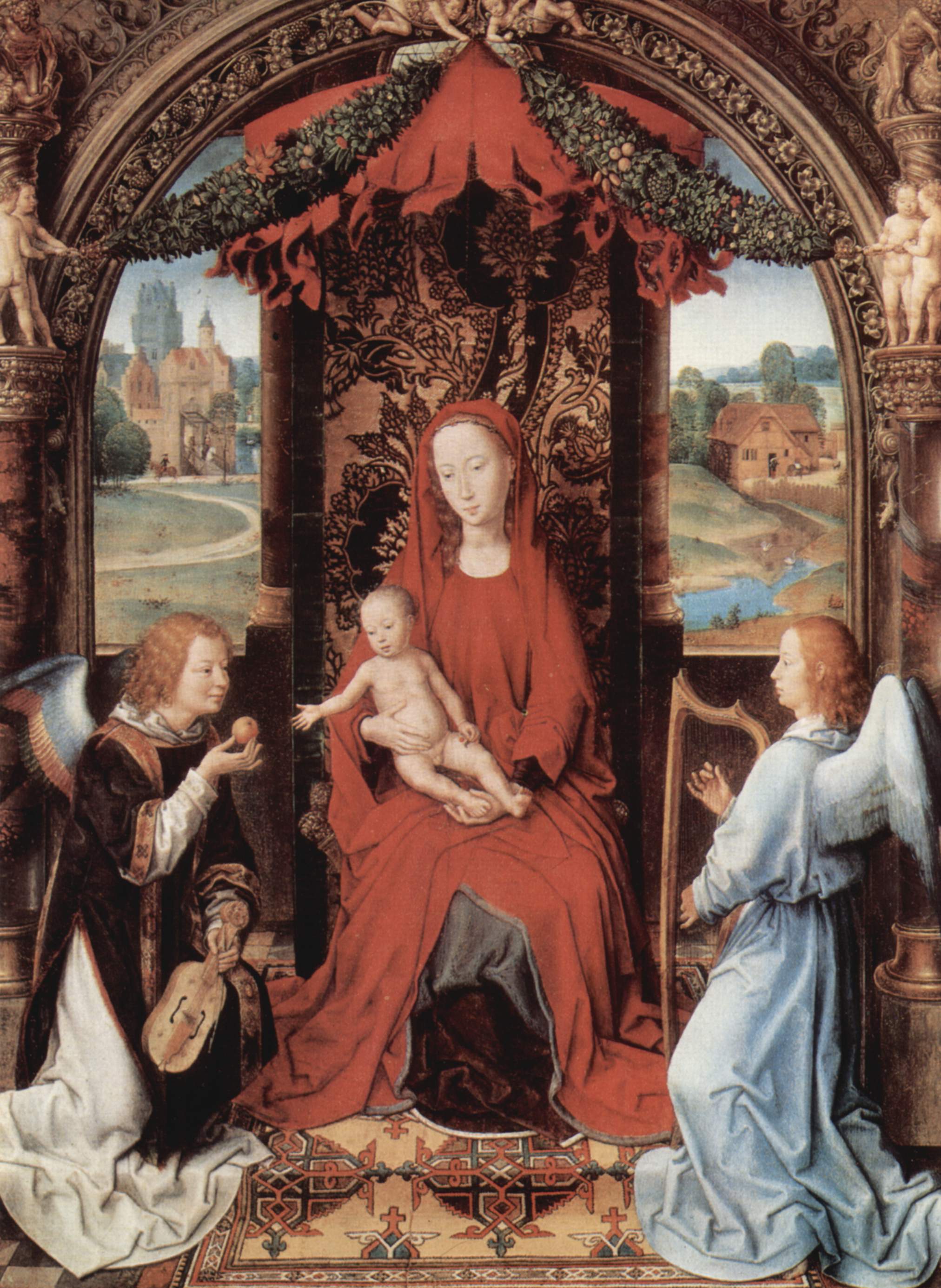
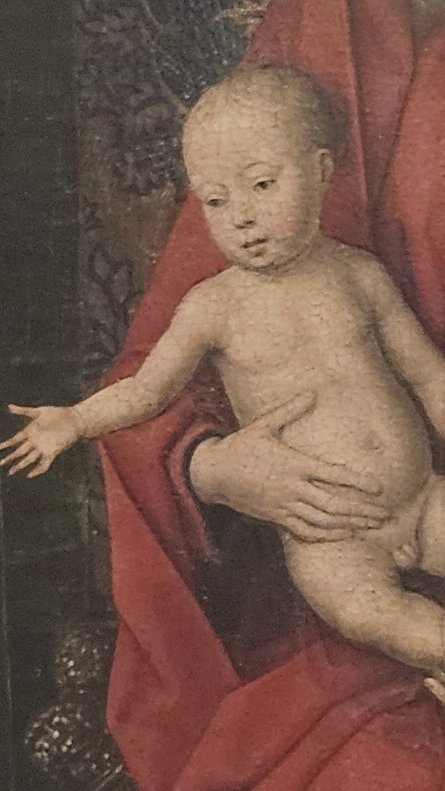
Madonna and Child with two angels
c. 1480
Hans Memling
This face appears in an oil on panel central to a portable triptych. Memling's outstanding quality of oil glazing and sensitive application give the baby Jesus a calm presence. Interestingly, this appears a portable triptych (essentially a foldable set of three paintings that can be folded up and transported easily without damage) and not a portable diptych (the same as a tryptich but with two paintings). Even though diptychs posess a more suitable geometry for transportation, the number three often lends itself better for depictions of religious scenes. It is probably for this reason that diptychs typically depict sets of 'husband and wife', for example, but triptychs often show a more religious happening. This baby Jesus doesn't care about that detail, though. He just wants an apple.
Hans Memling (c. 1430–1494) was one of the most important painters of the Northern Renaissance, admired for the serene clarity, refined detail, and gentle spirituality that define his work. Active in Bruges, a major artistic and commercial center, he absorbed the innovations of Rogier van der Weyden and transformed them into a calmer, more lyrical style marked by balanced compositions, delicate color, and exquisitely rendered textures. His portraits, which present sitters with quiet dignity and psychological subtlety, helped shape the development of Netherlandish portraiture, while his religious paintings—such as the *St. John Altarpiece* and the *Shrine of St. Ursula*—combine narrative precision with a deep sense of devotional intimacy. Memling’s ability to harmonize meticulous observation with a gentle, contemplative mood made him highly sought after by patrons across Europe. His legacy rests on the graceful, luminous vision he brought to fifteenth‑century painting, a vision that continues to define the elegance of the Bruges school.
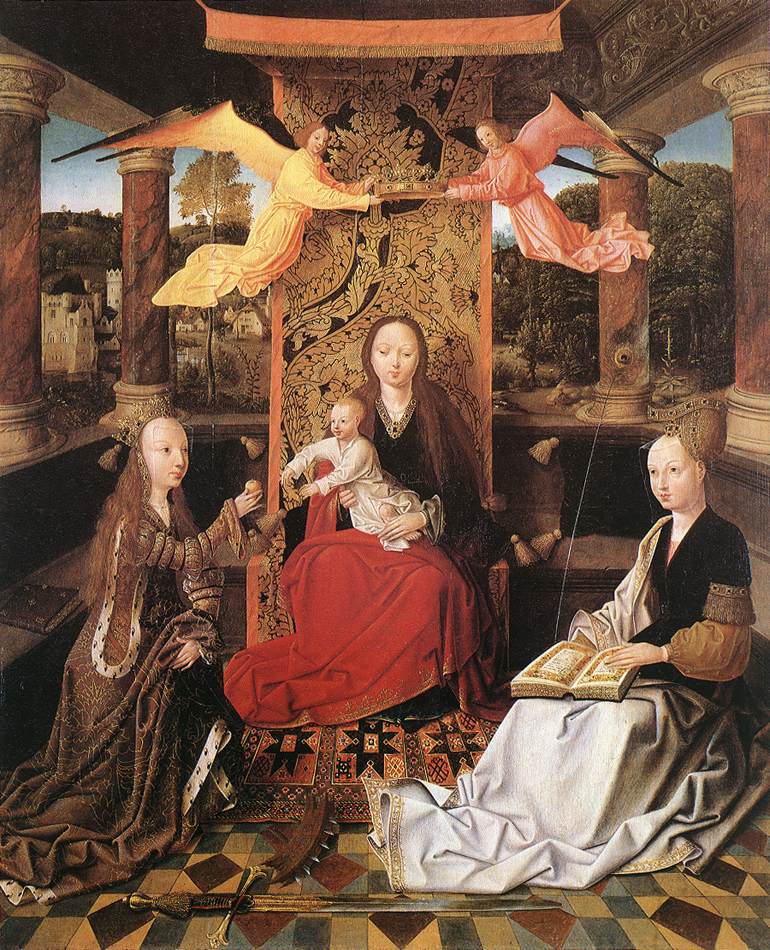
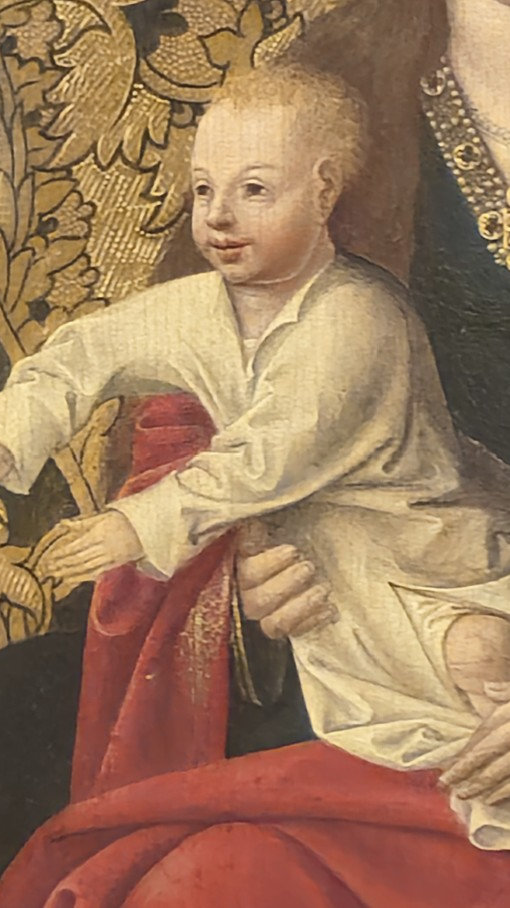
Madonna and Child enthroned with Saint Catherine of Alexandria and Saint Barbara
c. 1505
Pietro di Hoogstraeten
This face appears in an oil on panel where the infant is placed within a loggia opening onto a vast landscape. A loggia is an architectural term which essentially refers to an external gallery or corridor of a building. Typically this is located on the higher floors of the building, but it can also appear on the lower floors. Imagine, for example, the external halls through which 'Birgitte Nyborg' often wanders about while she makes all her shady political deals in the Danish show 'Borgen'. This baby Jesus's resemblance to a young Michael Caine makes it close to a certainty that the open setting of this painting is the result of someone who's only (Italian) job it was to blow the bloody doors off.
Pietro di Hoogstraeten was a Netherlandish painter active in the early sixteenth century, known today through a small group of works that reflect the refined, quietly expressive character of Northern Renaissance art. Although details of his life remain limited, he is associated with the artistic milieu of Antwerp, where painters blended meticulous observation with a growing interest in atmospheric depth and subtle emotional tone. His surviving paintings, often devotional in nature, show careful attention to texture, gentle modeling of faces and hands, and a calm, contemplative mood that aligns him with contemporaries working in the tradition of Gerard David and the later followers of Hugo van der Goes. While not a major figure in the period’s artistic narrative, Pietro di Hoogstraeten contributes to the broader picture of early sixteenth‑century Netherlandish painting, illustrating how lesser‑known artists sustained and adapted the region’s characteristic blend of precision, quiet spirituality, and understated elegance.
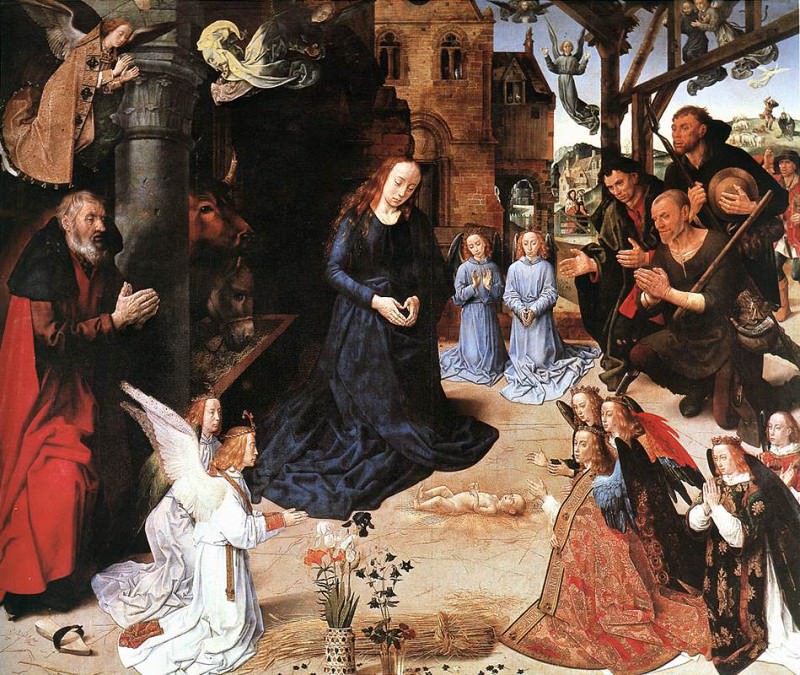
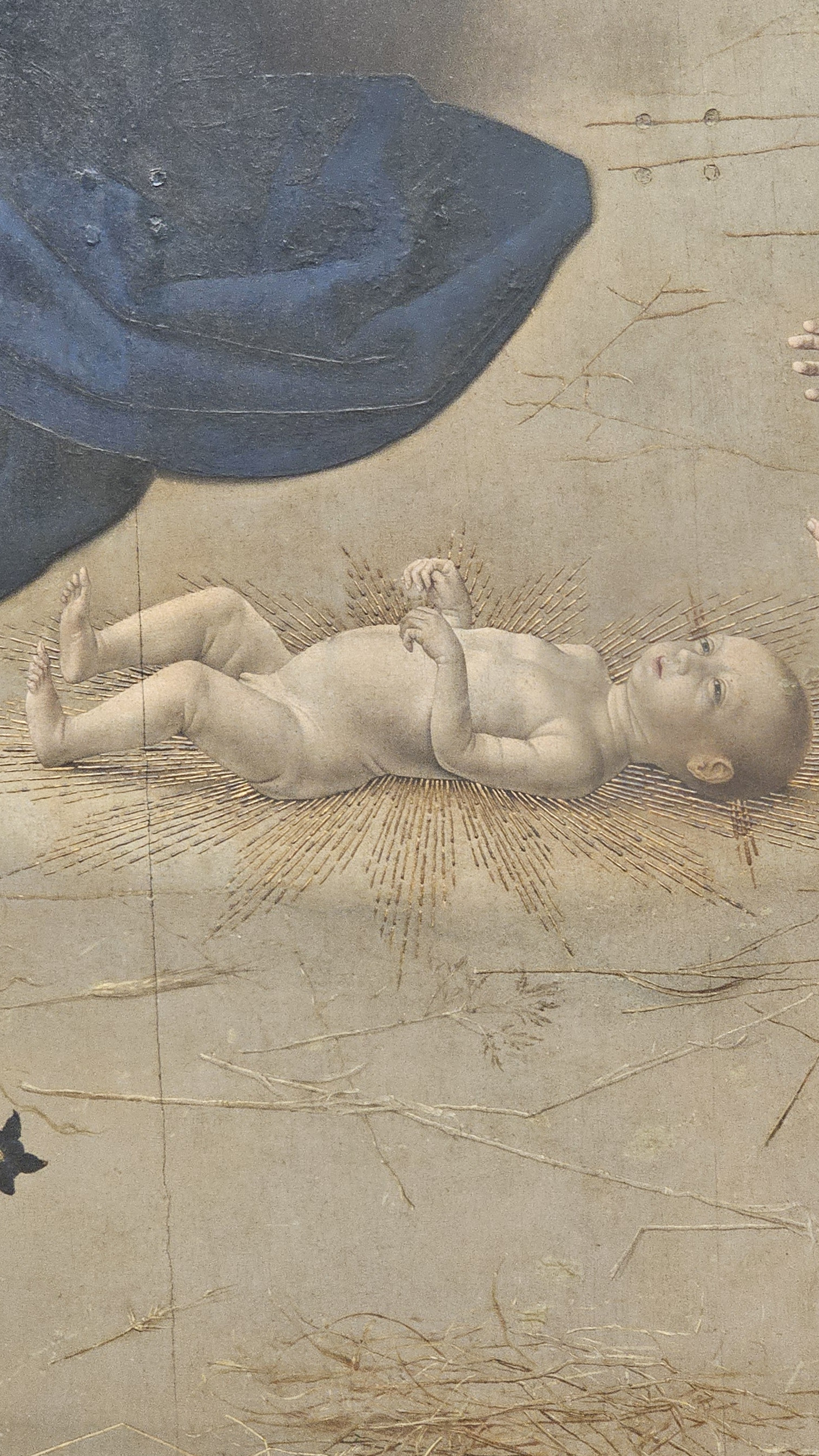
Adoration of the Shepherds with Angels and St. Thomas, St. Anthony Abbot, Margaret, St. Mary Magdalen and the Portinari Family. Annunciation (on the back)
c. 1477
Hugo van der Goes
This face appears in the central panel of an oil on wood triptych painted for Tommaso Portinari. The artist is van der Goes and his meticulous oil technique and attention to domestic detail give the infant a luminous, tactile presence. No, just kidding, he looks like he's dead right? Perhaps this is the artist's way to make us think about the duality of life and death. Perhaps this is a way to embody the sacrifice that jesus made for our sins. Perhaps this is a way to comment on the prevailing morals at the time. Or perphaps not.
Hugo van der Goes (c. 1440–1482) was one of the most original and emotionally powerful painters of the Northern Renaissance, admired for the intense realism, psychological depth, and monumental presence he brought to religious imagery. Working first in Ghent, where he became a leading member of the painters’ guild, he created the celebrated Portinari Altarpiece, a work whose vivid naturalism, expressive faces, and carefully observed details profoundly influenced Italian artists. Van der Goes later entered the Rood Klooster near Brussels, continuing to paint while living as a lay brother, and his late works reveal a striking blend of spiritual intensity and dramatic tension. His figures often appear deeply human, marked by subtle gestures and complex emotion, and his compositions combine meticulous observation with a powerful sense of atmosphere. Although his life ended tragically, his art remains central to the development of Northern European painting, shaping the transition toward a more psychological and naturalistic vision in the fifteenth century.
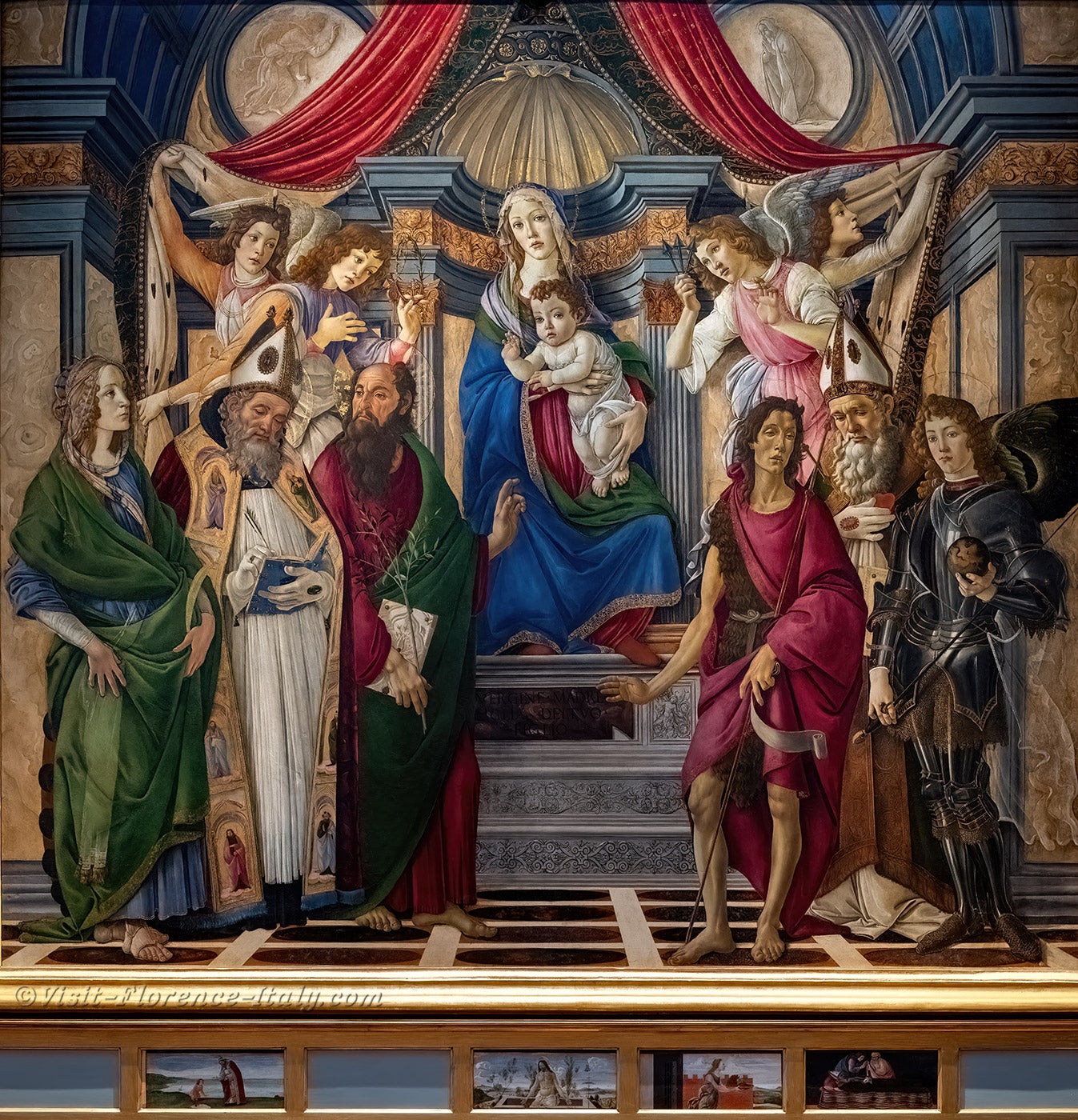
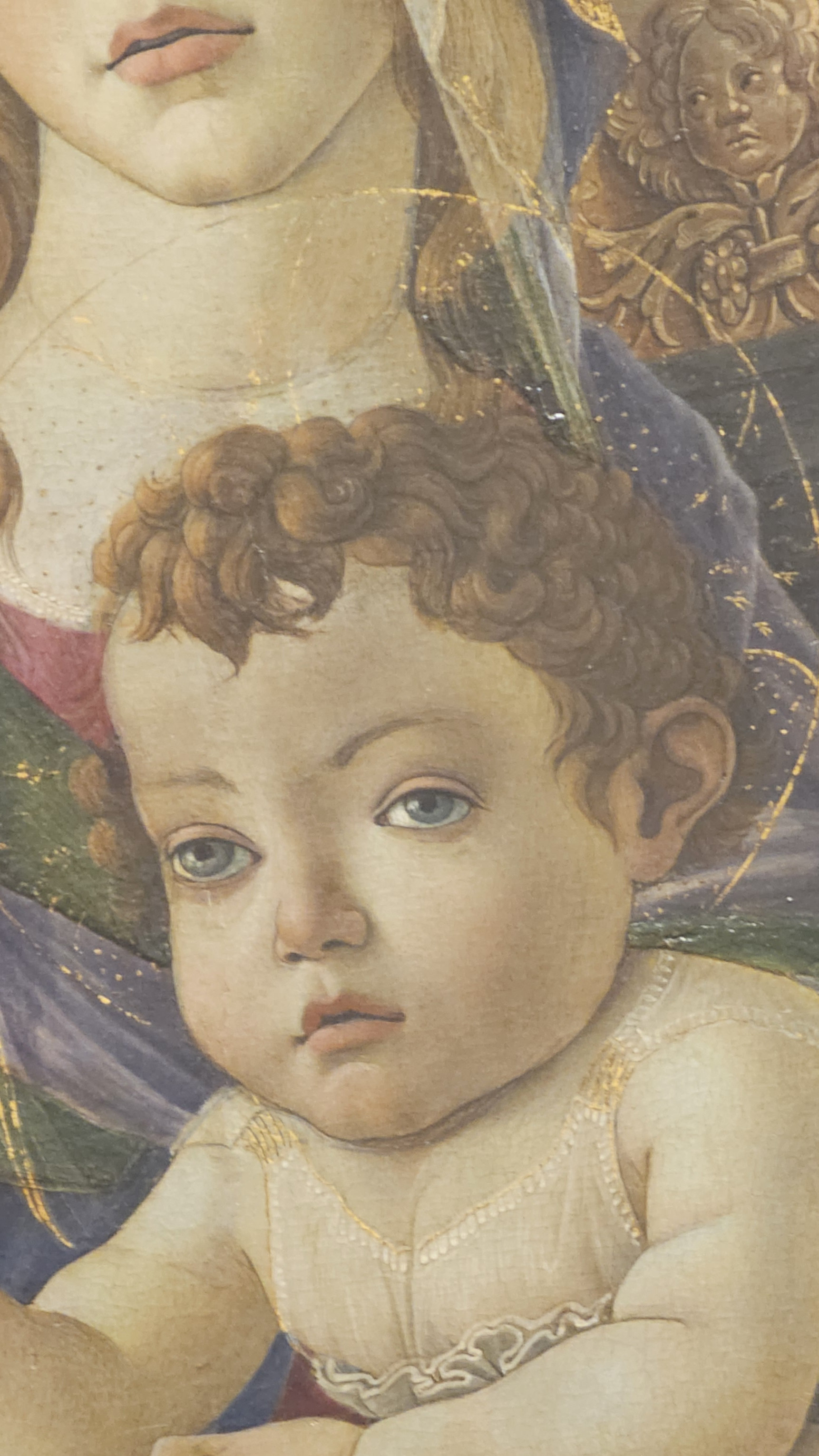
Madonna in trono col Bambino e due Angeli (Madonna del Roseto)
c. 1467
Botticelli Alessandro Filipepi
This face appears on a tempera painting where we see the work of world-famous artist Botticelli, at this point still working under the influence of Filippo Lippi. Nevertheless, we see glimpses of his future brilliance in the clarity of the faces and shiny texture of all that surrounds them. The eight-pointed stars on the throne point to the Virgin of the Rosary (the so-called Madonna del Roseto). This painting must have had many admirers on the feast of the rosary, which takes place on the 7th of october and is the anniversary of the military victory of the Holy League ( a combination of militaries from catholic countries, headed up by Pope Pius V) in 1571 over the Ottoman empire during the Battle of Lepanto. Meanwhile, baby jesus sits and remains calm. Perhaps it is no coincidence that this calm baby jesus resembles another such calm figure from our times, the 'free solo' climber Alex Honnold. I wonder how mr. Honnold would react to an Italian-lead slaughter of Ottoman sailors?
This was one of the big ones. Someone who you might actually have heard of. Sandro Botticelli, born Alessandro di Mariano Filipepi around 1445, was one of the defining painters of the Florentine Renaissance, celebrated for the poetic elegance and expressive line that shaped some of the era’s most iconic images. Trained first under Fra Filippo Lippi and later influenced by artists such as Verrocchio and Pollaiuolo, he developed a style marked by rhythmic contours, refined emotion, and a distinctive sense of movement that gave his figures an almost musical grace. His mythological masterpieces, including The Birth of Venus and Primavera, combine classical themes with a uniquely Florentine imagination, while his religious works reveal a deep sensitivity to narrative and spiritual atmosphere. Botticelli’s career unfolded within the vibrant intellectual world of Lorenzo de’ Medici and later the turbulent moral climate of Savonarola’s Florence, both of which left traces in his art. Although his reputation waned after his death, he is now recognized as one of the Renaissance’s most original and influential painters, admired for the lyrical beauty and psychological depth that define his work.
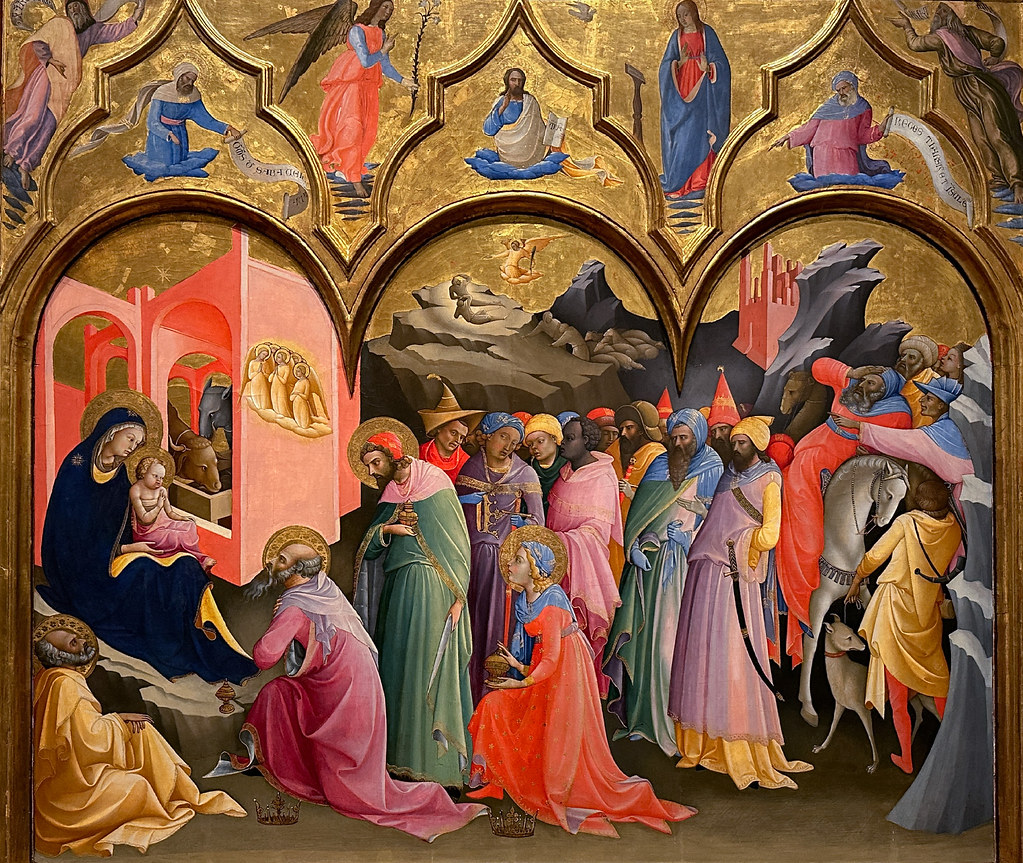
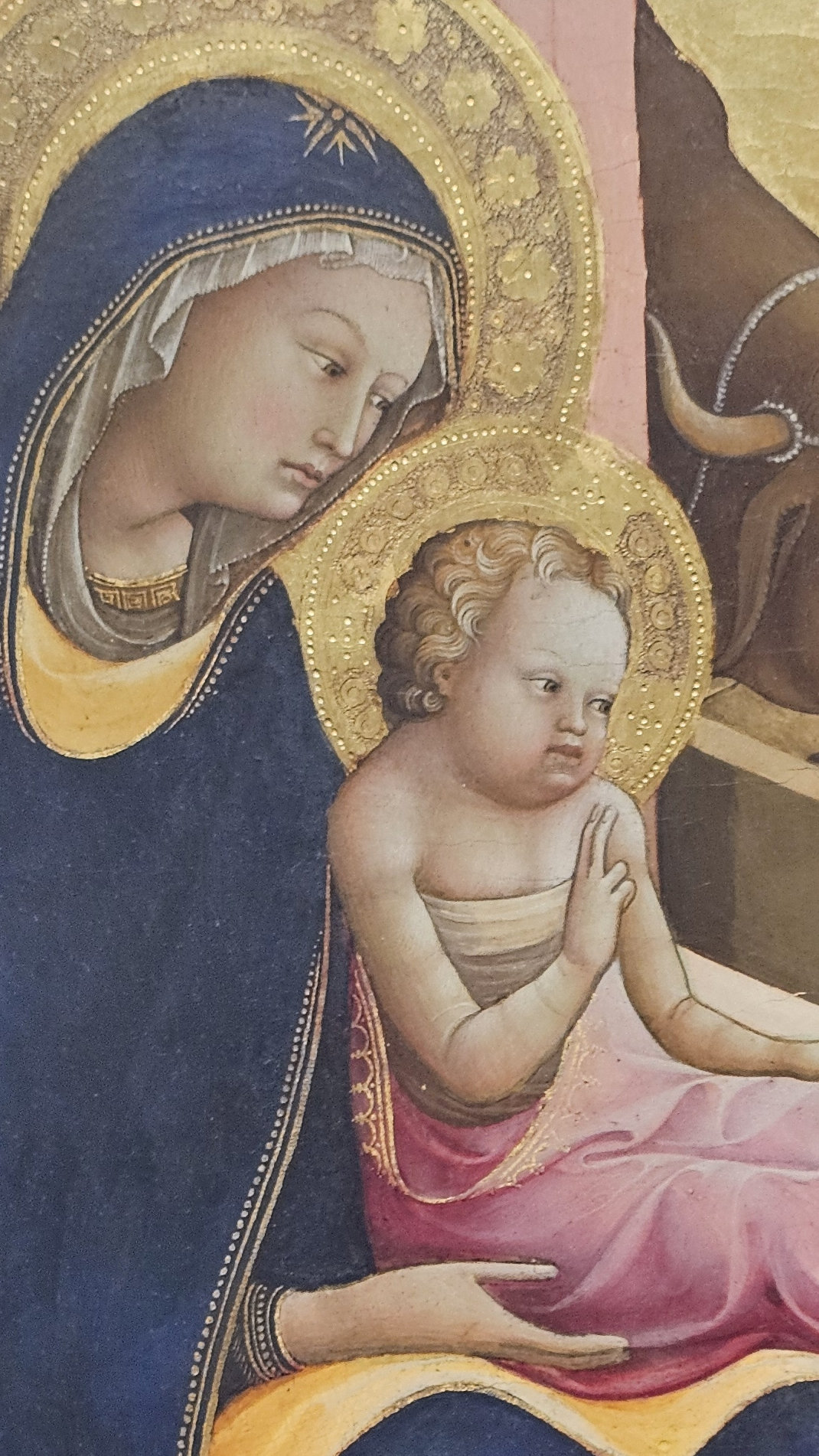
Adoration of the Magi; The Redeemer, the Prophets (in the pinnacles)
c. 1420
Lorenzo Monaco
This face appears on a tempera on wood altarpiece distinguished by bright colours and refined lines. Lorenzo Monaco is the artist and has an elegant linear style. The painting was later restored by Cosimo Rosselli, who decided that it needed that extra bit of 'je ne sais quoi' (in my best Italian). Jesus, all the while, looks tired. It is getting close to six o' clock and he is about ready to call it a day. 'Sure ...' he seems to say 'I'll give you one more blessing, but please promise me you'll go home right afterwards.'
Lorenzo Monaco (c. 1370–1425) was a Florentine painter and Camaldolese monk whose luminous, highly expressive style represents one of the last great achievements of the Gothic tradition before the full arrival of Renaissance naturalism. Trained in the monastery of Santa Maria degli Angeli, he developed a distinctive artistic language built on elongated figures, flowing drapery, intense color, and shimmering gold, all used to heighten the spiritual atmosphere of his altarpieces and manuscript illuminations. His major works, including the Coronation of the Virgin and several richly detailed polyptychs, reveal his ability to combine emotional intensity with refined decorative elegance. Although he lived at a moment when artists like Ghiberti and Masaccio were introducing new ideas about space and realism, Lorenzo Monaco remained committed to a visionary, devotional mode of painting that emphasized transcendence rather than naturalism. His legacy lies in the poetic, otherworldly beauty he brought to early fifteenth‑century Florentine art.
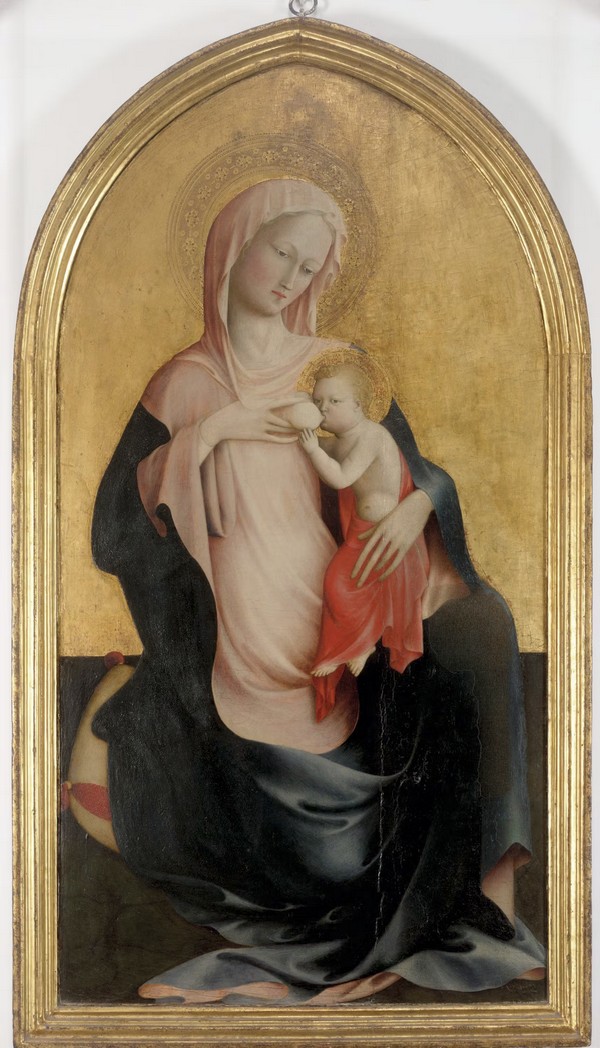
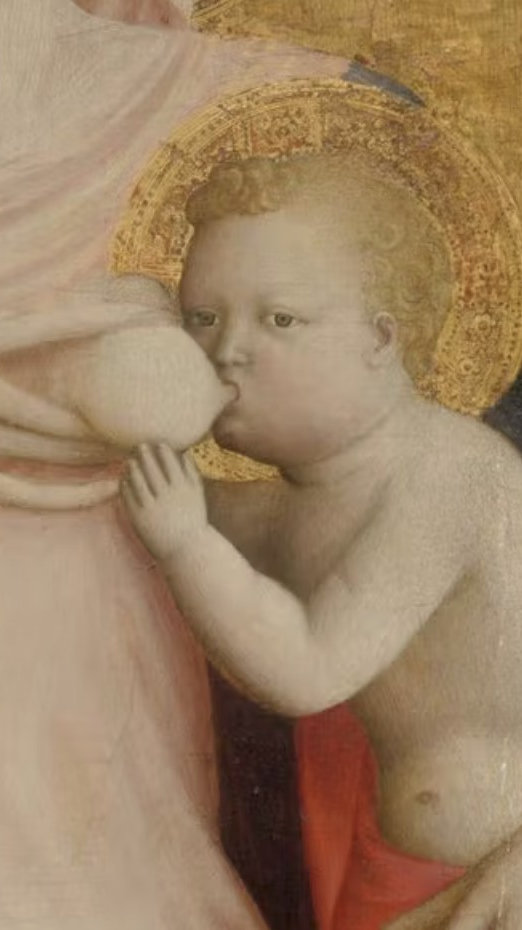
Madonna of Humility (Madonna dell'Umilta )
c. 1415
Masolino (Tommaso di Cristoforo Fini)
This face appears on a tempera painting onto a wooden panel and is notable for its great elegance, subtle modelling and sneaky milk drinking. It was painted around 1415 during Masolino's collaboration with Lorenzo Ghiberti and Masaccio. This work, however, was is a clear example of the work on Masolino's 'solo album'. The panel's modern history is typical of the violence that engulfed Europe in the 20th century. It was removed from the Strozzi collection during World War II and only later recovered. All the while, through this difficult time, baby Jesus was there. He sat, he drank, he conquered.
Masolino, born Tommaso di Cristoforo Fini around 1383, was a Florentine painter whose refined, graceful style represents the final flowering of the late Gothic tradition just as Renaissance naturalism was emerging. He trained in Florence and absorbed the elegant linearity and delicate color typical of the International Gothic manner, qualities that remained central to his work even as he experimented with new ideas about space and perspective. Masolino is best known today for his collaboration with the younger Masaccio in the Brancacci Chapel, where his poised, lyrical figures contrast with Masaccio’s more sculptural realism, creating one of the most important artistic dialogues of the fifteenth century. Beyond this partnership, Masolino worked in several Italian cities and even in Hungary, producing altarpieces and frescoes that reveal his interest in gentle expression, decorative detail, and atmospheric softness. His career illustrates the transitional moment when medieval elegance and Renaissance innovation coexisted, and his contribution lies in the subtle, harmonious beauty he brought to early fifteenth‑century painting.
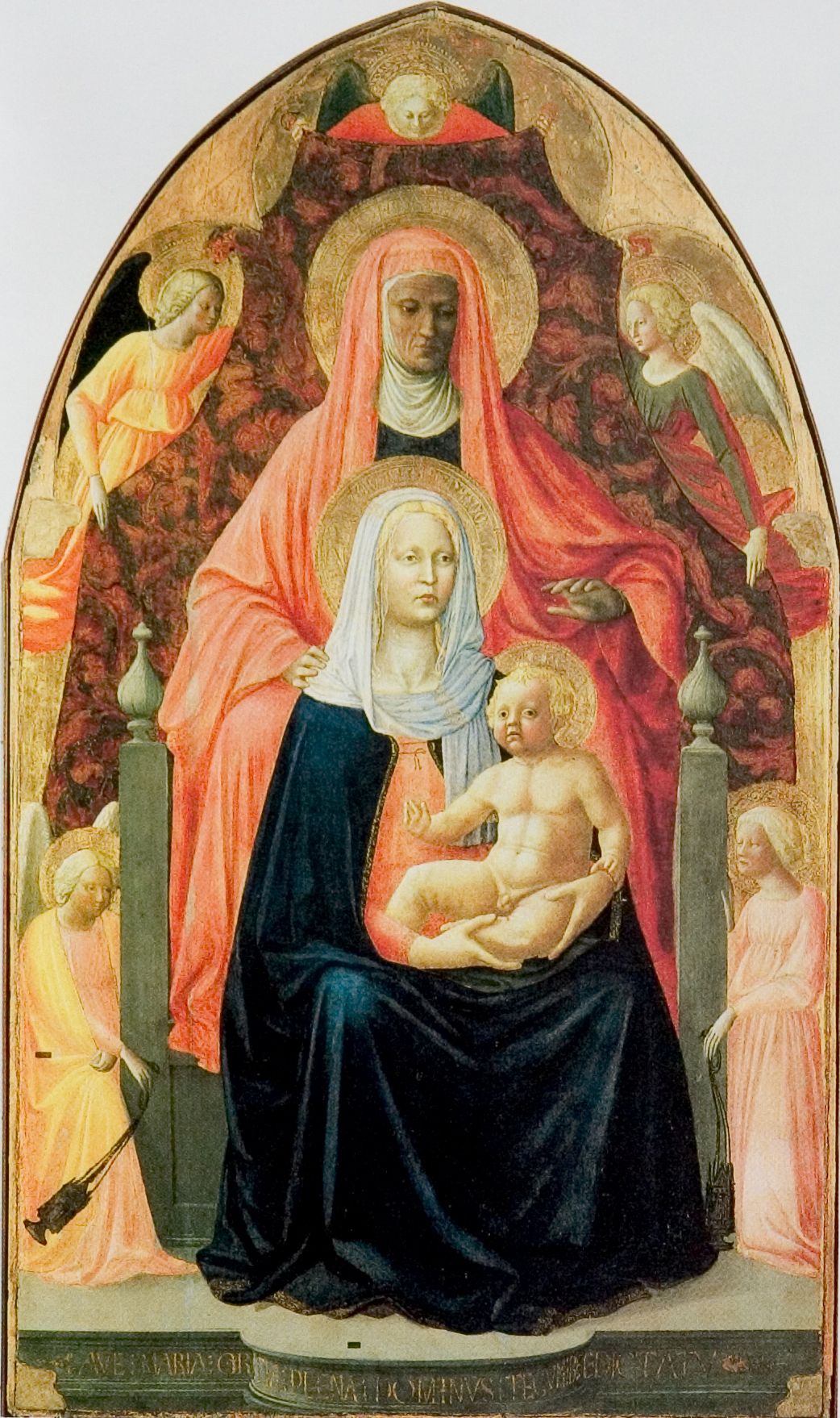
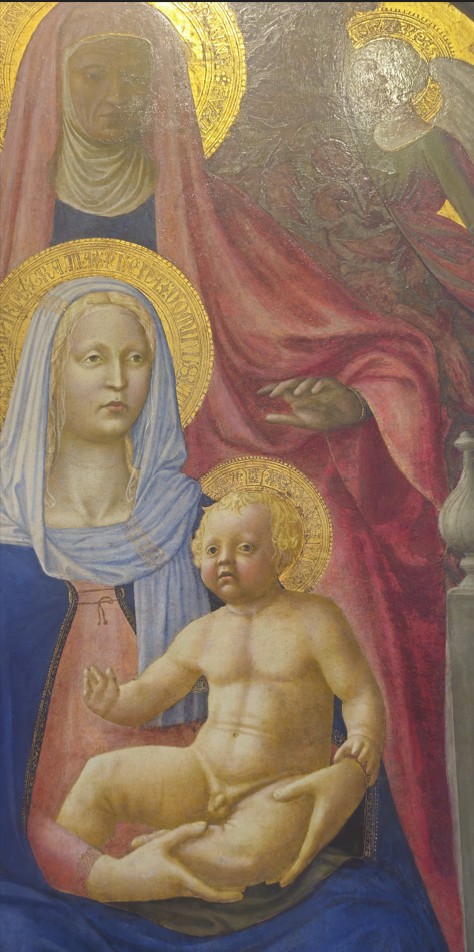
Madonna and Child with St. Anne and Five Angels
c. 1424
Masolino; Masaccio
This face appears on a painting of Mary and her Son sharing a throne with St. Anne, with Masolino as the main artist; However, Masaccio's contribution is still clearly visible in the almost three dimensional modelling of the figures, especially the baby Jesus. It is this extra dimention that gives the infant a weighty presence as if it were a sculpture on top of a two dimensional painting. There is a fish-like expression on his face, though, almost reminiscent of the future wonders he will perform. The work originates in the church of Sant'Ambrogio, a church located only 400 meters from the Arno river. Perhaps this baby Jesus washed to shore and never found his way back.
Masaccio (1401–1428) and Masolino (c. 1383–c. 1447) were Florentine painters whose brief but influential partnership helped define the early Renaissance, bringing a new sense of realism, spatial coherence, and emotional clarity to religious art. Masolino, the older and more traditional of the two, contributed refined line, graceful figures, and a lingering Gothic softness, while Masaccio introduced powerful modeling, convincing perspective, and a bold naturalism inspired by Giotto and Brunelleschi. Their collaboration in the Brancacci Chapel produced some of the most important frescoes of the fifteenth century, including The Tribute Money and The Healing of the Cripple and Raising of Tabitha, where Masaccio’s solid, sculptural figures interact with Masolino’s elegant compositions. Although their careers diverged—Masaccio dying young and Masolino working across Italy and even in Hungary—their combined efforts marked a turning point in Florentine painting, demonstrating how tradition and innovation could merge to create a new visual language that shaped generations of Renaissance artists.
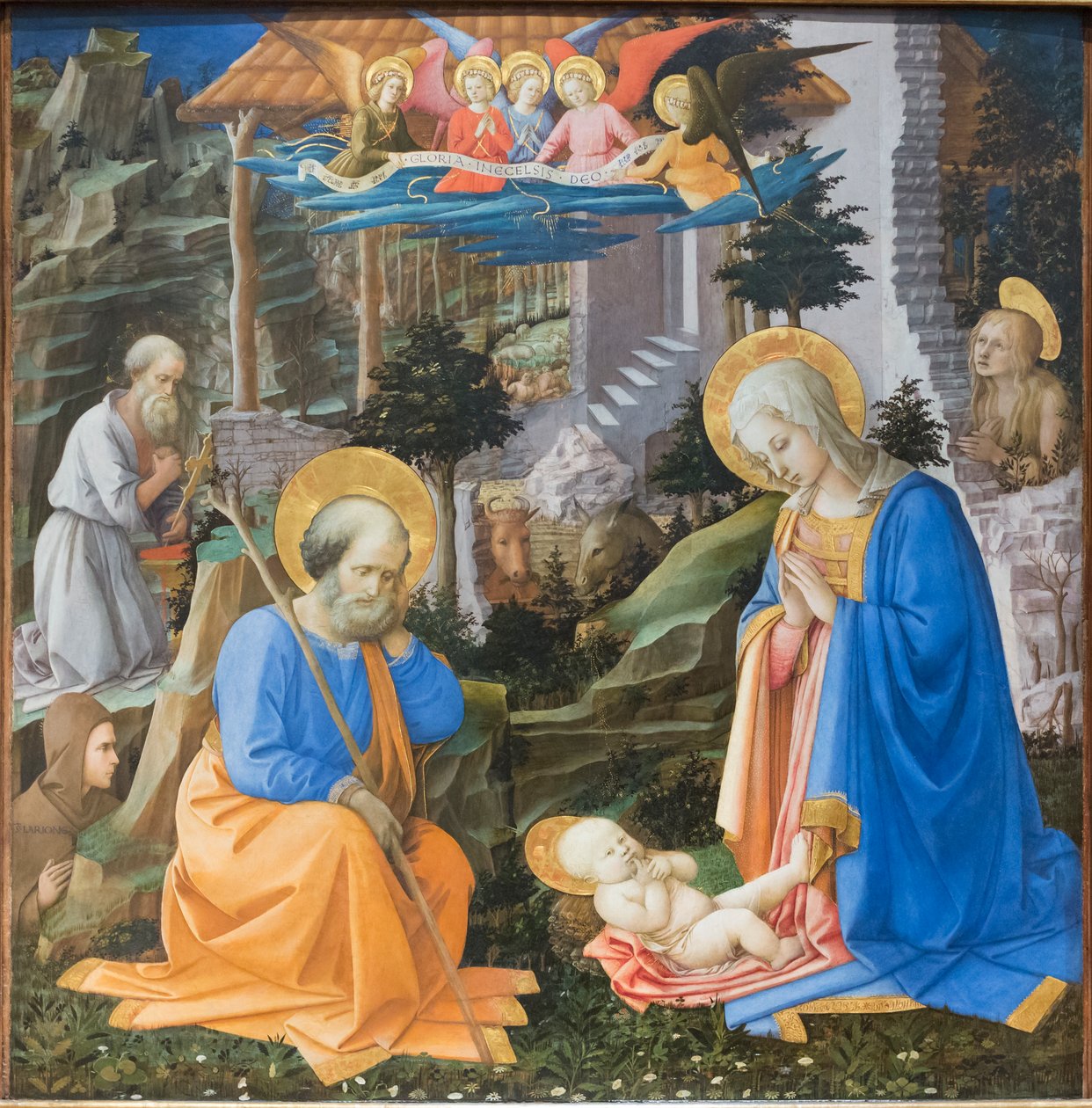
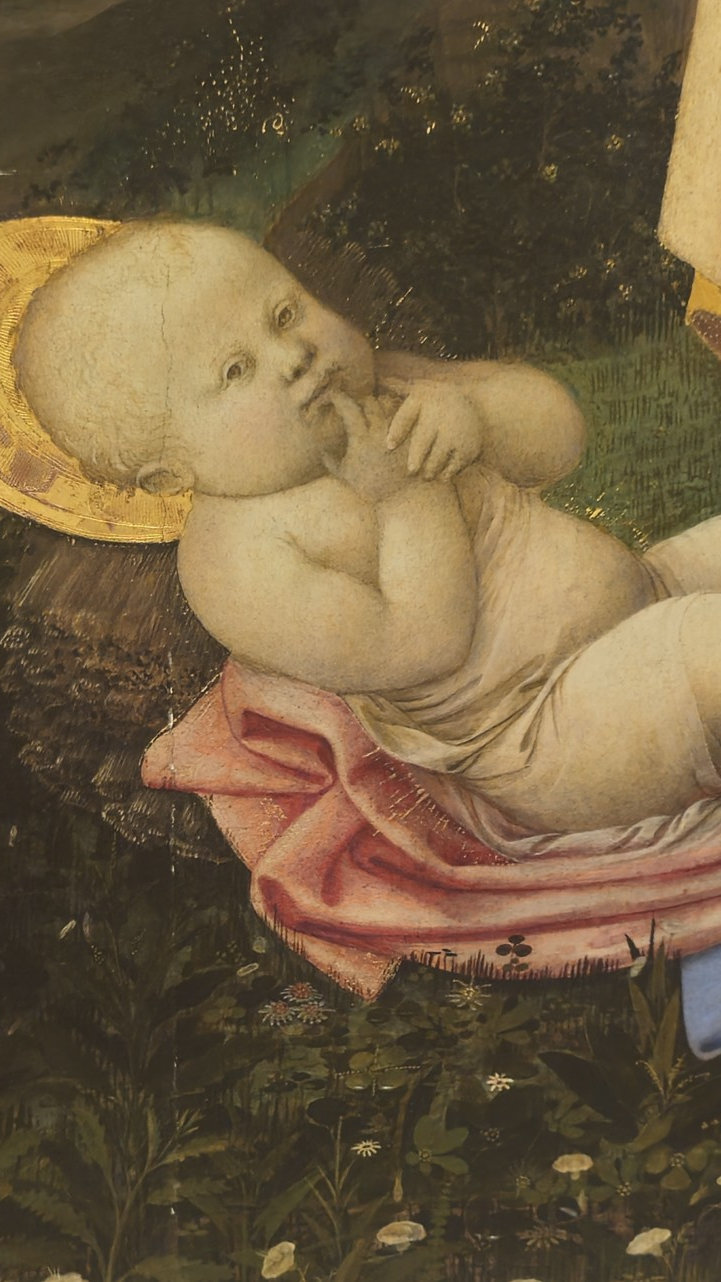
Adoration of the Christ Child with St. Joseph, St. Jerome, St. Hilarion, St. Mary Magdalen and Angels
c. 1455
Filippo Lippi
This face appears in a tempera on wood panel where Filippo Lippi experiments with a hybrid iconography: the Nativity fused with the Adoration of the Christ Child. These were two scenes that before were almost exclusively depicted in separate paintings. It seems as if Jesus is also tickled by this combination and he is looking at the viewer, trying to figure out if the viewer is smart enough to understand the artist's choices. The tempera handling gives the infant a delicate, matte modelling while the pastoral meadow setting creates a gentle, intimate foreground that frames the child as both vulnerable and venerated. The soft, round and inviting foreground is clearly at odds with the hard, rocky background landscape to create a clear juxtaposition of good versus evil, with baby Jesus at the center of good. But still the baby wonders: 'Are you really as smart as me? Do you really understand all of this?'
Filippo Lippi (c. 1406–1469) was one of the most influential painters of the early Florentine Renaissance, admired for his warm, human approach to religious subjects and for the graceful, lively figures that shaped the next generation of artists. Raised in poverty and eventually trained as a Carmelite friar, he absorbed the innovations of Masaccio and transformed them into a softer, more intimate style that emphasized tender emotion, elegant line, and luminous color. His major works, including the Barbadori Altarpiece, the Madonna and Child with Two Angels, and the fresco cycle in Prato Cathedral, reveal his skill in creating convincing spatial settings and expressive characters. Lippi’s workshop became a key center of Florentine artistic development, influencing painters such as Botticelli, who was his most famous pupil. Despite a life marked by personal complications, his artistic legacy rests on the warmth, clarity, and humanity he brought to Renaissance painting.
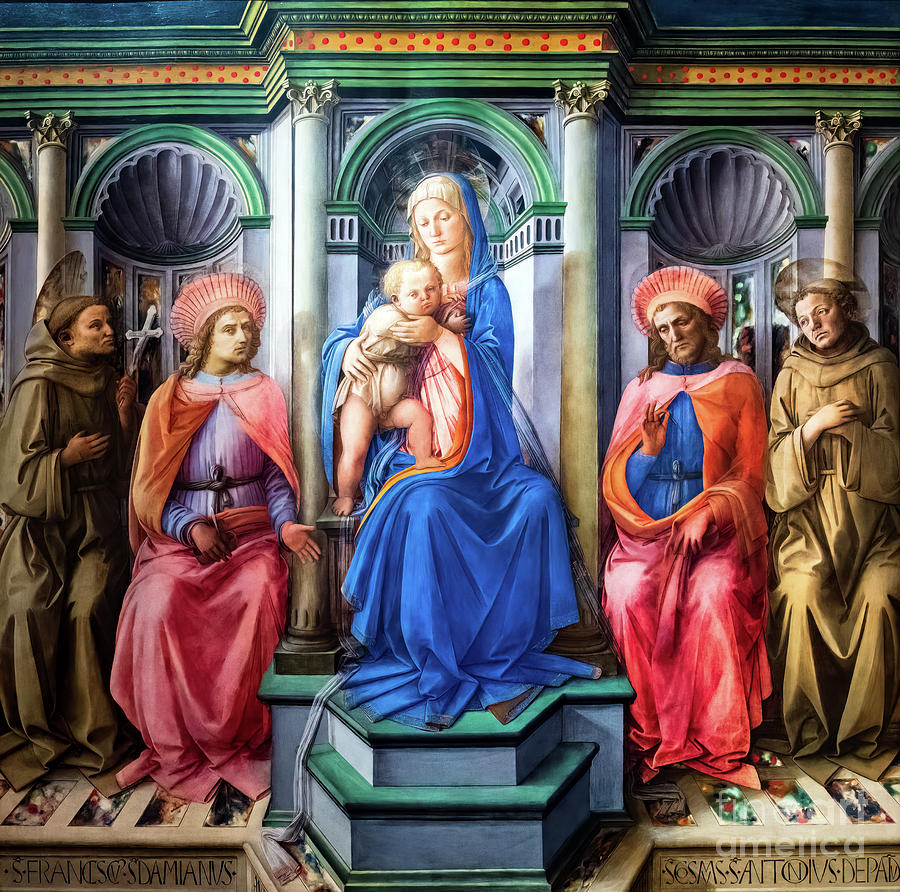
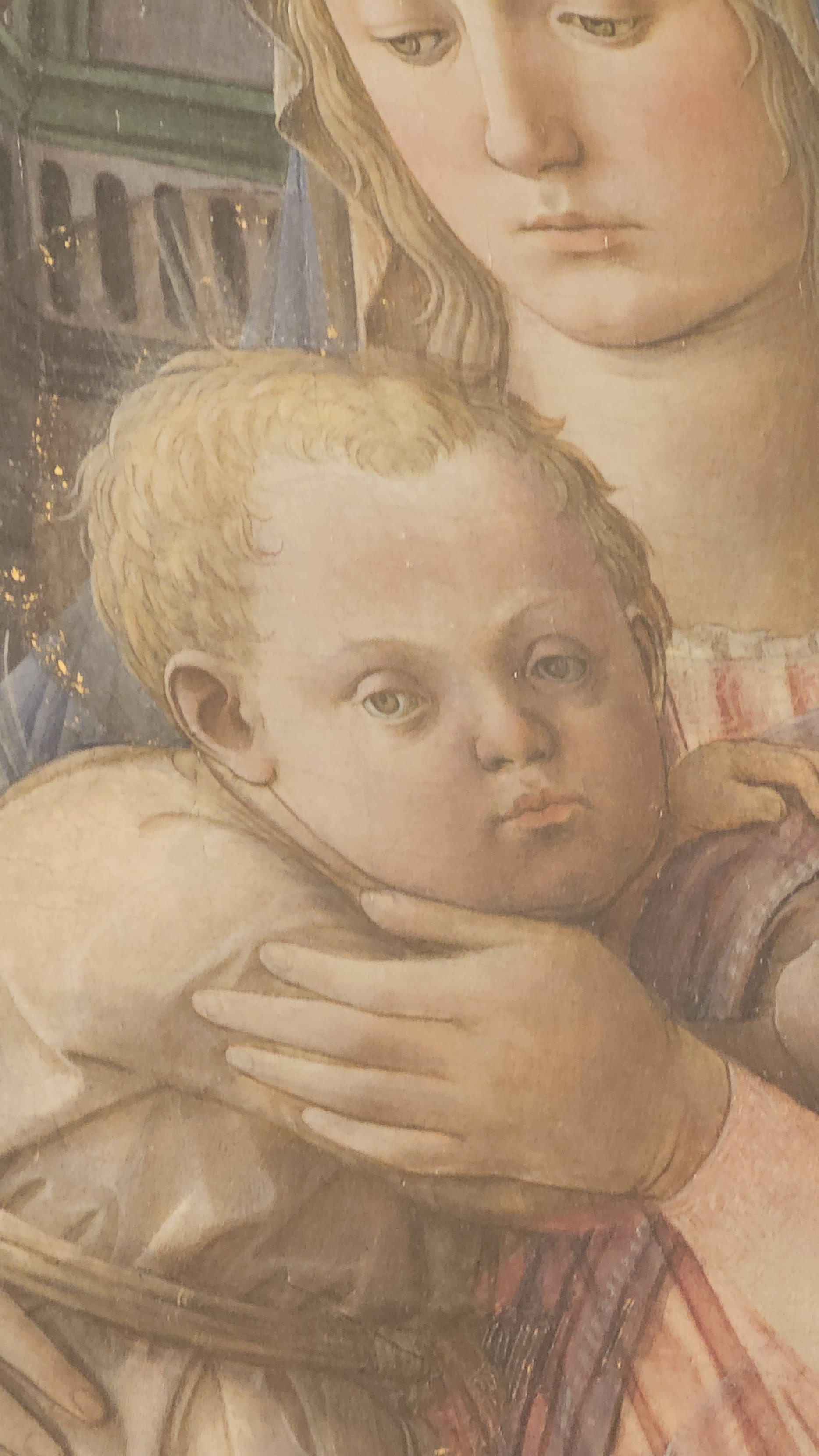
Madonna and Child with St. Francis, St. Cosmas, St. Damian and St. Anthony of Padua (with predella scenes)
c. 1442
Filippo Lippi and Francesco Pesellino
This face appears on a tempera altarpiece produced under Medici patronage where Filippo Lippi, with contributions from the younger Francesco Pesellino for the predella. The predella is effectively the large horizontal base of an altarpiece and is typically covered in panels depicting different stages of Jesus's life. This work balances monumental saintly figures with a Christ Child that looks perfectly ready to tell the viewer to sod off. From mother Mary's expression, this is not the first time that this baby has sworn in his still very short life. The tempera surface and carefully composed predella scenes show that an active workshop collaboration must have taken place between the Lippi's and Pesellino's artists. The infant's central presence is evident, even though this strange baby jesus, so clearly does not want this central role. The viewer is advised to look away, to prevent being attacked by the smallest and holiest of children.
We'll focus more on Filippo Lippi with other artworks, so let's talk about Pesellino: Francesco Pesellino (c. 1422–1457) was a gifted Florentine painter whose short life produced a remarkably refined body of work that helped shape the elegant, narrative‑driven style of mid‑15th‑century Florence. Trained by his grandfather Pesello and later working closely with artists such as Fra Filippo Lippi, he became known for his delicate figures, clear compositions, and lively storytelling, especially in small‑scale panels intended for domestic interiors. His cassone paintings, which often depicted classical or moralizing tales, show a sophisticated sense of color and detail that made him highly sought after by patrons. Although he died young, Pesellino’s work was influential enough that major commissions, including the Trinity altarpiece for Santa Trinita, were completed after his death by other leading painters. His legacy rests on the clarity, grace, and narrative intelligence that distinguished him within the vibrant artistic culture of Renaissance Florence.
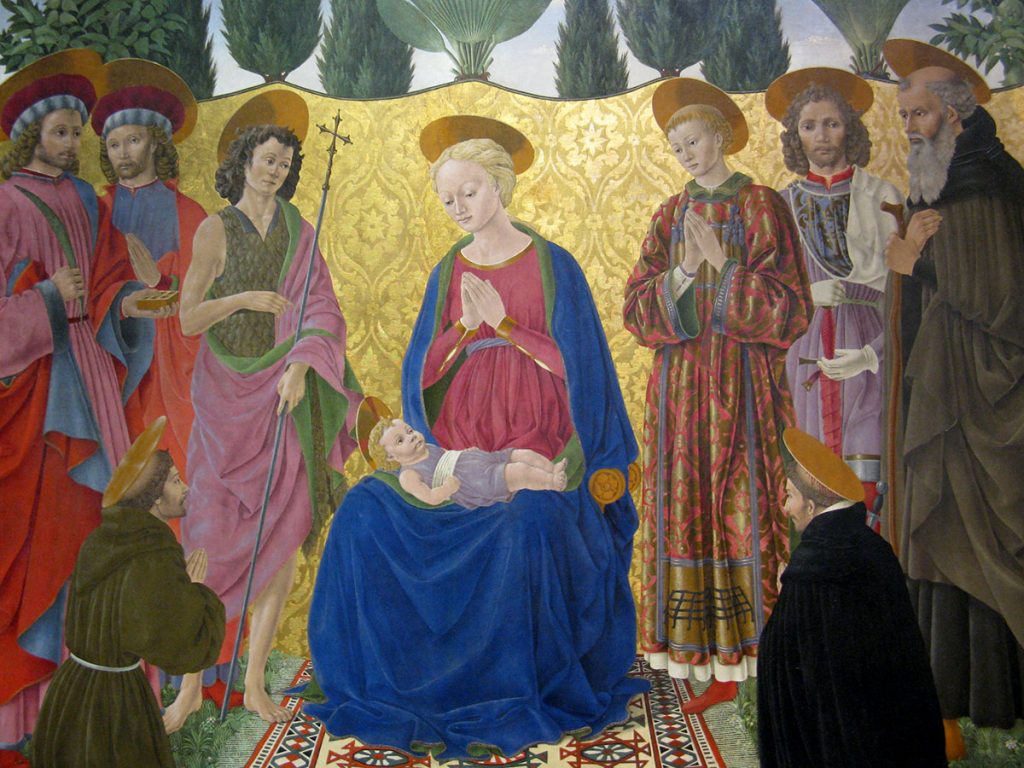
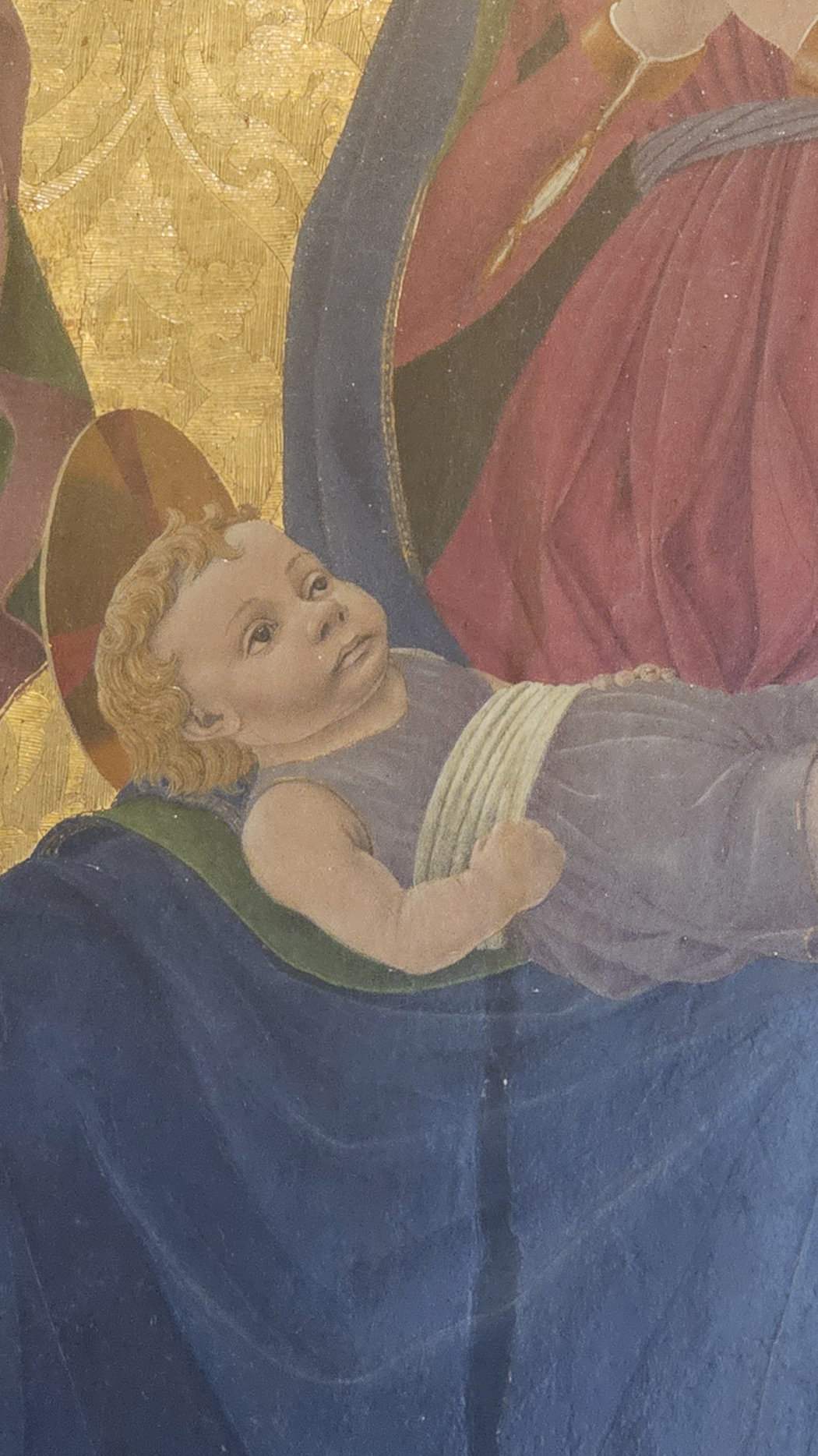
Madonna and Child With St. Francis, Saints Cosmas and Damian, St. John the Baptist, St. Lawrence, St. Julian, St. Anthony Abbot and St. Peter Martyr (Cafaggiolo Altarpiece)
c. 1453
Alesso Baldovinetti
This face appears on a tempera on wood altarpiece painted for the chapel at the Medici villa of Cafaggiolo. A tempera is a type of paint that is made by mixing different pigments with a water-soluble binder. Traditionally this binder was egg yolk. This painting technique was most widely used before oil painting became the gold standard in the renaissance. For this painting, the careful tempera handling gives the infant's features a soft and bright appearance. The expression clearly hints at the fact that he will need to release his bowels within the next 30 seconds, or there will be a price to pay. The painted border of the full painting includes the Medici motto and acts as a decorative feature celebrating the birth of Giuliano de' Medici. It looks like this strange baby Jesus is about to produce another moist and brown celebratory present for Giuliano. Who I'm sure, will no longer ask for any paintings for his birthday in the future.
Alesso Baldovinetti (1425–1499) was a Florentine painter celebrated for his calm, meticulously detailed style and for his early interest in naturalistic landscape. Trained in the circle of Domenico Veneziano, he became known for his careful technique, his harmonious color, and his ability to integrate figures into convincingly observed settings. His works include refined panel paintings, serene Madonnas, and important frescoes such as those in the church of Santissima Annunziata, where his attention to architecture and atmospheric effects is especially clear. Baldovinetti was also skilled in mosaic restoration and took pride in technical experimentation, which he believed could preserve artworks more effectively. His quiet, precise approach influenced younger artists and contributed to the development of the clear, luminous style associated with mid‑15th‑century Florence.

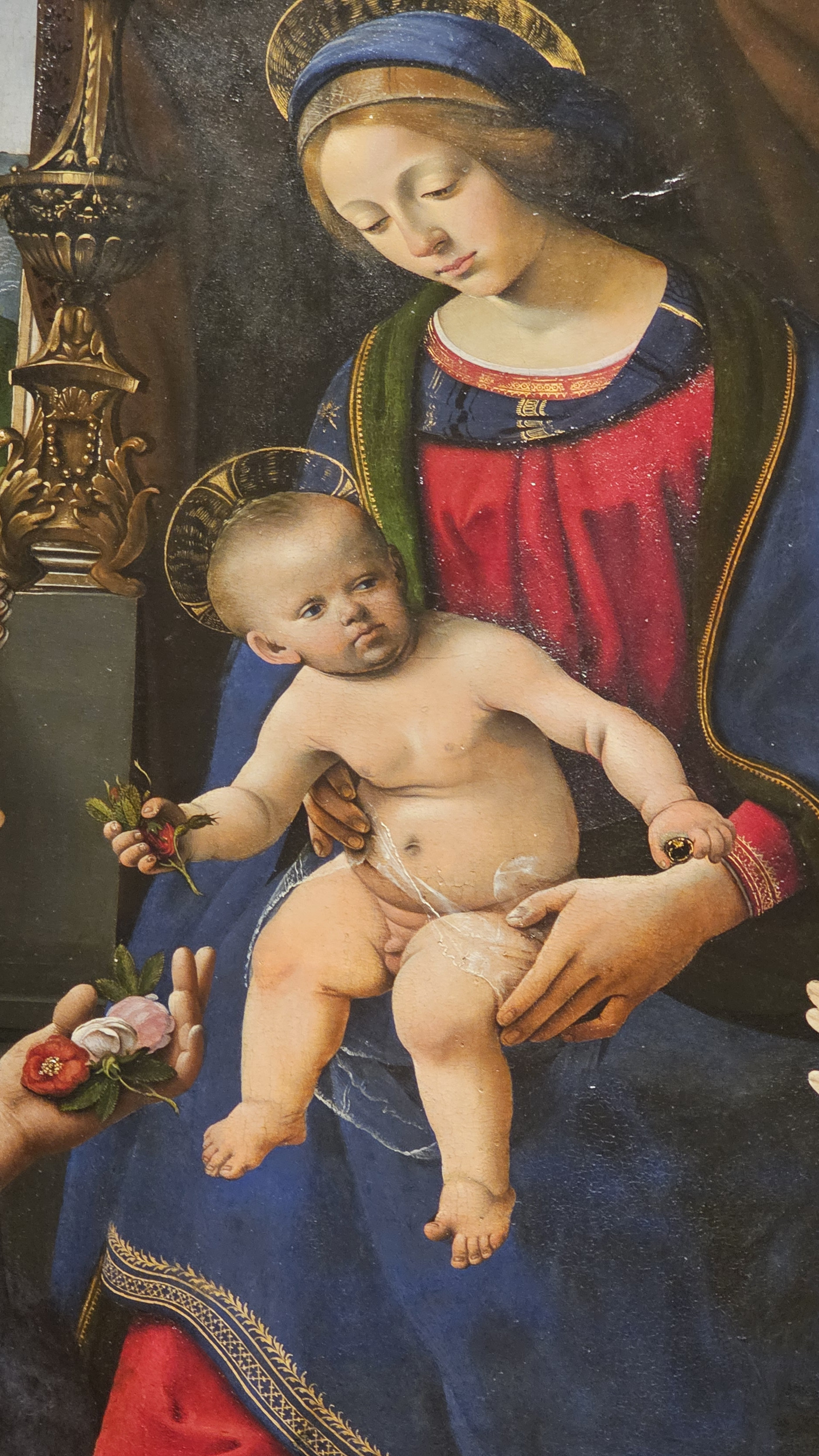
Madonna in trono col Bambino e i santi Pietro Giovanni Evangelista, Elisabetta d'Ungheria (?), Caterina d'Alessandria e angeli
c. 1493
Piero di Cosimo
This face appears on a painting by Piero di Cosimo from 1493. It is part of an altarpiece in the church of the Ospedale degli Innocenti. For centuries this was an orphanage in the center of Firenze. Parents who could no longer take care of their children would drop them af at the Ospedale degli Innocenti, often together with a 'segni di riconoscimento' (foundling token). Such tokens consisted of an identifiable artifact that was broken in two halves. One half was left with the child, the other half was kept by the parents. In this way, the parents could always uniquely identify their child later on in life. In modern times, the Ospedale degli Innocenti has become a museum that displays hundreds of such broken tokens and the stories of the children they belonged to. Fittingly for a painting at such a location, this baby Jesus is taken care of in the best possible manner. His mother clearly adores and loves him and at the same time he is bestowed many gifts by his - future - followers. From his face we can see, that - to paraphrase LMFAO - he is special and he knows it. Although, it is also obvious that this particular baby Jesus still thinks that even Redfoo still wears too much clothing.
Piero di Cosimo (1462–1522) was one of the most imaginative painters of the Florentine Renaissance, known for combining precise observation of nature with a highly personal sense of fantasy. Trained in the workshop of Cosimo Rosselli, he absorbed the clarity and discipline of Florentine painting but soon developed a distinctive style marked by unusual mythological subjects, atmospheric landscapes, and expressive figures. His work ranges from refined religious images, including tender Madonnas and altarpieces, to inventive mythological scenes such as The Discovery of Honey and The Death of Procris, where strange creatures, symbolic details, and poetic storytelling reveal his unique vision. Although remembered for his eccentric habits and solitary temperament, he influenced younger artists like Pontormo and remains a singular figure in the artistic culture of late‑15th‑ and early‑16th‑century Florence.
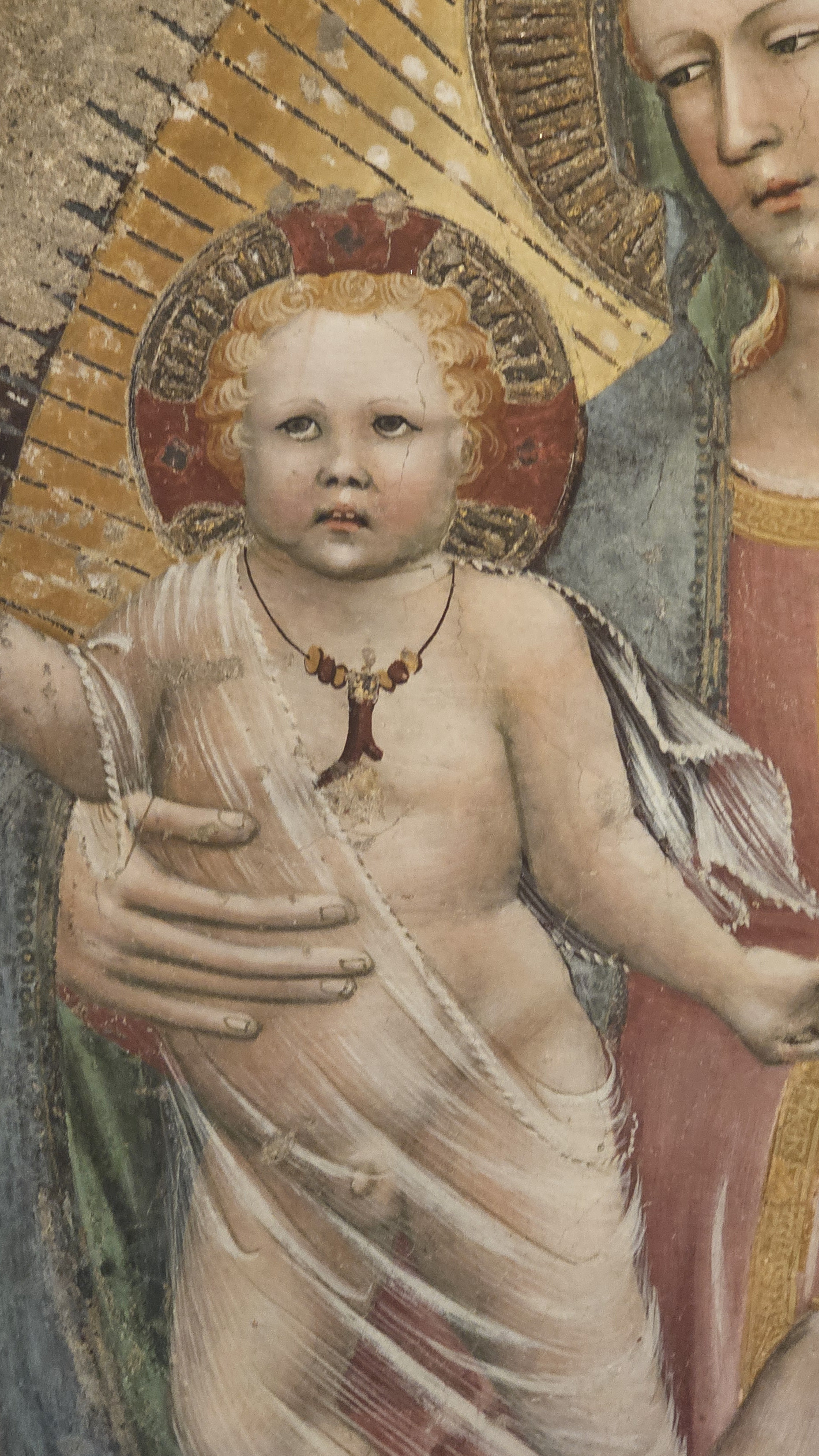
Fresco in Basilica della Santissima Annunziata
unknown
unknown
This face appears on a freso in the Basilica della Santissima Annunziata in Firenze. Although its authorship is unknown to me, the creator seems to have drawn significantly from the stylistic precedent set by Giotto di Bondone. Especially the stylistic halo and the semi-transparent drapes around the Christ's body follow the typical style of this Italian master of the early-rennaisance era. Although Italy as we know it now was not yet united when this artwork was created, the necklace that the Christ is wearing is eerily familiar to the geographical outline of Italy today. The outline of this peninsula, however, was already known in detail to the people living in the 15th century, as can be seen from the famous 1450 map of the Venetian cartographer Fra Mauro. This map was at that time the most accurate and detailed depiction of the entire world. In this depiction of baby Jesus, it almost seems as if Jesus is trying to escape from his mother. He looks anxiously away from her and upwards as if he is planning an escape. At the same time Maria is staring suspiciously at her child, expecting the inevitable separation and hardship that will befall them later in their lives.
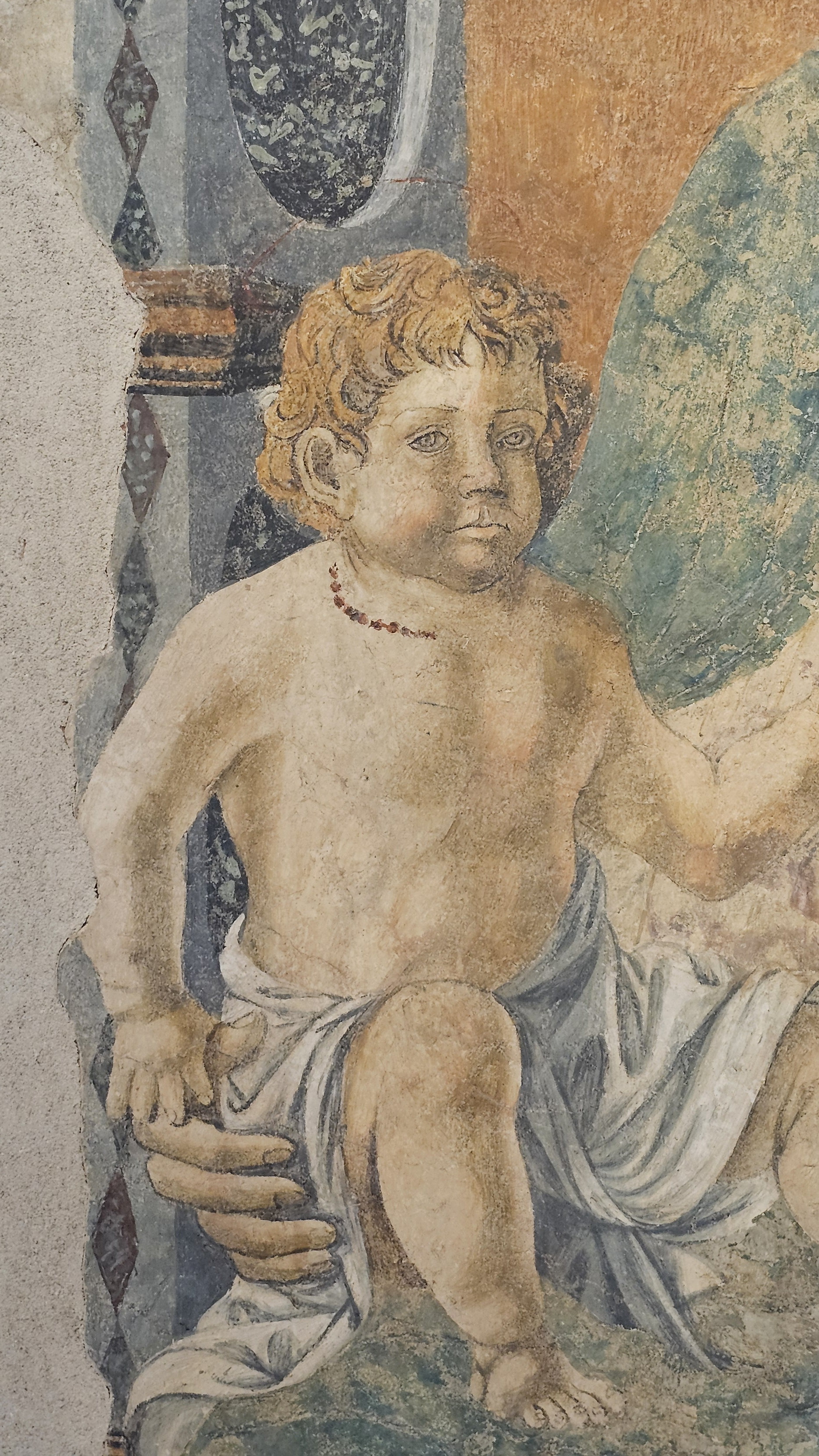
Fresco in Basilica della Santissima Annunziata
unknown
unknown
This face appears on a fresco, the details of which have been lost in the archives of this author. It hangs in the interion of the Basilica della Santissima Annunziata in Firenze. This church is the main Marian shrine in Firenze and the mother church of the Servite order. The Servite order is one of the five original Mendicant orders within the Catholic church. These orders ask of their members to live in poverty and travel and prophesize mainly in urban areas where they have the most outreach capabilities. Upon their establishment, such orders went against the commonly established orders that prescribed their members to remain in one place, learn a craft and share ownership of their possessions with others. Mendicant orders, on the other hand, promoted travelling but completely negated the need for possesions in the first place. It is therefore fitting that this depiction of baby Jesus does not show him appareled with fancy garmentry, but only dressed in rather plain linen cloths. Unfortunately, because the details of this artwork are unknown to me, I cannot definitively state that this is not a depiction of a young Owen Wilson.
-
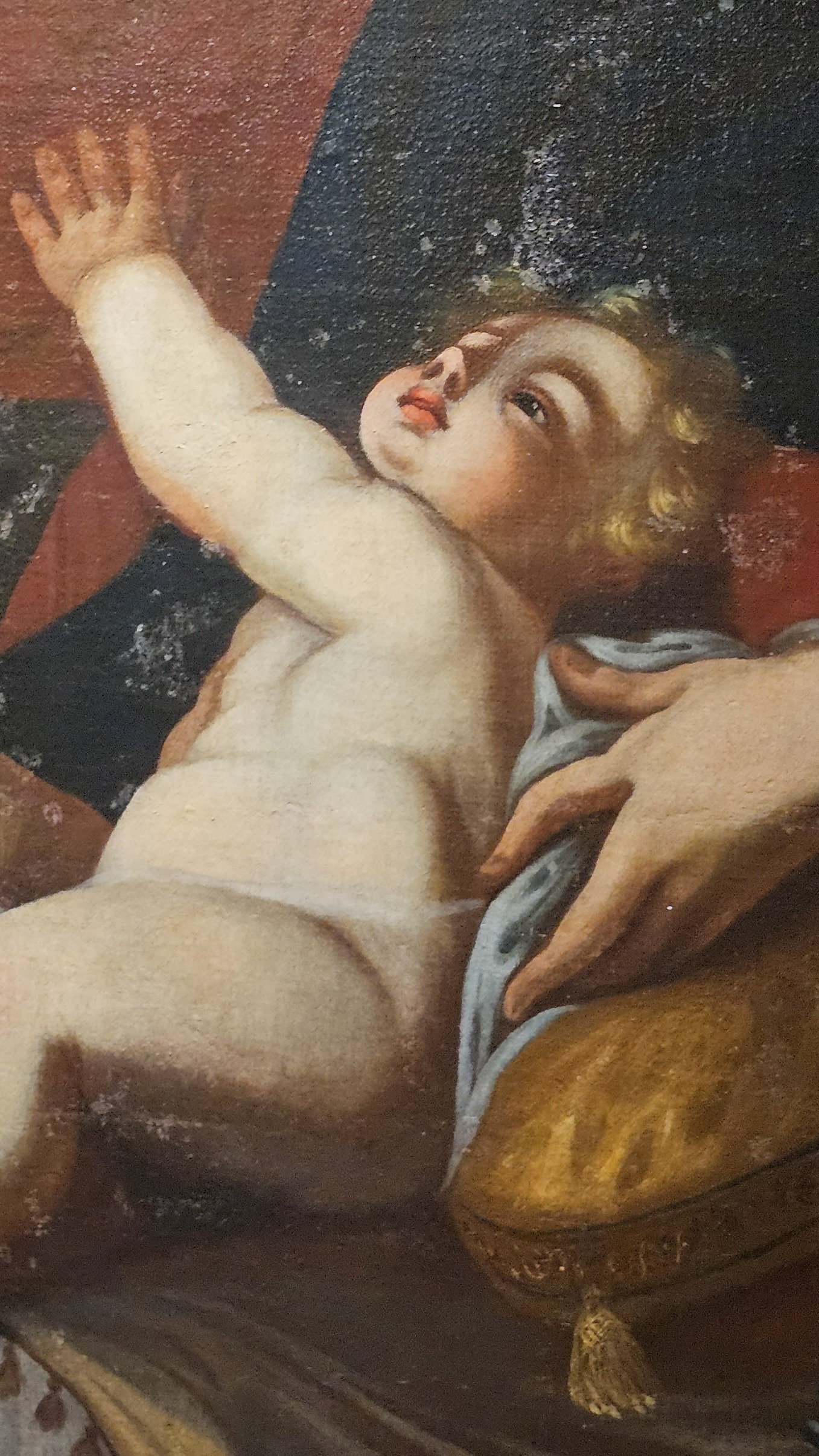
Sacra famiglia e san Giovannio
c. 1744
''Ambito Toscano''
This face appears in a prototypical late-rennaissance religious painting depicting the holy family. Even though, or perhaps exactly because, it was painted in the middle of the eighteenth century, it combines the visual styles of both Baroque and Rococco artistry. In the painting, Jesus lovingly looks up at his mother. However, upon closer inspection we see that there is more emotion there than just love. A sense of desparation seems to befall the young child as he reaches up to try and connect with his mother. Maria also does not make eye contact with her son, instead staring coldly into the distance, a clear departure from early-rennaisance art. In comparing the face of the baby to that of an adult Lord Byron, you would be forgiven in thinking that this child was modelled after the famous British poet. However, seeing as Lord Byron would only be born a few decades after the creation of this painting, it rather seems as if his parents modelled his facial features after this work by Ambito Toscano.
Don't get confused here, Ambito toscano is not an artist's name. Instead it is a term used by art historians and it refers broadly to works produced within the Tuscan artistic sphere. Specfically in Florence, Siena, Pisa, and their surrounding territories when the exact painter is unknown but the stylistic traits clearly point to a Tuscan origin. In the 13th century, this label typically signals art shaped by the major forces of the period: the Italo‑Byzantine tradition, with its gold backgrounds and iconic solemnity; the emerging Cimabue‑Giotto line, which introduced more naturalistic bodies and expressive storytelling; and the distinctive regional variations seen in places like Siena, where artists favored elegant linework and lyrical color. Works attributed to ambito toscano from this era often include panel Madonnas, fresco fragments, and small devotional images, all showing the transitional moment when Tuscan painters were moving from rigid Byzantine formulas toward the more human‑centered realism that would define the early Renaissance. The term ultimately helps situate anonymous works within the rich artistic ecosystem of medieval Tuscany, highlighting shared visual language even when the individual hand remains unidentified.
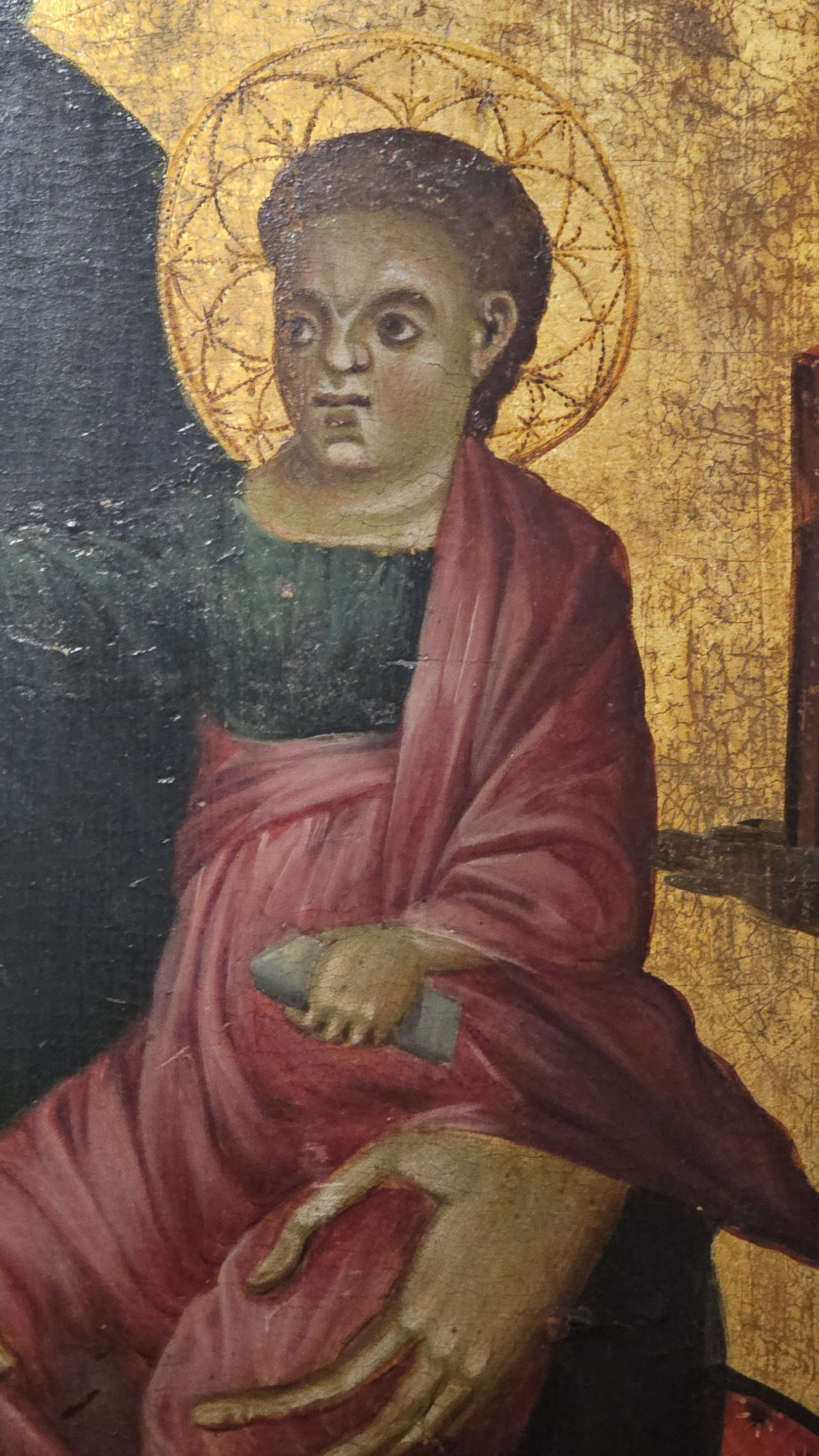
Madonna con Gesu Bambino in trono e Annunciazione
1275-1300
Corso di Buono
This face appears in a painting that first hang in the Church of San Jacopo al Girone in Fiesole. It is a tempora on wood and specific care is taken to highlight the cruciform halo around the head of the baby Jesus. This type of halo is often only reserved for Jesus himself and uses a cross within the halo to identify the figure as Christ and to symbolize and predict his crucifiction later in life. Typically such a halo depicts one large cross within, but this figure is surrounded by many smaller crosses, a style that was particularly prevalent in the Byzantine era. Although the creators might repute it, it is the strong opinion of this author that the figure Worf from the popular Star Trek franchise was based almost entirely on this depiction of a strange baby Jesus.
Corso di Buono was a Florentine painter active in the late 13th century, known today almost entirely through a small but important group of surviving frescoes that highlight the 'state of the art' (pun intended) the moment just before Giotto transformed Italian painting. His only securely documented work is the 1284 fresco cycle in the church now called San Lorenzo at Montelupo Fiorentino, signed “Corsus me pinxit” and depicting a solemn Christ Redeemer and narrative scenes from the life of St. John the Evangelist. These frescoes, along with additional attributed works in Sant’Andrea a Mosciano—including fragments of King David and Isaiah dated around 1290–1300—and a Madonna enthroned with saints in the pieve of San Giovanni Battista a Remole, show his adherence to the Cimabue‑influenced style: elongated figures, frontal compositions, sharply defined drapery, and clear, readable storytelling. Art historians value Corso di Buono for his rare signed and dated contribution to pre‑Giottesque Florentine painting, offering a fixed point in the artistic landscape of the Duecento and illustrating how major stylistic models were adapted for local churches and devotional programs.
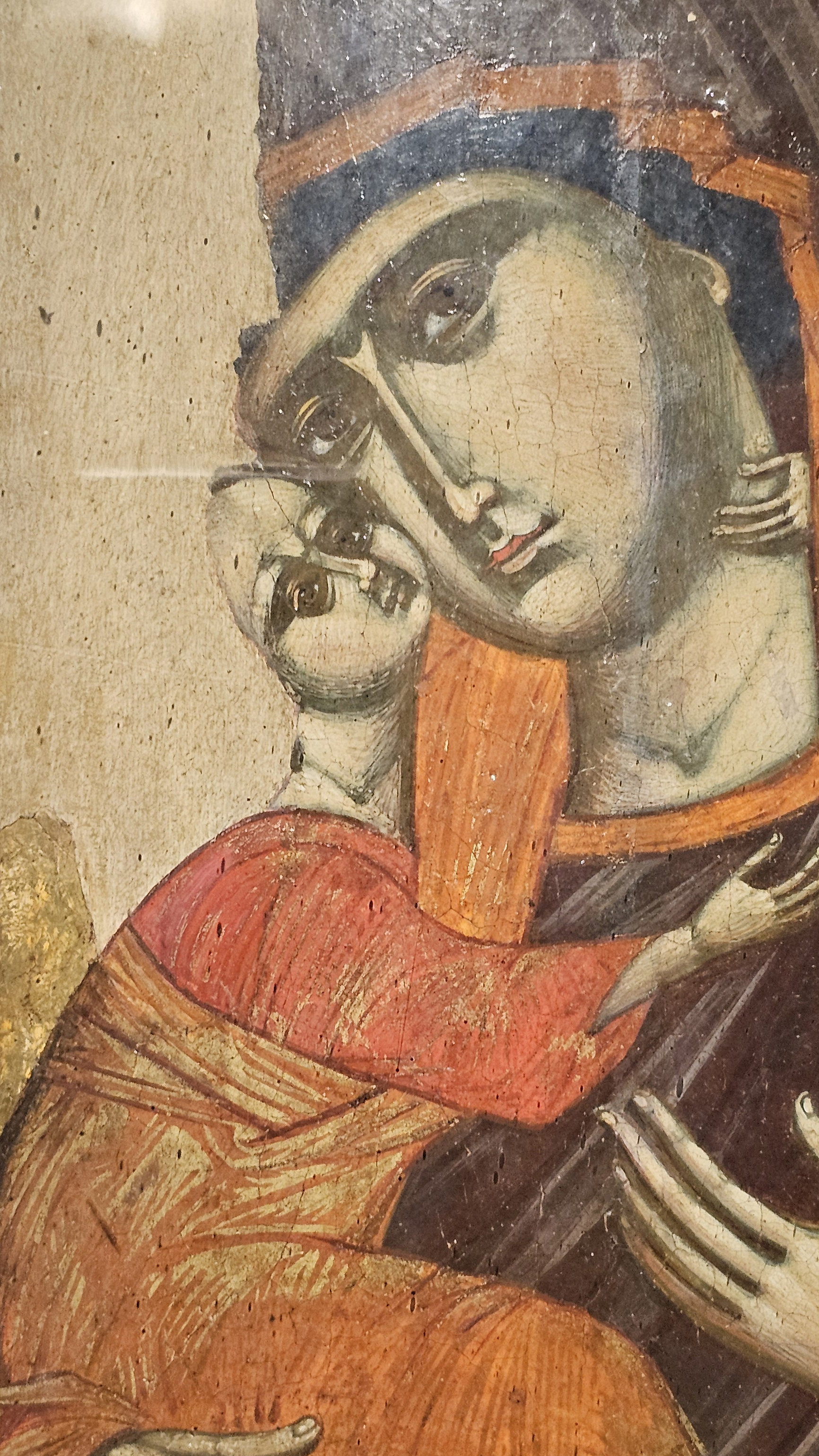
Madonna con Gesu Bambino (Madonna della tenerezza)
1280 - 1310
Scuola Greco-orientale
This face appears in a painting about which not much is known. It used to hang in the church of San Michele Aarcangelo and originates from the late 13th century. As was common for those days, the painting is a tempera on wood. Tempera is a technique where the pigment is mixed with an egg-based binder that is soluble in water. Typically this was egg yolk. The paint dries quickly and - although this painting is not the best example - it is also extremely durable. This is part of the reason why today paintings from early or late middle ages are often better preserved than oil-based paintings from the - technologically more advanced - rennaisance period. Tempera paint doesn't flake, yellow or even darken over time in the same way as oil based paintings can. The wood was often first smeared in a mixture of chalk and glue, called 'gesso', to create a smooth surface to paint on. This gesso can be seen here in the top-left corner. Although painted in the typical two-dimensional Byzantine style of the time, the dark shading and strange bending of the limbs almost remind us of early-20th-century cubism. The face of baby Jesus is perhaps the clearest example of this haunting and almost surreal quality.
Although they also produced art pieces, the Scuola greco‑orientale in the 13th century did not focus on this. Instead, they were a broader network of Greek‑speaking and Eastern Christian learning centers that preserved, translated, and taught Greek philosophical, medical, and theological texts within the Eastern Mediterranean and Near Eastern world. These schools—often monastic, such as the Syriac centers described in contemporary scholarship—continued the long tradition of transmitting Greek knowledge into Syriac and Arabic, maintaining a Hellenized curriculum even as Greek itself was no longer widely known among their students. Their work played a crucial role in keeping Greek‑Syriac intellectual traditions alive during a period of intense cultural exchange with the Islamic scholarly world, shaping the philosophical and scientific landscape of the 12th–13th centuries
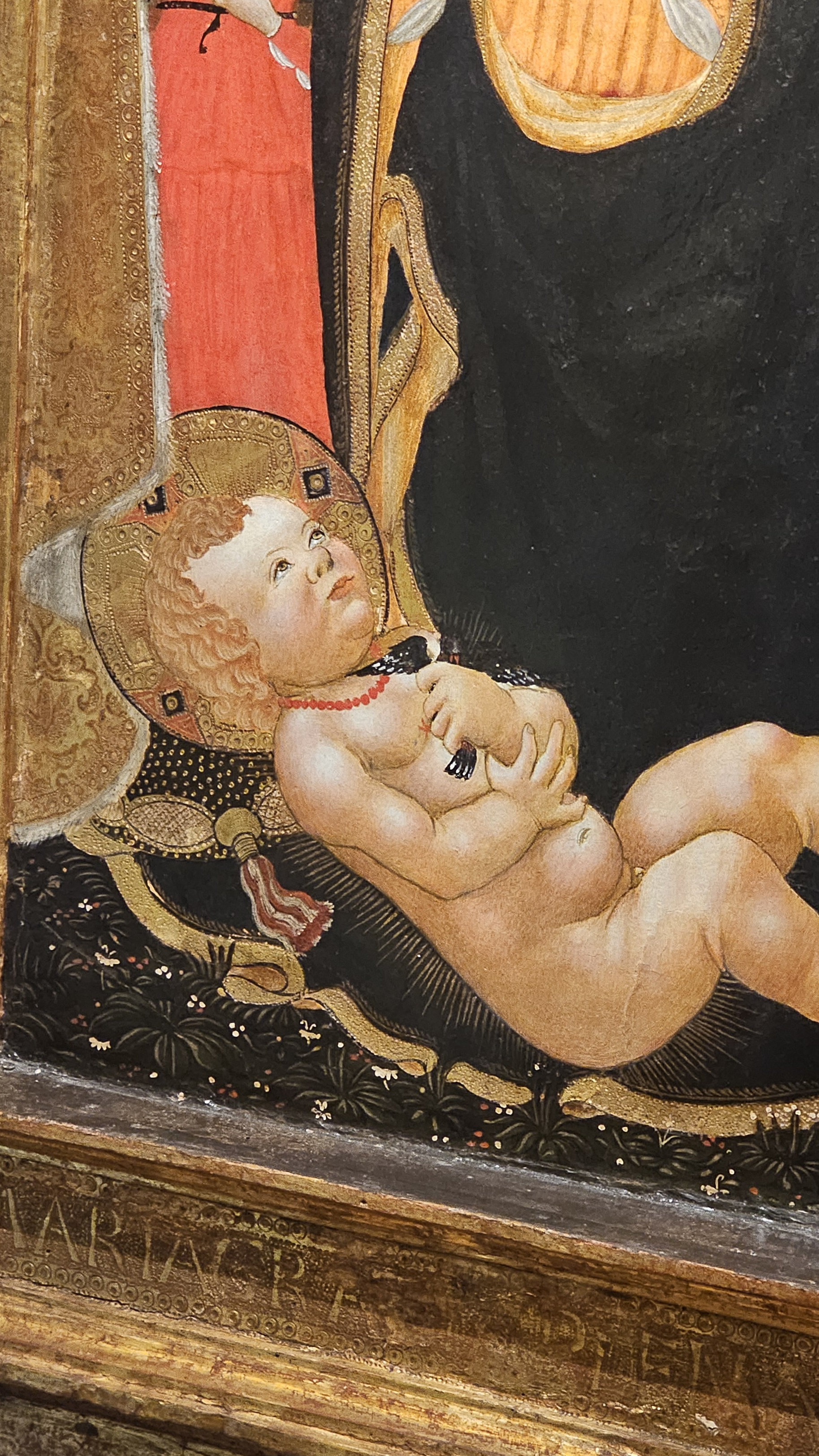
Madonna con Gesu Bambino, san Giovannino e santa Rosalia
1450-1500
Workshop of Jacopo del Sellaio
This face appears in a classic work from the workshop of Jacopo del Sellaio. Like Botticelli, del Sellaio learned his craft under the guidance of Fra Filippo Lippi. Much like those artists, Sellaio brought warmth and humanity to religious subjects. Although del Sellaio did not dare to step as far away from religious norms as Botticelli, he was still inspired by his sense of elegance, especially in painting his main subjects. This shows in this work, where the baby jesus looks up almost tenderly at his mother. It is clear from this painting that this is no ordinary child, rather it is a child who from the moment he is born understands the special bond that he and his mother share.
Jacopo del Sellaio (1441/42–1493) was a Florentine Renaissance painter whose work blended the elegant, flowing style of Botticelli with the narrative clarity he learned from his teacher, Filippo Lippi. Born into a saddle‑maker’s family—hence the nickname Sellaio—he became active in Florence’s artistic guilds and ran a productive workshop that collaborated with painters such as Biagio d’Antonio and, later, his own son Arcangelo. Sellaio is best known for richly detailed cassone panels (decorated wedding chests) illustrating mythological and biblical stories, including celebrated cycles like the Story of Esther and Cupid and Psyche. He also produced numerous small devotional paintings and several altarpieces, characterized by graceful figures, lively color, and intricate architectural or landscape backgrounds. His work reflects the vibrant artistic culture of late‑15th‑century Florence, where storytelling, craftsmanship, and decorative refinement were deeply intertwined.
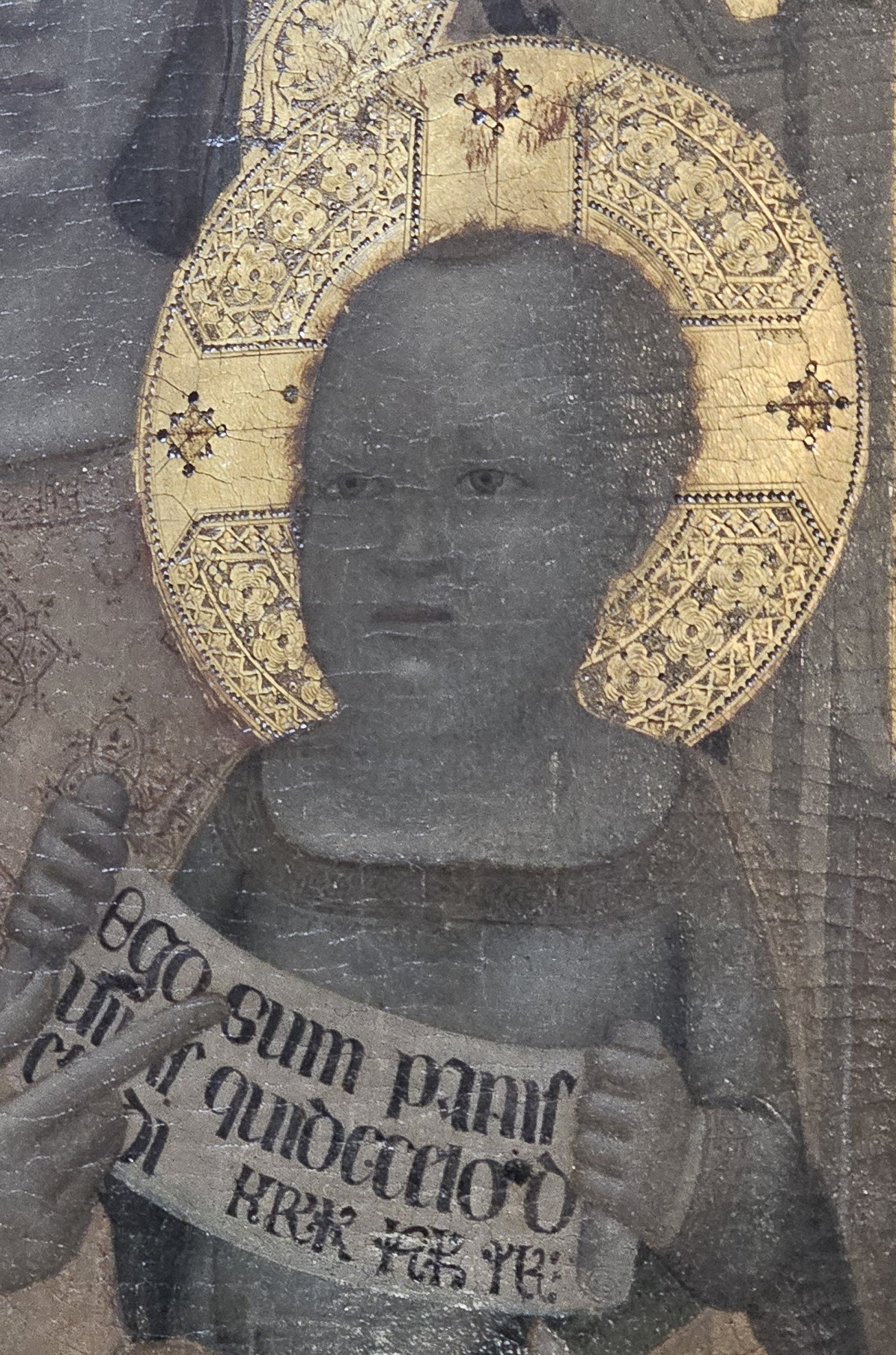
Madonna in trono col Bambino e Santi
c. 1344
Daddi Bernardo
This face appears on the oldest known work that was signed by the artist Bernardo Daddi. Althought this piece contains five panels it is often referred to as a triptych. It was designed for an altar piece in the Ognissanti monastry in Firenze. The term 'triptych' originally comes from ancient greek and translates as 'three writing tablets'. Triptychs appear most commonly as a format in Christian art of the middle ages and early rennaissance, especially for altar pieces. Not only did the format highlight the importance of the holy trinity, it also draws the eye towards the centerpiece, which often depicted a painting of the Madonna and her child. In this work, Daddi depicts jesus surrounded by Saint Matthew, a tax collector that later became one of the twelve apostles, and saint Nicholas, on whom Sinterklaas in the Netherlands is based, which in turn was the inspiration for Santa Claus in the rest of the world. The main focus, however, is drawn to the enigmatic face of Jesus in the center. He holds up a banner that translates to: 'I am the living bread which came down from heaven'. This comes straight from the gospel of John chapter 6, verse 51. It’s a deeply symbolic line where Jesus describes himself as the spiritual nourishment for humankind. His face looks thoughtful, determined and strong. He is ready to promise eternal life, which shall now begin.
Bernardo Daddi (c. 1280–1348) was a leading Florentine painter of the early Renaissance, known for helping move Italian art away from the rigid Gothic style toward more natural, emotionally expressive scenes. Drawing heavily on the innovations of Giotto, he created graceful religious images that blended clear storytelling with refined decorative detail. Daddi ran a busy workshop, producing both large church commissions and intimate devotional panels, many of which survive in major museums today. His work is characterized by soft modeling, bright colors, and elegant figures, and he played an important role in shaping the visual language of Florentine painting in the first half of the 14th century.